Toyota Revives Scion to Sell Tiny Japanese Trucks in America
Toyota is resurrecting the Scion brand to import Daihatsu kei trucks as low-speed vehicles, betting that American businesses and rural buyers want something smaller than a pickup truck.
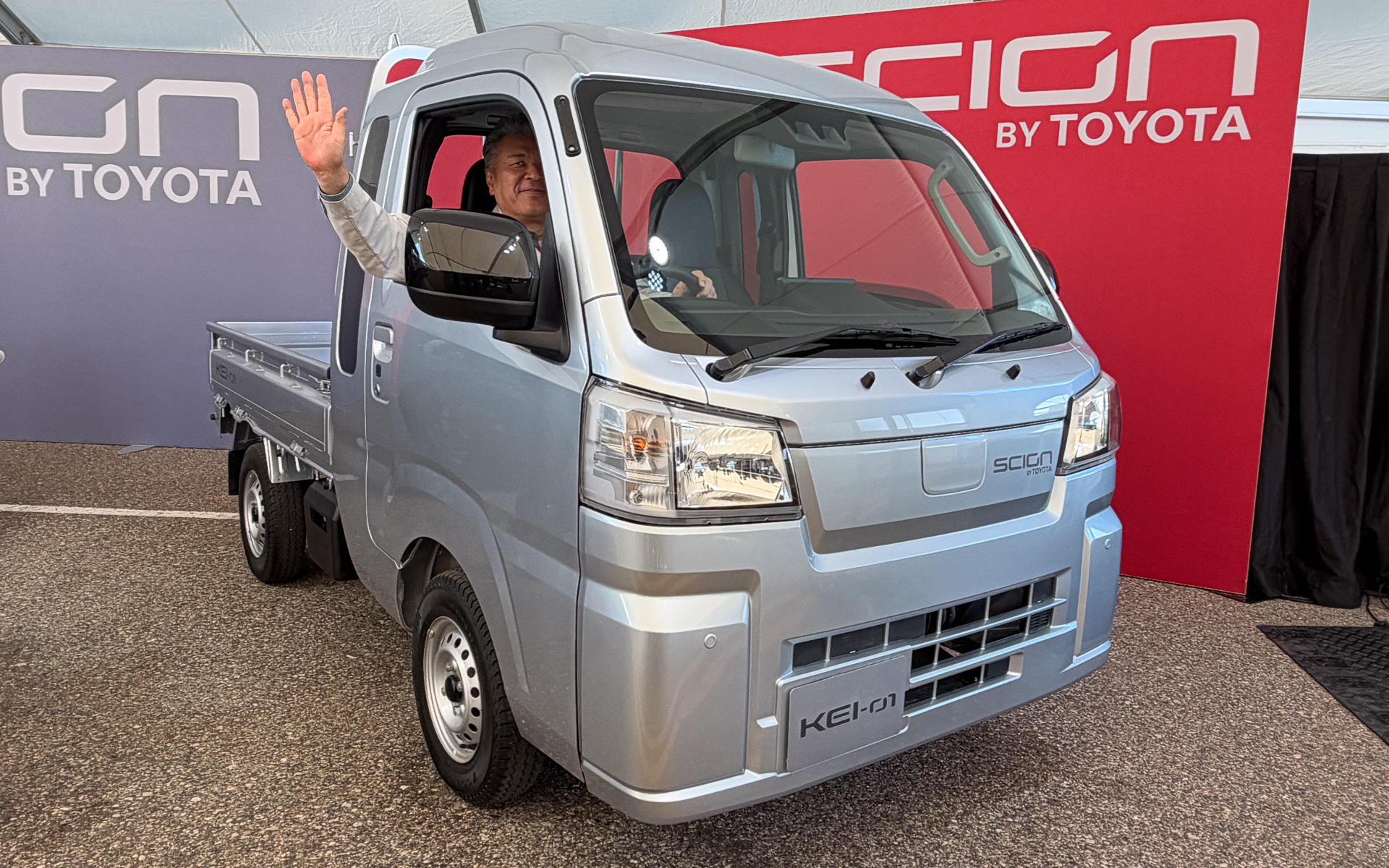
A Truck the Size of a Suitcase, Aimed at a Pickup Nation
Toyota just walked into one of the most peculiar corners of the American automotive market — and it brought a tiny Japanese truck to do it.
On November 10, Toyota Motor North America announced the revival of Scion, a brand it let die in 2016, this time under the banner “Scion by Toyota.” The first vehicle? A Daihatsu Hijet Truck Jumbo, rebranded as the KEI-01, assembled from knocked-down parts at Toyota’s Indiana plant and sold as a low-speed vehicle capped at 25 miles per hour.
It sounds like a novelty stunt. It isn’t.
The KEI-01 is classified under Federal Motor Vehicle Safety Standard No. 500, which governs low-speed vehicles — road-legal but restricted to streets with posted speeds of 35 mph or less. That means no highway commuting, no cross-country runs. But it does mean a 660cc three-cylinder engine, all-wheel drive, air conditioning, and a price point far below anything in the American pickup aisle.
Why Scion Now
Scion was never just a car brand. From 2003 to 2016, it was Toyota’s laboratory for younger buyers, generating over a million sales with a seventy percent conversion rate into new Toyota customers. Half of Scion buyers were under thirty-five when the program ended — Toyota declared its mission accomplished and folded the sub-brand into the main marque.
Ten years later, the playbook looks different but the instinct is the same. Scion by Toyota is positioned around curiosity, exploration, and finding new ways to use mobility. The KEI-01 is the first physical proof of that philosophy.
But there is a sharper business reason for the revival. Scion opens a door Toyota cannot walk through alone under the Toyota name: it signals willingness to challenge American assumptions about what a truck should be.
A full-size F-150 weighs nearly four tons and guzzles fuel even in hybrid form. A Toyota Tacoma starts above fifty thousand dollars. The Hijet Truck Jumbo tips the scales at roughly one-tenth that mass and costs a fraction of either. In a market saturated with oversized pickups, the KEI-01 offers something almost nobody else sells — a genuinely compact utility vehicle that still hauls cargo.
Who Buys a 25-mph Truck?
Toyota is not pretending this appeals to everyone. The initial rollout targets fleets — small businesses, construction sites, farms, municipal operations, university campuses, and delivery operators who move goods within defined grounds rather than on public highways.
Sales begin through a limited network of selected Toyota dealerships participating in a trial program. Toyota will track usage patterns, gather data, and decide whether to expand beyond fleet customers. General consumer sales remain possible but constrained in volume, pending results.
The logic is sound. These buyers already operate vehicles that legally qualify as off-road machines or neighborhood electric vehicles. The KEI-01 sits between those categories — road legal where LSV rules allow, compact enough to navigate tight job sites, and priced to compete with used equipment rather than new trucks.
Right-hand drive and CVT transmission carry over from the Japanese spec. That is intentional. It signals that this is not a cost-cut domestic adaptation but an authentic transplant of a proven Japanese design.
The Indiana Factory Bet
Here is where the strategy gets concrete. Toyota committed $34 million to retool part of its Toyota Motor Manufacturing Indiana facility for semi-knock-down assembly of the KEI-01. Approximately fifty new jobs are expected. Production begins in the second half of 2027.
The supply chain is straightforward: engines, bodies, and components ship disassembled from Daihatsu’s Kyushu Naka Factory in Japan, then get put back together in Kentucky. The KEI-01 thus avoids the full tariffs that would apply to complete vehicle imports while preserving most manufacturing value inside the United States.
That distinction matters enormously. The current U.S. tariff regime penalizes foreign-built vehicles entering at their complete form far more than parts shipped for domestic assembly. By choosing SKD rather than full import, Toyota sidesteps a significant portion of that penalty — without appearing to outsource every last step to Japan.
It also gives Toyota data on American operational conditions before deciding whether to scale further.
Trump’s Kei Truck Paradox
President Donald Trump has publicly endorsed allowing Japanese kei cars into the United States, framing it as consistent with a tougher trade posture toward Japan. His reasoning: American buyers deserve more vehicle choice, and kei cars represent a category the U.S. lacks entirely.
The KEI-01 sits at the intersection of that rhetoric and actual policy reality. It does not enter as a passenger car subject to the so-called chicken tax, which imposes a 25 percent tariff on imported light trucks. Instead, it enters as a low-speed utility vehicle designed for specific operational niches — a categorization Trump himself has suggested deserves accommodation.
Whether this endorsement translates into regulatory tailwinds remains unclear. The KEI-01 currently qualifies under existing LSV rules. Any expansion of that framework would require action from NHTSA or Congress. But the political signal is unmistakable: a senior American official has stated that Japanese-style compact trucks belong in the U.S. market.
Toyota is betting that signal will harden into policy over the coming years.
Beyond the KEI-01
The KEI-01 is only the beginning. Toyota also unveiled two concept vehicles under the Scion banner.
The SxS Concept is a side-by-side off-road buggy powered by the i-FORCE MAX hybrid system — the same 2.4-liter turbocharged four-cylinder plus electric motor found in the Tacoma Hybrid. Toyota Chairman Akio Toyoda personally test-drove it. This directly competes with Polaris, Can-Am, and John Deere Gator offerings while adding Toyota reliability and electrified torque.
The BKE Concept is a folding electric motorcycle built for on-road use, with suspension tuned for pavement rather than trails. It expands the Scion lineup into personal micro-mobility, complementing the company’s planned land-hopper three-wheeler due later in 2027.
Together, these concepts paint a coherent picture: Scion by Toyota is not about one strange truck. It is about proving that Toyota can bring unconventional, efficiently engineered Japanese vehicle types to American consumers who currently have nowhere else to buy them.
What Happens Next
If fleet feedback validates demand, Toyota will likely broaden dealer participation, add consumer-facing inventory, and eventually introduce additional kei-derived models under the Scion badge. If demand falls short, the program remains contained to fleets and concepts — a controlled experiment rather than a brand resurrection.
Either outcome advances Toyota’s longer objective. The Indiana assembly line becomes reusable capacity for future small-vehicle programs. Scion gains credibility as a platform for experimentation without diluting the main Toyota brand. And the U.S. market receives its first serious post–1990s attempt to make compact utility trucks culturally relevant again.
The real question is whether American buyers will accept a vehicle that requires speed-limit awareness to drive legally. The KEI-01 will never replace a Ford F-250. But for farmers, landscapers, campus security teams, and small contractors who currently juggle UTVs, golf carts, and beat-up pickups, it may be the most practical vehicle they have ever seen — if they can find it at a dealership willing to explain the 25-mile-per-hour limit patiently.