Toyota Revives Scion With a Kei Truck — And That's Deliberate
Toyota's bringing back Scion to sell a Daihatsu-based kei truck in the US under LSV rules. It's not nostalgia — it's a calculated move into a gap left by tariffs and a president who praised tiny Japanese trucks.
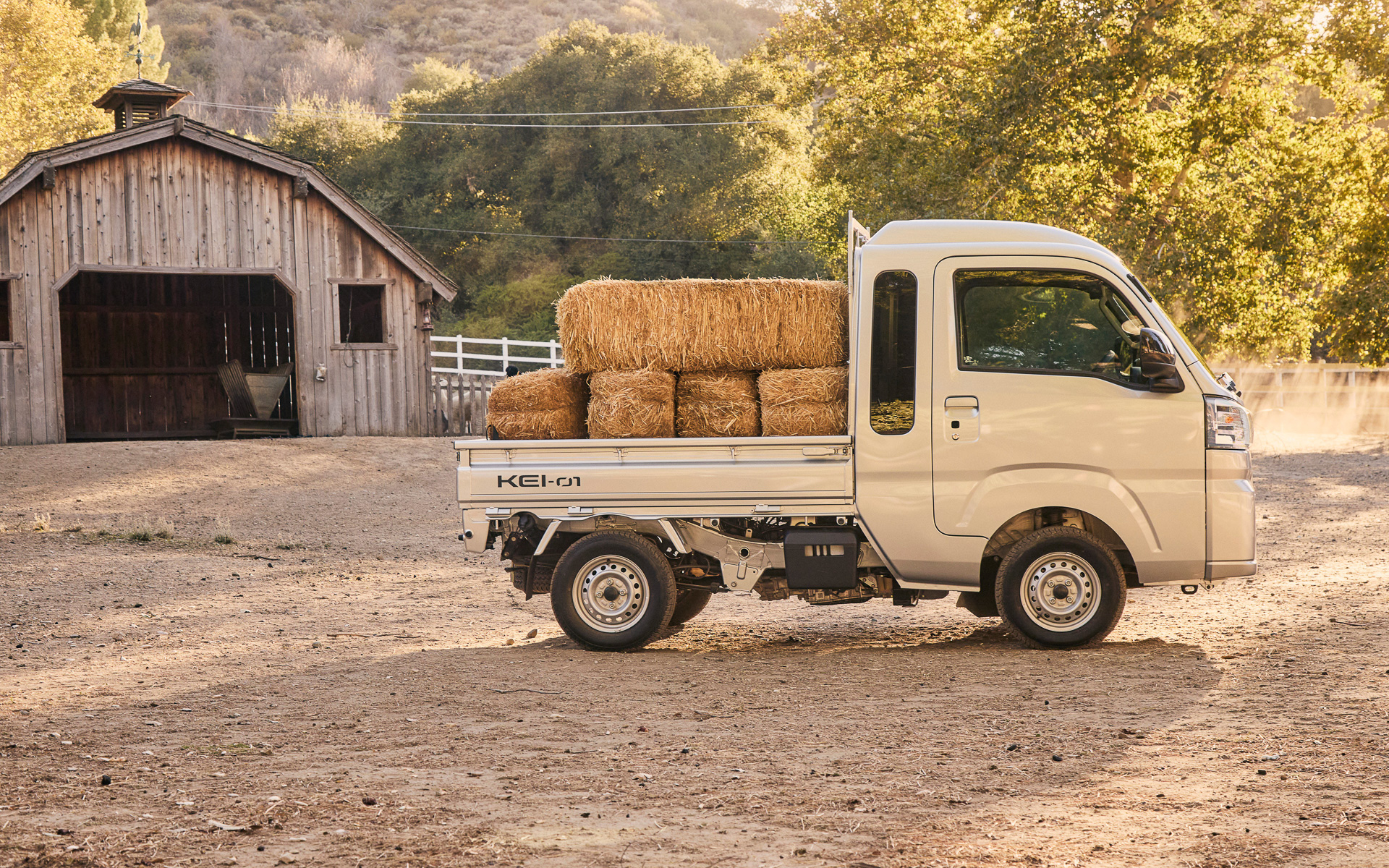
Toyota just did something unusual: it killed a brand, waited nearly a decade, and brought it back to sell the smallest, slowest truck America legally allows on public roads.
Scion by Toyota was unveiled November 10 by Toyota Motor North America, and its first — and right now only — vehicle is the KEI-01, a stripped-down, sub-40 km/h utility truck that is, in everything but name, a Daihatsu Hijet Truck Jumbo rebadged for the US market. Production starts the second half of 2027 at Toyota’s Indiana plant, using semi-knock-down parts shipped from Daihatsu’s Kyushu facility. Toyota is putting $34 million behind the line and creating roughly 50 jobs. The truck will come in right-hand drive.
On paper, this looks like a modest niche play. In practice, it’s one of the most precise reads of the current US political and trade landscape I’ve seen from any automaker this year.
The Kei-Truck Underground Already Exists
For more than twenty-five years, Japanese kei trucks have quietly thrived in the United States despite never being officially sold here. Owners import them, register them, and use them — on farms, ranches, construction sites, and university campuses across rural and exurban America. The demand is real enough that Japanese media have covered the phenomenon. These trucks cost a fraction of a midsize pickup and do almost everything a small commercial buyer needs.
Mainstream US manufacturers simply don’t make anything in this category. Ford, GM, and Stellantis won’t touch a vehicle that tops out at 25 mph. They’ve ceded the entire segment to gray-market imports and a handful of specialty converters who already struggle to keep up with demand.
Toyota sees a gap no competitor is filling, and it’s choosing to own it rather than let independent operators fill it forever.
The LSV Loophole Is the Whole Strategy
The KEI-01 is engineered from the ground up to comply with the federal Low-Speed Vehicle standard — the rule that permits vehicles rated between 20 and 25 mph to operate on roads with posted speeds up to 35 mph in many states. That rating comes with a limiter bolted into the powertrain. Add AC, an automatic transmission, and four-wheel drive, and you’ve got exactly the kind of no-nonsense workhorse that small businesses, municipalities, and outfitters have been importing by hand for decades.
This isn’t an accident. Designing for LSV classification lets Toyota sell a near-stock Hijet inside US borders without clearing the far more expensive and demanding full-speed FMVSS requirements that would apply to a conventional passenger car or light truck. The regulatory path is shorter, cheaper, and opens doors that would otherwise stay shut under existing trade friction.
Right-hand drive stays. That’s notable — it signals Toyota isn’t trying to repackage the truck as something it isn’t. It’s selling authenticity to a buyer cohort that specifically wants the Japanese configuration.
Trump’s Comments Were the Green Light
In December 2025, President Trump visited Japan and publicly praised kei cars, calling them “very small” and “really cute.” That remark may sound like trivial diplomatic chatter, but it carried weight. A president willing to compliment Japanese light vehicles opens political space for policies that accommodate them — whether through tariff treatment, regulatory leniency, or sheer silence.
Toyota isn’t waiting for a formal policy shift. It’s moving now into the corridor that such comments create. The brand resurrection arrives in a climate where the US government has shown willingness to let certain Japanese products slip through trade friction intact, particularly where domestic economic benefits — jobs, investment, rural utility — can be pointed to as justification.
Thirty-four million dollars and fifty Indiana jobs give the story a Washington-friendly frame. That’s not incidental.
Why Scion? Why Now?
Toyota killed the Scion brand in 2016 after five years of trying to win young buyers with sporty, customizable, affordable cars. The experiment ended quietly. Bringing it back for a single utility truck might look odd, but the branding choice is sharp: Scion carries none of the legacy expectations attached to the Toyota badge. It can be positioned as lean, utilitarian, and unburdened by corporate heritage. That’s exactly how you launch a product category that most Americans have never seen offered new.
The strategy mirrors what successful brand resurrections share — you reuse the name to signal identity, but you populate it with something the original never offered. No one expects a Scion xB in a Scion by Toyota lineup. They expect a box on wheels that gets stuff done.
What Happens Next
Toyota says it will begin with a fleet-oriented trial program through late 2027 and early 2028, gauging reaction before deciding whether to open retail sales. That cautious sequencing makes sense. The company is testing whether a factory-backed, warrantied, LSV-compliant kei truck can displace the used-import ecosystem that currently serves this market — and whether consumers will pay a premium for that assurance.
If the trial succeeds, the implications reach beyond a single truck. Scion becomes a vehicle — literally and figuratively — for Toyota to test how much of Japan’s compact-car expertise can be exported under new regulatory guises. The SKD model proves that assembly can happen domestically without a full plant buildout. Other Japanesemakers could follow a similar path if they choose.
The competitive vacuum is the story. No US automaker competes here. Ford’s Raptor and GM’s Hummer EV sit on opposite ends of a market that refuses to middle. Toyota is stepping into the empty space between them with a vehicle most Americans have only encountered as a used import in someone else’s driveway.
The KEI-01 may be small. The bet behind it is not.