Trump's 57 vs. Seoul's 120: The North Korean Nuke Gap That Matters
Trump publicly cited 57 North Korean nuclear weapons while South Korea's defense minister quoted estimates of 80–120. The gap is not just a numbers dispute — it reveals how nuclear ambiguity benefits both Washington and Pyongyang, and why Japan and Europe are quietly recalibrating their own deterrence calculations.
The number that isn’t really a number
Donald Trump told reporters at the White House that North Korea possesses 57 nuclear weapons. An Gyu-baek, South Korea’s defense minister, told the National Assembly that his government generally assesses the figure at 80 to 120. Sixty warheads separate the two claims. On paper, it looks like a standard intelligence disagreement.
It is not.
Trump’s figure tracks closely with open-source Western estimates. The Stockholm International Peace Research Institute placed North Korea’s assembled warheads at roughly 60 as of January 2026, up from about 50 the year before. The Bulletin of the Atomic Scientists estimated a similar range. These are plausible numbers for a regime that has been enriching uranium and producing plutonium for two decades.
South Korea’s higher range comes from domestic think tanks, not from independent intelligence collection.jung Wook-sik, director of the Hani Peace Institute, told this newspaper that Korean institutions inflate figures partly to provoke alarm and partly because they do not gather their own raw data — they extrapolate from Western estimates with a risk premium attached.
That dynamic matters more than the headline discrepancy.
What 57 really signals
Trump did not pick 57 because he had access to classified intelligence the rest of the world does not. He picked it because 57 is specific enough to sound authoritative and vague enough to be defensible. It is close to the SIPRI figure without requiring a formal admission that the United States has a precise count — which it does not.
North Korea will read the precision the way it always does: as either a sign of American ignorance or American intention. If Washington claims to know the exact number, Pyongyang assumes the worst — that the United States is targeting those weapons. If Washington is vague, Pyongyang assumes the United States is guessing. Either outcome gives Kim Jong-un room to maneuver.
The ambiguity serves both sides. The United States gains political cover — it can warn about North Korea’s growing arsenal without committing to a single data point that could be disproven. North Korea gains strategic breathing room — it can expand its program knowing that every public estimate will be contested.
The new enrichment facilities change everything
Lee Sang-gyu of the Korea Defense Studies Institute raised the domestic estimate to 127–150 warheads last November. His reasoning was straightforward: North Korea has opened new uranium enrichment plants at Yongbyon and Kangson that Western estimates have been slow to fully incorporate. He also noted that North Korea produces enough fissile material each year for roughly six additional warheads — a rate that accelerates the timeline.
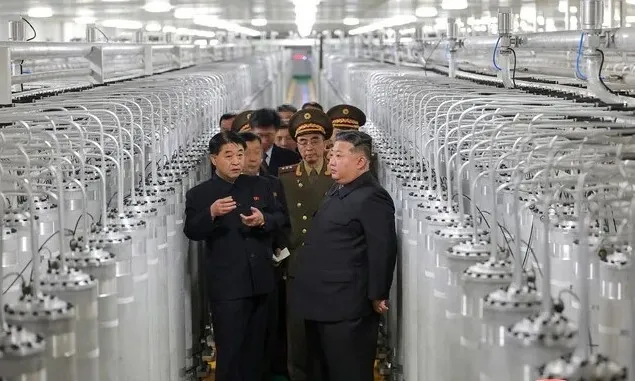
The image of Kim inspecting a newly operational centrifuge hall in June was not staged for domestic consumption alone. It was a signal to external observers that the enrichment program is active and expanding. The question is no longer whether North Korea can produce more warheads. It is how fast the curve steepens.
The Union of Concerned Scientists and the RAND Corporation both warned in 2023 that North Korea could reach 300 warheads by 2030 if current trajectories hold. Those projections remain directionally useful even if the exact number is uncertain.
Who wins and who loses from the gap
Japan is the immediate loser from the discrepancy. Tokyo already operates under a different threat calculus than Seoul or Washington. A North Korea with 60 warheads is a crisis. A North Korea with 120 is an existential scenario. The gap between those two assessments drives different defense spending priorities, different missile defense architectures, and different diplomatic postures.
Europe loses in a slower, quieter way. Every time a major power publicizes a different number about a proliferating state’s arsenal, it erodes the credibility of non-proliferation norms. If the United States and South Korea cannot agree on North Korea, what confidence do European capitals have in their own intelligence assessments regarding Iran or other actors?
North Korea wins regardless. Ambiguity is a force multiplier for a regime that survives on perceived strength. Whether the West cites 57 or 120, Pyongyang can claim both numbers prove its deterrence is real.
What comes next
The United States will continue to cite low estimates. South Korea will continue to plan for high estimates. Neither side is lying — they are simply performing different functions. Washington needs a figure it can use in public diplomacy. Seoul needs a figure it can use in military planning.
But the widening gap between them should prompt a conversation the current framework does not support: at what point does ambiguity stop being useful and start being dangerous? When the United States speaks in rounds of 57 and South Korea speaks in bands of 80 to 120, neither alliance partner can coordinate responses with confidence.
The practical next step is not to resolve the discrepancy — that may be impossible without North Korean cooperation, which will not come. The practical step is to acknowledge that all estimates are likely low. North Korea’s production capacity is growing. New facilities at Yongbyon and Kangson are now operational or near-operational. The 300-warhead trajectory by 2030 is not speculation — it is the logical endpoint of current trends.
The real question for Tokyo, for Brussels, and for Washington is not whether North Korea has 57 or 120 warheads today. It is whether any of them are prepared for a future where the answer to both questions is yes.