Trump's AI Self-Policing Accord Is a Trojan Horse for Global Influence
The voluntary AI accord Trump announced with Big Tech isn't just a domestic regulatory pivot—it's a play to set the global standard. While the EU and China tighten their own rules, Washington is betting that voluntary frameworks will prove more influential than legislation.
The deal that isn’t a deal
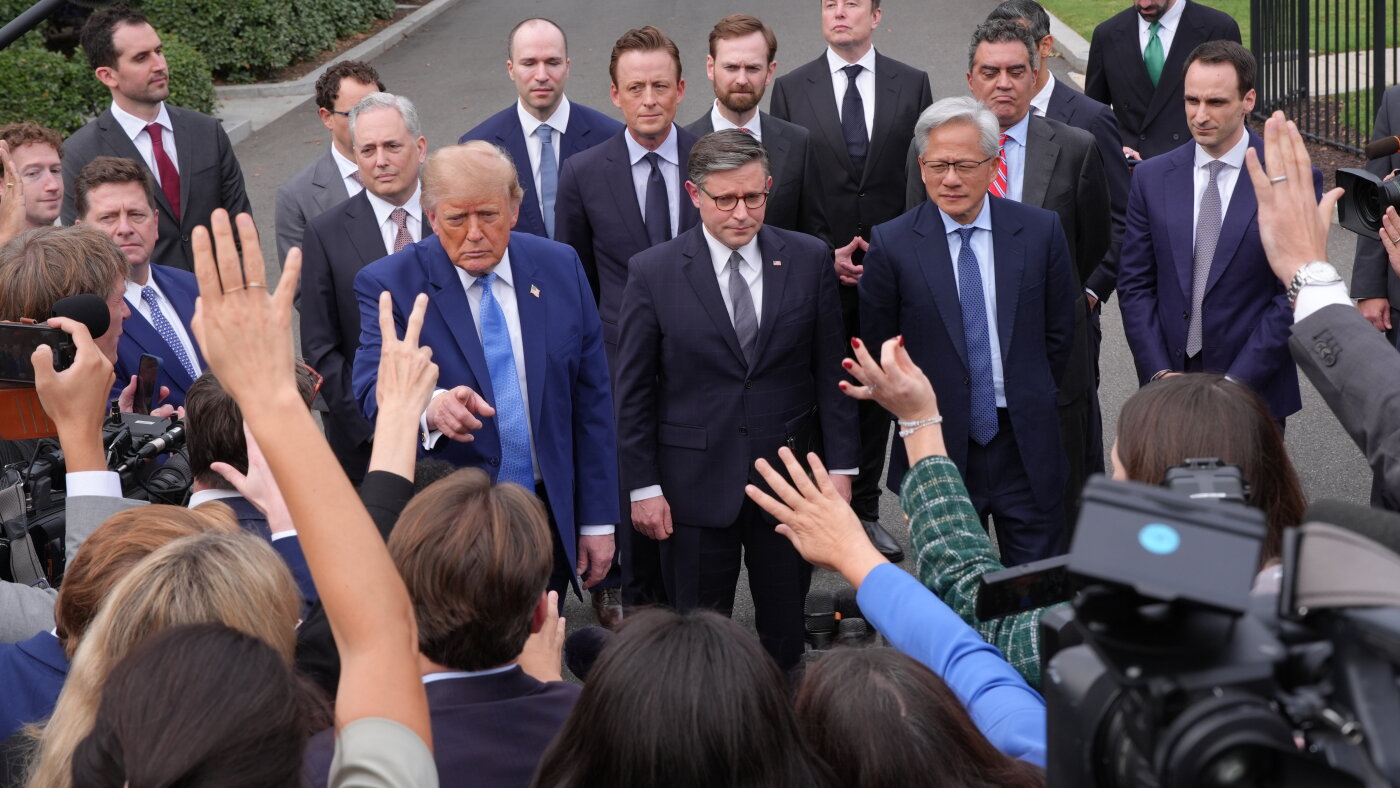
President Donald Trump stood in the West Wing on September 29 and declared that the leaders of the world’s most powerful AI companies had signed a voluntary accord to self-police their own development. No penalty. No enforcement mechanism. Just a commitment to internal controls, external audits, and board-level oversight—a framework that Trump called “morally binding” and which opens the door to future legislation but commits to nothing specific.
What came next was telling. Trump also unveiled America.gov, a government chatbot that could soon let Americans apply for passports online. He praised AI as a technology “bigger than the industrial revolution.” He told local communities opposing new data centers that if they didn’t cooperate, the industry would simply leave for overseas markets. And he made clear that cooperation with China on AI governance was off the table—“we’re leading. Why would I want to do anything?”
Taken together, these moves reveal a coherent strategy. The self-policing accord is not a regulatory alternative. It is a regulatory positioning move—one designed to establish American-style AI governance as the default standard while the rest of the world is still writing its rules.
Who wins and who loses
The immediate winners are the signatories. Dario Amodei, Sundar Pichai, Mark Zuckerberg, Greg Brockman, Jensen Huang, and Elon Musk now have a Washington-sanctioned framework that looks like action without actually being one. The accord acknowledges that “over time, it may make sense to codify these steps into laws and regulations,” but that qualifier is a escape hatch, not a commitment. The companies keep their innovation latitude. They keep spending hundreds of billions on data centers and chip infrastructure. They keep racing each other—and, according to Trump’s framing, racing China.
The losers are harder to see but real. Americans whose communities are being reshaped by data center development—the very bipartisan opposition Trump alluded to—get a consultation, not a veto. Residents concerned about energy costs, water usage, or the pace of deployment receive promises of “more financial support to local schools” but no binding safeguards.
Then there is the public interest itself. Robin Jia, a computer science professor at USC, warned that as models improve, the consequences of security failures will only grow. Alex Pascal of the Berkman Klein Center argued that only “robust legal liability, regulation and fundamentally changing the race dynamics” can address AI risks. Both are describing the gap between what the accord guarantees and what the technology demands.
The global standard question
Here is what English-language coverage has mostly missed: the self-policing accord is an export strategy.
The European Union has already passed the AI Act, a comprehensive regulatory framework that imposes binding requirements on high-risk AI systems. China has its own rules, including regulations on algorithmic recommendation and generative AI that carry enforcement teeth. Neither approach resembles the voluntary model Trump just celebrated.
But regulatory frameworks only matter if they shape behavior. And behavior is shaped by standards. When American companies—the same companies that dominate global AI development—adopt a self-policing framework backed by the White House, that framework becomes the reference point for multinational operations. Companies operating in multiple jurisdictions will look for the path of least friction. A voluntary accord signed with the world’s largest economy carries gravitational pull that a paper regulation in Brussels or Beijing does not.
This is the Trojan horse. The accord costs the companies nothing enforceable today. But it gives Washington a seat at the table where global AI governance is being written—and a framework to export. If the United States can position its voluntary approach as the pragmatic middle ground between European regulation and Chinese control, it wins influence without writing a single enforceable law.
The China question
Trump’s remarks about China were revealing. He acknowledged a recent agreement to establish an incident-response channel with Beijing but dismissed the need for deeper cooperation. “We’re leading. Why would I want to do anything?”
That framing ignores a structural reality. AI risk does not respect borders. A model trained in California can be accessed in Shanghai. A safety failure in one jurisdiction affects users everywhere. The incident-response channel Trump referenced is a stopgap, not a strategy. Meanwhile, China is investing heavily in AI governance as a tool of soft power, offering its regulatory model to countries in the Global South that see the American approach as either too permissive or too extractive.
By treating AI governance as a zero-sum competition with no room for cooperation, Trump risks ceding influence to countries that are willing to engage. The EU’s AI Act is already being cited as a template by regulators in countries from Brazil to Japan. China’s rules are shaping discourse in authoritarian and democratic governments alike. The United States, for all its technological advantage, is opting out of the conversation.
What happens next
The accord’s vague language is a feature, not a bug. It allows the framework to persist regardless of how AI developments unfold. If incidents are few, the companies can claim success. If incidents multiply, the “over time” qualifier gives Washington an opening to push for codification on its own terms—or to double down on the voluntary approach and blame the companies for failing to self-regulate.
Either way, the companies are locked into a narrative of responsibility without the tools to fulfill it. And the American public is left with a system that looks like governance while operating as public relations.
The more immediate test will come from the data centers. Trump predicted they would become “very popular.” He also hinted that opposition could force the industry offshore. That threat is credible—companies already face permitting delays and community pushback in California, Texas, and Virginia. If the accord delivers tangible benefits to affected communities, it gains political cover. If it doesn’t, the bipartisan opposition that Trump dismissed will find a different language.
Meanwhile, the signatories are already adjusting. OpenAI’s Sam Altman said the day before the announcement that the company halted a model rollout over safety concerns and is “pacing our progress.” That is a concession to the narrative the accord is designed to project. Whether it reflects genuine caution or strategic posture will determine whether voluntary frameworks hold—or collapse under the first major incident.
The accord is a gambit. It positions the United States as leading without regulating, innovating without accountability, and competing with China without engaging. That works until it doesn’t—and in AI, the cost of being wrong is measured in ways that no voluntary framework can contain.