Trump's Cheon-Gong-II Play Reveals South Korea's Arms Crossroads
Trump's public sharing of a column urging Korea to sell Sky Bow II air defense missiles to Ukraine is more than diplomatic signal-crafting — it exposes a country at the center of a geopolitical tightrope.
A Signal Wrapped in a Column
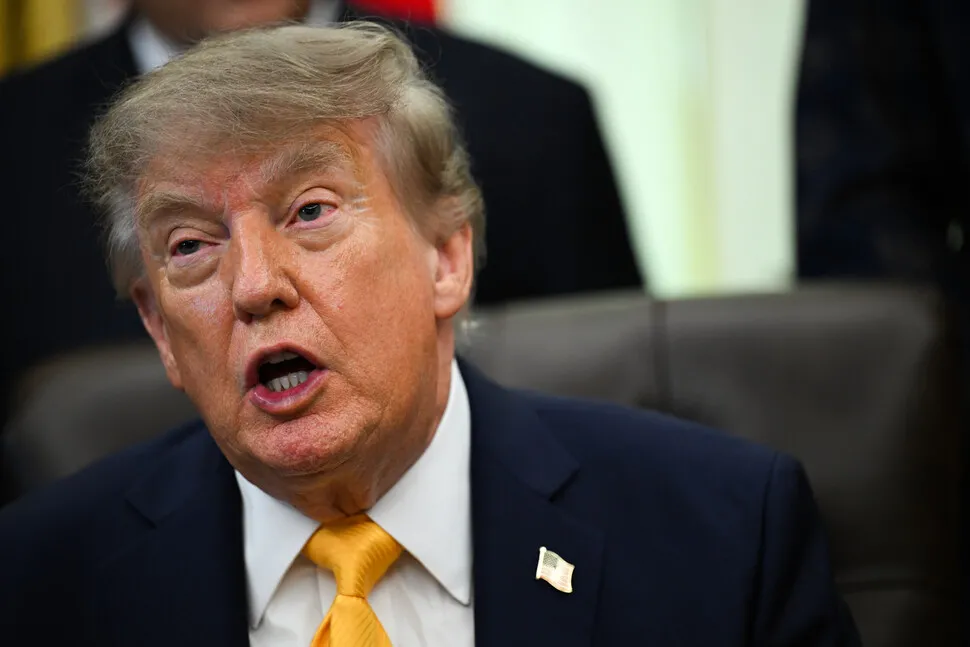
Donald Trump did not announce a policy shift on Friday. He shared a column. But the gesture carried weight far beyond the boundaries of his Truth Social post. On September 4, the former president amplified an essay by Mark Thiessen — a former George W. Bush speechwriter and Trump adviser — published in the Washington Post, in which Thiessen argued that Seoul should sell its Cheon-gong-II (Sky Bow II) air defense missile system from its own stockpile to Ukraine.
Trump offered no commentary of his own. He did not need to. The mere act of redistribution, from a figure whose instincts are as much about signaling as policy, told the story: Washington is now actively pushing for Seoul to become a direct supplier in a war it has so far kept a careful distance from.
Why the Sky Bow II?
The Cheon-gong-II, often called the Korean Patriot, is a medium-range surface-to-air missile system developed by Hanwha Defense. It entered South Korean service in 2024 and has since attracted attention not just for its performance — reportedly able to detect enemy missiles and reach launch readiness within ten minutes — but for its export trajectory.
South Korea already signed a roughly 4.2 trillion won deal to sell the system to Saudi Arabia in early 2024. Hanwha Defense also completed a sale of the missile system to the United Arab Emirates in January 2022. Those are established customers. They are not at war. The question now is whether Seoul can pivot to a battlefield — and whether Trump intends to make that pivot happen.
Thiessen acknowledged the legal obstacle directly: South Korea maintains restrictions on arms sales to countries engaged in active conflict. His counterargument was blunt — Seoul has already circumvented the spirit of that restriction by selling to the UAE, a nation that has not been shy about covert involvement in regional conflicts. The logic, from Thiessen’s perspective, is simple: if Korea can sell to the UAE, the legal and moral architecture for selling to Ukraine collapses entirely.
But the UAE comparison is imprecise. Those transactions involved peacetime buyers operating under established foreign military sale frameworks. Ukraine is a country under full-scale invasion. The precedent here is untested, and Seoul will know it.
The Strait of Hormuz Angle
There is another thread in Thiessen’s argument that reveals the underlying transactional logic of the Trump approach. He noted — correctly — that Trump is already frustrated with South Korea for refusing to send naval vessels to support Strait of Hormuz operations. In Thiessen’s framing, a Cheon-gong-II sale to Ukraine is not just aid to Kyiv; it is a peace offering from Seoul, a way to repair a relationship that has grown strained over burdensharing disputes.
This framing treats alliance politics as a ledger. Contribute missiles here, and the tariff question there softens. It is a way of thinking that has defined Trump’s Korea approach throughout his second term: transactional, public, and relentlessly explicit about leverage.
For South Korean officials, the subtext is clear — and it is uncomfortable. The White House is not privately requesting a sale. It is orchestrating a column, sharing it publicly, and letting the market, the media, and Moscow interpret the signal. That is not diplomacy as usual. It is pressure applied through attention.
What This Means for Korea’s Defense Industry
South Korea has spent the last decade building something remarkable: a domestic defense industry capable of exporting systems that were once exclusively American or European. The Cheon-gong-II is one product among many — the K9 Thunder howitzer, the T-50 Golden Eagle jet, the L-SAM system, and a growing portfolio of unmanned platforms are all finding buyers across the Middle East, Southeast Asia, and Europe.
In 2024 alone, South Korea’s arms exports approached or exceeded $15 billion, placing it firmly among the top ten global suppliers — a dramatic shift from two decades ago, when the country was largely a net importer. The trend is not slowing. The Ukraine war has only accelerated demand for artillery, air defense, and ammunition across Europe.
A Cheon-gong-II sale to Ukraine, even a limited one drawn from existing stockpiles, would be symbolic and practical. Symbolically, it marks South Korea as a willing partner in Europe’s defense architecture. Practically, it opens the door to larger follow-on contracts — ammunition, spare parts, upgrade packages, and possibly a licensed production line for Ukrainian operators.
That pipeline matters because the economics of defense manufacturing reward volume. A single system sale is a marketing success. A sustained supply relationship transforms a buyer into a partner — and partners return for the next generation of equipment.
The Legal and Diplomatic Tightrope
Seoul’s calculus is not straightforward. The country has walked a careful line since Russia’s full-scale invasion: providing humanitarian aid and nonlethal support to Ukraine while avoiding anything that would look like direct military involvement. That line has held. It has also kept China — Seoul’s largest trading partner — from intensifying pressure over Taiwan-related questions.
Selling weapons to Ukraine, even indirectly, would break that pattern. Beijing would interpret it as alignment with a US-led anti-China coalition. Pyongyang would likely respond with renewed provocation. Both outcomes are costly for a government that has invested heavily in strategic ambiguity.
And yet, ignoring Washington’s public request carries its own risks. The Trump administration has already signaled that it views South Korea’s defense spending and burden-sharing commitments as inadequate. A refusal to engage — especially after Trump has elevated the issue to a public post — could be read as dismissal.
Who Wins, Who Loses
If South Korea moves toward a sale, Hanwha Defense wins first — with expanded revenue, a high-profile wartime reference, and a stronger negotiating position in future European contracts. Ukraine benefits from additional air defense capability at a moment when its Patriot batteries are stretched thin. The United States gains a partner absorbing some of the logistical and political burden of supplying Kyiv.
China and Russia lose leverage. A South Korean system on Ukrainian soil changes the narrative about the war’s geography and about who is willing to bet against Moscow. It also reinforces the emerging picture of a multi-polar defense market, where the US is no longer the sole supplier of advanced missile systems to NATO-adjacent conflicts.
South Korea, however, enters a zone of exposure. Every shipment recorded, every serial number logged, becomes a datum point for adversaries seeking to understand Seoul’s priorities. The country’s defense industry may grow, but so does its target profile.
What Happens Next
No official sale has been announced. Seoul has not responded publicly to the column. The absence of a Korean response is itself data — a signal that the government is weighing options rather than dismissing them outright.
The most likely path forward, assuming momentum builds, involves a carefully framed transfer: perhaps through a third-party intermediary, perhaps structured as a humanitarian or bilateral cooperation package rather than a direct military sale, and deliberately limited in scale to avoid the appearance of escalation.
None of those cover stories will fool anyone. But in international arms politics, plausible deniability is not about secrecy — it is about giving all sides room to move without losing face. That is the game South Korea is being asked to play. And the fact that the opening move came through a column shared on social media, not through a formal diplomatic cable, is precisely the point. Trump does not negotiate quietly anymore. He negotiates loudly. The question for Seoul is whether it can answer without breaking its line.