Trump's Grid Emergency Is Triggering a Covert Reshoring Push
A national emergency declaration on foreign grid equipment is reshaping U.S.-allied supply chains in ways that go far beyond energy security. Manufacturers are scrambling for clarity as the administration moves toward blocking foreign-made transformers, batteries, and software from the bulk-power system.
The emergency order is about more than security
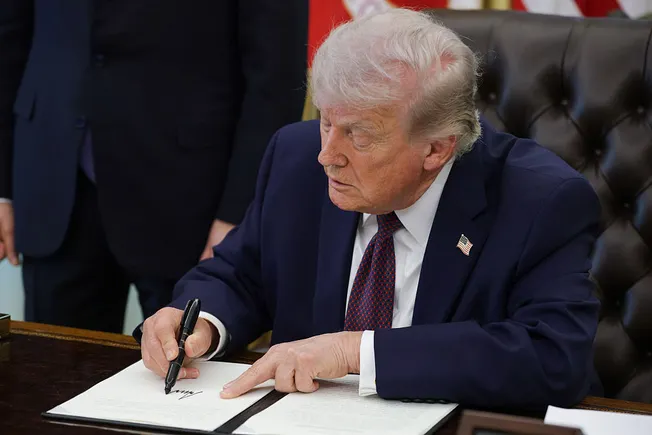
President Donald Trump declared a national emergency on August 26, 2026, directing the Department of Energy to develop rules that would block utilities from connecting certain foreign-made equipment to the bulk-power system. The scope is wider than any previous action. It covers transformers, batteries, inverters, and the software and digital products that run alongside them. It even contemplates replacing equipment already installed.
The White House framed the order as a response to what it called an extraordinary foreign threat involving bulk-power systems produced abroad. The reasoning is specific: rapid growth in advanced manufacturing, data centers, artificial intelligence, and defense production has magnified the consequences of a successful attack on the grid.
But the order’s real significance lies in what it signals about supply chains. This is not just an energy-security move. It is a structural shift in how the United States thinks about the hardware and software that keep lights on.
China already dominates the grid-equipment supply chain
The International Energy Agency estimates that China accounts for 80 percent or more of the world’s production of certain grid equipment, including lithium-ion battery cells and some solar components. That concentration is not new. It is the result of decades of industrial policy, subsidy, and scale that the United States and its allies largely accepted while focusing on other trade priorities.
The 2020 executive order targeting large power transformers from China was a narrower effort. Bridget Bartol, head of industry and regulatory affairs at the National Electric Manufacturers Association, described the new order as an update and expansion of that earlier action. The difference is scope. Transformers are a single category. The new declaration pulls in batteries, inverters, and software.
Software is where the order becomes complicated. Bartol flagged that the concept of equipment designed or developed by a covered foreign entity raises questions the order does not answer. Modern grid systems rely on firmware, control software, and cloud-connected monitoring tools. Many of those products are built by teams distributed across multiple countries. A battery cell might be manufactured in one facility, programmed with software developed in another, and integrated into a system assembled in a third. Determining origin under these conditions is not straightforward.
Utilities face a $1.1 trillion decision
The Edison Electric Institute, which represents investor-owned power companies, said utilities are committed to working with the DOE on implementation while maintaining reliability and affordability. The group noted that U.S. electric utilities are projected to invest $1.1 trillion between 2025 and 2029, a rapid increase in capital spending driven by rising electricity demand.
That investment picture changes meaningfully if a significant share of the equipment being purchased falls under restriction. Utilities do not buy grid hardware in isolation. They buy it from manufacturers who source components globally. The NEMA’s warning about potential confusion in the markets is a polite way of saying that the industry does not yet know how to comply.
The 120-day rulemaking window gives the DOE time to define covered entities and establish compliance pathways. But the timeline does not align with utility capital cycles. Major grid projects are planned years in advance. Procurement contracts are signed. If the rules change mid-project, the financial consequences are immediate.
The reshoring impulse meets reality
The order’s architecture assumes that American manufacturing can absorb supply previously held by foreign producers. That assumption is unproven. The United States has seen revitalization in some industrial sectors, but grid equipment requires specialized facilities, skilled labor, and long qualification cycles. A transformer厂 cannot be built overnight. Battery-cell production requires chemical-supply chains that are heavily concentrated in Asia.
What the order is likely to do first is create incentive pressure. If foreign equipment faces barriers, domestic producers gain market access. If the DOE imposes conditions on continued use of already-installed foreign equipment, it creates a replacement market. Both scenarios favor manufacturers with U.S. presence, regardless of whether the equipment is actually made here.
The second-order effect is a reshaping of supply relationships with allies. Europe and Japan are not China. But their industrial sectors supply components that fall within the order’s scope. A battery manufactured in Germany using Chinese cell stock, or an inverter assembled in Japan with Chinese semiconductors, creates classification problems that the order does not resolve.
Who wins and who loses
Domestic manufacturers of grid hardware stand to gain if the rules create preference for U.S.-sourced equipment. Incumbent utilities with existing contracts and qualified vendors face disruption costs. Foreign manufacturers excluded from the market lose access to the world’s largest electricity grid, which is also one of the most capital-intensive upgrade cycles in history.
The software dimension is the wildcard. If the DOE interprets software origin broadly, it could restrict tools used by American engineers working for American companies. If it interprets origin narrowly, the order’s impact shrinks to hardware categories where China holds dominant position.
Either way, the order marks a departure from the assumption that globalized supply chains are net positive for critical infrastructure. It treats grid equipment the way other sectors treat semiconductors or defense contracts: as something that cannot be left to market forces alone.
What happens next
The 120-day rulemaking period will determine whether this is a signal or a structural change. Industry groups like NEMA have indicated they will engage with the administration on clarity. The dialogue will shape the final rules.
Utilities are already budgeting for the next five years of capital expenditure. Any meaningful restriction will force re-planning. The $1.1 trillion figure becomes smaller or larger depending on how much spending gets redirected toward qualified suppliers.
The order’s language about replacing already-installed equipment is the most aggressive element. If enforced, it turns the grid into a phased replacement cycle rather than a static system. That creates demand. It also creates cost.
The question is not whether the order changes anything. It is whether the DOE’s rules are narrow enough to avoid fracturing supply chains with allies, or broad enough to trigger a realignment that leaves the United States more self-sufficient and its partners more uncertain.
The answer will come within four months.