Trump Renames a Lake — and Shakes Up Everything Else
Google Maps already shows 'Lake America' after Trump's executive order — a symbolic move that reveals how trade coercion is rewriting North American identity. Korean battery makers face a quiet but real risk in the crossfire.
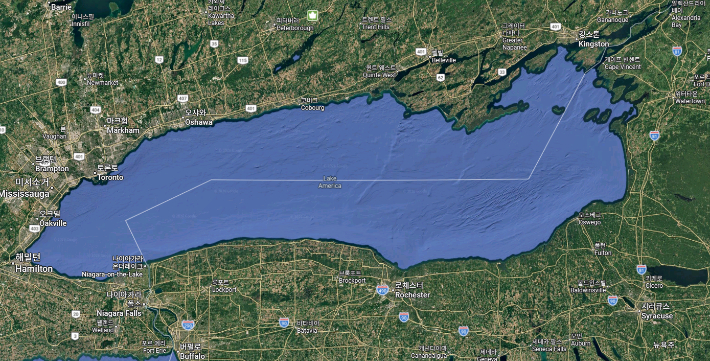
A Name on a Map Is Never Just a Name
Google Maps now shows it as Lake America. For three days, the world called it Lake Ontario. On the 30th, someone checked a map and the name was gone.
The US Geological Survey feeds place names into Google’s system. When the naming authority shifts — even temporarily, even through an executive order signed on the 27th by Donald Trump — the digital map follows. The physical lake hasn’t moved. The border hasn’t changed. But for anyone navigating by screen rather than landscape, the question of who owns the name became the question of who owns the lake.
Mark Carney, Canada’s prime minister, responded quickly. He pointed out that Lake Ontario’s name predates the Canadian Confederation and the American Declaration of Independence by more than 400 years. The word itself comes from an Indigenous language, roughly meaning “lake of shining water.” Ontario province took its name from the lake in 1867.
Doug Ford, premier of Ontario province, didn’t wait for a diplomatic statement. He put up signs. “Lake Ontario — Now and Always,” they read, along the shoreline. It was a gesture that bypassed Ottawa entirely and spoke directly to the people who live on that shore.
Both moves were about something larger than cartography.
The Renaming Was Never About the Water
Trump announced the review of the lake’s name on Truth Social on the 25th. He signed the executive order two days later. Google updated its maps three days after that. The speed was deliberate — and the context was everything.
Trade negotiations between the United States and Canada had collapsed. That is the frame. The renaming came after the talks broke down, not before. It followed a pattern: when leverage stalls, escalation replaces negotiation.
This is not the first time Trump has used symbolic aggression against Canada. Tariffs came first. Threats about annexation followed. A border crisis in El Paso was staged for domestic audiences while being aimed north. The lake rename is the latest step in a campaign that treats Canadian sovereignty as a negotiation chip rather than a fixed boundary.
The effect on Canada is not merely diplomatic. It is psychological. A country that has spent decades trying to define itself in contrast to its southern neighbor suddenly finds that neighbor erasing one of its most visible geographical markers. The message is not subtle: Canadian institutions, Canadian history, Canadian claims to identity — all of it is negotiable if Washington decides it is.
Who Wins, Who Loses, What Comes Next
Trump wins a story cycle. The rename dominates headlines for days. Carney looks defiant. Ford looks decisive. Both Canadian leaders gain domestic credibility without costing Washington anything real. The lake is still shared. The water still flows between the two countries. But the optics have shifted further in America’s favor, and every shifted optic makes the next demand cheaper to extract.
Canada loses ground it didn’t know it was holding. The naming dispute may seem trivial until you realize what it normalizes: that the United States can unilaterally redraw Canadian geography and expect compliance from international platforms. Google’s decision to follow the USGS feed after a presidential order sets a precedent that extends far beyond one lake.
If this becomes routine, the next target could be anything with a dual-name history across the border. The Mackenzie River. The St. Lawrence. Places that have carried Indigenous, French, or British names for centuries could face the same pressure to conform to a single American narrative.
The Quiet Risk to Korean Battery Makers
This is where the symbolism connects to something concrete for readers outside North America.
South Korean battery manufacturers — Samsung SDI, LG Energy Solution, SK On — have been investing heavily in North America. They are building gigafactories in Michigan, Ohio, Tennessee, and elsewhere, betting that the Inflation Reduction Act’s supply-chain incentives will remain stable and that USMCA will keep parts flowing freely across the border.
The lake rename is a signal that stability is conditional. If Trump can redefine a Canadian lake through executive order, he can redefine the rules of trade, investment, and supply-chain eligibility overnight. The battery industry depends on minerals and components moving across the US-Canada border multiple times before a cell is finished. A single component might cross the line six or seven times during production.
Every act of escalation against Canada introduces friction into that loop. Tariffs on Canadian aluminum and steel have already been tested. Future moves could target critical minerals sourced from Quebec or British Columbia. The IRA credits depend on North American assembly and sourcing thresholds — thresholds that become harder to meet if Washington treats the entire supply chain as a hostage rather than a partnership.
Korean manufacturers are watching closely because the math doesn’t work in their favor. Their factories in the US are built to serve the American market and the American subsidy regime. If the regime becomes unpredictable, the investments become exposed. There is no quick exit. A gigafactory cannot be unpacked and shipped to Hungary.
Why This Matters Beyond the Border
The renaming of Lake Ontario is a small event with outsized implications. It tells the world that the United States is willing to rewrite geographic facts when it suits its political purposes. It tells allies that agreements are only as durable as the current administration’s mood. It tells competitors that America’s internal distractions can be weaponized externally.
For Canada, the battle over the name is a battle over the idea that the country exists independently of American permission. Carney and Ford may disagree on policy, but on this they are aligned: the lake’s name is not up for renegotiation.
For Korean battery makers, the lesson is quieter. Supply chains are only as secure as the political relationships that hold them. When those relationships become contests of dominance rather than frameworks of mutual interest, the costs land on the factories, not the politicians.
The water in Lake Ontario will keep flowing whether the map calls it America or Ontario. But the precedent set by this rename will outlast the headline. Whatever happens next, Google Maps won’t be the last thing to change.