Trump's Russia Ping Signals a Dangerous Gamble on Ukraine
Kushner and Witkoff's 8-month absence from Moscow ends with a Kremlin meeting that could reset Ukraine negotiations — but at the expense of Kyiv's leverage and Europe's security faith in Washington.
The Kremlin Door Opens Again
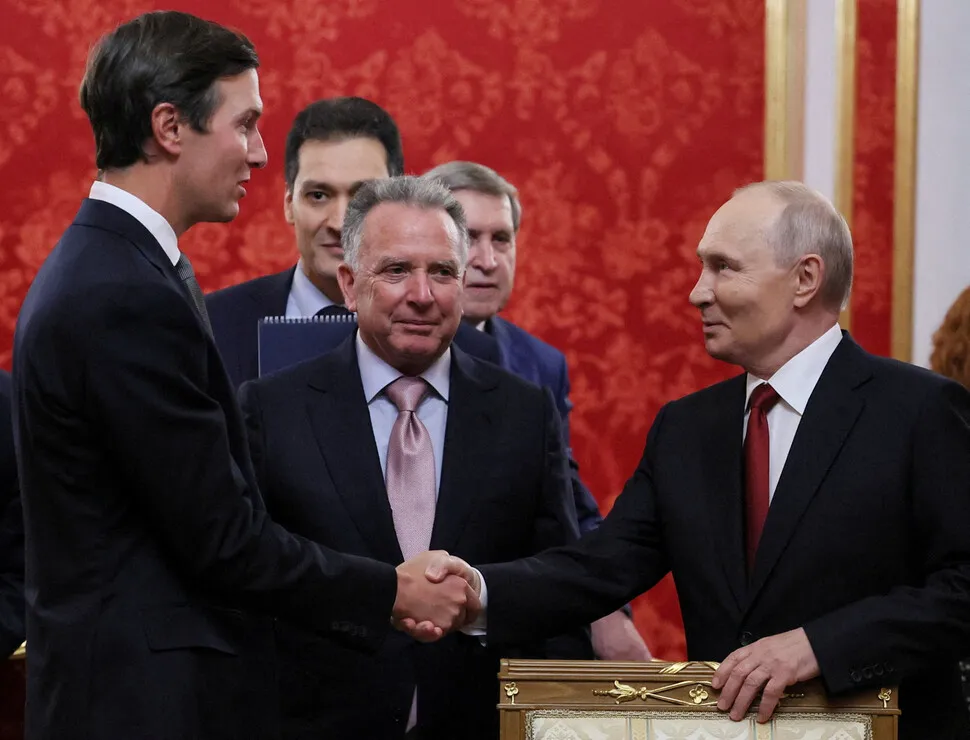
After eight months of silence, Steve Witkoff and Jared Kushner walked into the Kremlin on January 5th and sat across from Vladimir Putin for roughly three hours. The meeting was not a fluke or a photo op. It followed a pattern — Witkoff’s eighth visit to Moscow — and it came with Treasury Department official Jeannette Langhaft in tow, which is the closest thing to a red flag the diplomatic world gets these days.
What happened inside those walls matters less than what just happened around them. Russia and Ukraine announced a three-day ceasefire beginning the same day, stretching from Moscow to Kyiv. That is not coincidental. That is choreography.
Putin called the battlefield situation anything but simple. Yuri Ushakov, his foreign policy adviser, said the discussions went beyond Ukraine to economic issues and mutually beneficial US-Russia projects. Translation: this is not a narrow hostage exchange. It is a restructuring of terms.
The three-hour duration alone suggests substance. These are not hallway encounters designed for optics. According to sources familiar with the scheduling, the meeting was blocked off in advance with no overlapping commitments on either side — a deliberate investment of time that signals how seriously both parties are treating this reopening.
The Iran Distraction Is Over
The Trump administration pivoted hard toward the Iran war that erupted around late February, leaving the Ukraine track to freeze. Months passed. Both sides bled. Ukraine ran low on air defenses and watched Russian missiles land with impunity. Russia saw fuel infrastructure burned and civilian anger simmer. Winter was closing in on both.
The ceasefire announcement is the first signal that Washington has decided the Iran detour costs more than the Ukraine stalemate. But the calculus is dangerous. Reopening talks after eight months does not reset positions — it resets leverage, and leverage was never evenly distributed.
Kyiv will meet the envoys on the second day. That sequence — Moscow first, Kyiv second — is not trivial. The Kremlin already set the frame. The question now is how much ownership Zelenskyy retains over his own negotiation.
Inside the Ukrainian government, the timing has triggered quiet alarm. Officials who had grown accustomed to the administration’s sporadic attention are now confronting the possibility that the Iran pivot created a vacuum Moscow was happy to fill. Russian forces consolidated gains along the Donetsk front during the freeze period, extending foothills that any future settlement will have to account for. Those tactical adjustments, made while Washington was distracted, now carry strategic weight at the negotiating table.
Sanctions Are the Real Table
The presence of a senior Treasury official is the detail English-language coverage has largely slept on. Langhaft’s attendance makes it nearly certain that sanctions relief entered the conversation. Russia’s stated demand has been consistent: lift sanctions regardless of any Ukraine settlement. The US position has been equally consistent: no.
If Trump’s team is seriously considering any relaxation, the implications extend far beyond the battlefield. Sanctions have been the primary instrument of Western pressure short of direct military involvement. Erosion of that instrument — even incrementally — changes the cost equation for every European capital watching.
This is not about a single concession. It is about signaling that the economic war on Russia has an off-ramp, and that off-ramp leads toward a deal shaped in Moscow, not Kyiv.
The second-order effect reaches deeper than most analysts are tracing. If sanctions relief begins to take shape — even in phased or conditional form — it signals to global markets that the Russia risk premium may start compressing. Oil traders are already pricing in scenarios where Western enforcement fractures. Commodity flows that have rerouted through Turkey, the UAE, and Central Asia to reach Russian exporters could accelerate further, undermining the structural pain that sanctions were designed to inflict. The question is whether Washington is preparing to accept that erosion as the price of a diplomatic breakthrough, or whether it is testing the waters to see how much relief it can extract before European partners push back.
Europe’s Blind Spot
European leaders received little advance warning. That is the story nobody is writing yet. The Trump administration’s habit of bypassing Brussels and Berlin has grown from tactic to strategy. When the US decides to open a back channel to the Kremlin, Europe is expected to react, not plan.
The defense posture implications are immediate and compounding. If Washington is signaling willingness to cut a deal that accommodates Russian territorial claims — Moscow insists on the Donbas — Europe faces a binary choice: fill the gap or accept abandonment. Neither is comfortable.
Germany, France, and the Nordic states have already begun quiet mobilization planning. A Trump-Putin track that accelerates toward a frozen conflict rather than a negotiated settlement would force those plans onto fast-forward. The question is whether European defense industry capacity can keep up with the timeline Washington is now setting.
Beyond the defense question lies a deeper strategic recalibration. European intelligence services have spent years aligning their assessments with Washington’s. If the US is now pursuing a separate track with Moscow, those alignments fracture. NATO’s eastern flank — Poland, the Baltics, Romania — faces a scenario where American security guarantees become conditional on a deal that may not include their concerns. The instinct in Warsaw and Tallinn is likely to be to deepen bilateral ties with remaining committed partners in London and Paris, creating a Europe that is strategically bifurcated rather than unified.
Kyiv’s Narrowing Room
Zelenskyy enters this meeting with less room than he had six months ago. Ukraine’s air defense gap is real and worsening. Russia’s energy infrastructure damage is creating domestic pressure on Putin, yes — but it is also creating pressure on Moscow to secure gains before winter deepens further. The ceasefire gives both sides breathing room, but breathing room is never neutral. It consolidates positions.
Russia’s territorial demand has not softened. Ukraine’s refusal to cede land has not softened. The gap between them is being bridged not by compromise but by exhaustion — and exhaustion favors the side that can absorb it longer. That is not an objective judgment. It is what the current trajectory shows.
The human dimension of that exhaustion is being understated in Western coverage. Ukraine’s mobilization crisis has forced the government to lower the drafting age and scramble for replacements in forward positions that have been rotationally depleted. Russia, for all its losses, has maintained a steady flow of contract troops and prisoner recruitment. The manpower differential is widening, and it will be reflected in whatever territorial snapshot exists when negotiations resume in earnest.
What Comes Next
The White House said the envoys discussed “concrete plans for next steps” to be announced within weeks. That timeline is aggressive. It suggests the administration is not testing the water — it is launching.
The Iran war may still dominate headlines, but the Ukraine file is being reopened on Washington’s terms, not Kyiv’s or Moscow’s. Europe’s defense posture will have to respond to a settlement framework it did not help write. Kyiv will have to decide whether to accept terms it did not dictate or risk being left behind entirely.
The ceasefire is a gesture. The three-day window is a signal. The real negotiation begins when the envoys leave Kyiv and the numbers are on the table.
Who wins if that table is set in Washington and Moscow? Russia gains diplomatic normalization and potentially sanctions relief. Trump gains a photographed resolution. Europe gains uncertainty. Kyiv gains whatever is left after the deals are made.
The clearest loser in this architecture is the principle that Ukraine’s sovereignty should be defended on Ukrainian terms. That principle has held since 2022. The Trump-Putin channel does not destroy it overnight, but it sets a precedent that major powers can redraw settlement boundaries without the affected party having meaningful veto power. If the ceasefire holds and talks proceed, the question will not be whether Ukraine is included in the conversation — it will be how much of its own future it can still claim inside whatever framework emerges.