Trump and Xi's Airport Theater Masks a Substantive Reset
Xi Jinping's first state visit to the US in 11 years arrives with unusually reciprocal protocol and a reported trade truce extension — signaling a pragmatic de-escalation that could reshape tech policy and Asian alliances.
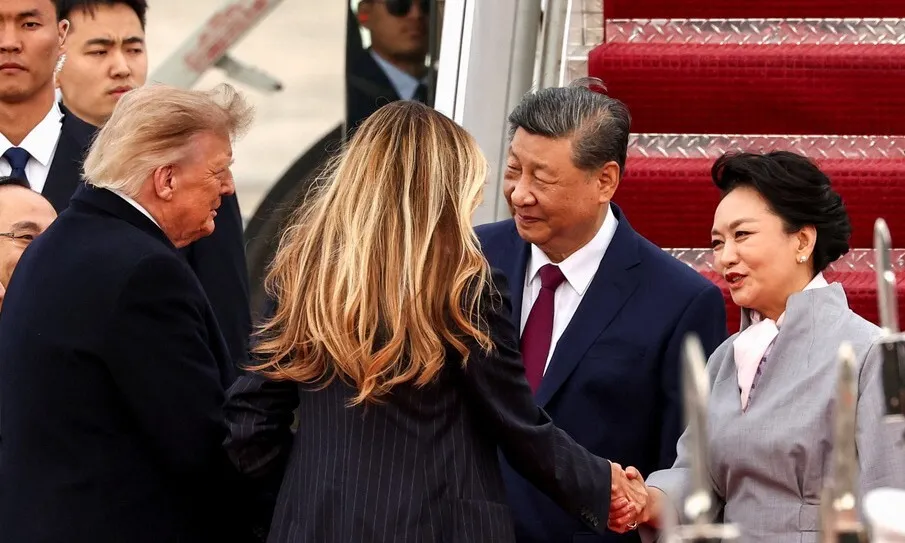
The reciprocity is the story
Xi Jinping landed at Andrews Joint Base on the 23rd to a reception that broke with routine American protocol. President Trump and First Lady Melania walked the red carpet themselves — not a stand-in, not a waiting-room gesture from the White House lawn — and stood with him for over two minutes of private conversation before the cameras rolled. The F-16s and F-22s lined up on the tarmac, the B-1 bombers passed overhead, and the 21-gun salute cracked across Maryland. It was a mirror image of what Xi showed Trump in May during the American president’s state visit to Beijing.
That mirroring is not accidental. In diplomatic terms, it signals something rarer than a friendly summit: deliberate parity. China’s leadership has long chafed at the hierarchical framing of US-China encounters. By matching the pageantry, Xi returns the favor on his own terms. The visual message to Beijing’s domestic audience — that China’s leader receives equal honor from the American president — is as important as any bilateral talking point.
A two-month truce with real teeth
The theater matters, but the substance lies elsewhere. The visit coincides with a reported two-month extension of the trade truce between Washington and Beijing. That extension buys time, yes, but it also represents a significant concession from both sides after months of tariff escalations and export-control confrontations. A two-month window is short enough to create urgency and long enough to matter — it forces concrete negotiations rather than indefinite drift.
This is not business as usual. The prior trade deal under the first Trump administration held together only because both sides had an interest in avoiding a full rupture. The current framework operates differently: the Trump-Xi personal dynamic has replaced institutional guardrails. When agreements depend on the relationship between two individuals rather than on bureaucratic structures, they are both more flexible and more fragile.
What is actually on the table
The White House agenda covers trade, tariffs, rare earths, artificial intelligence, Taiwan, and Iran. Four of those six items intersect with technology policy, which is where the stakes extend well beyond the bilateral relationship.
Rare earths are the most immediate leverage point. China controls roughly 60 percent of global rare earth mining and nearly 90 percent of processing capacity. Any de-escalation that includes rare earth supply assurances would be a significant relief for US defense contractors and the broader electronics industry, which have spent years scrambling to diversify away from Chinese supply chains. The alternative — a collapse into renewed tariff war combined with export restrictions — would force those supply chains to accelerate at enormous cost, with no guarantee of success within the two-month window.
AI policy is the less obvious flashpoint. Both governments have been moving toward tighter controls on AI export and investment, but their approaches diverge sharply. The US has focused on restricting chip sales and collaboration with Chinese research institutions. China has responded with its own export controls and an effort to build domestic alternatives. The summit’s discussion of AI will likely produce parallel announcements rather than convergence — each side framing its controls as necessary while accusing the other of overreach. The practical effect could be a bifurcation of AI development along geopolitical lines, which matters far more to Silicon Valley and Shenzhen’s tech ecosystems than any statement joint with the other.
Taiwan is the constraint no one mentions openly
Taiwan sits on the agenda but will define its limits. Xi cannot afford to appear soft on the issue domestically, and Trump cannot afford to alienate the bipartisan consensus in Congress that supports Taiwan without explicit commitment. The most likely outcome is a reiteration of existing positions — a diplomatic minimum that avoids escalation but also avoids progress. That outcome, however, is itself significant: it means both sides are choosing stability over confrontation on the question that has most often triggered crisis.
Who wins and who loses
Chinese exporters win the most in the near term. The truce extension preserves access to the US market during a critical period for Chinese manufacturing, which has been feeling the cumulative pain of tariffs and decoupling pressures. For China’s leadership, the reciprocal hospitality provides domestic propaganda value without costly concessions.
American alliance partners in Asia lose something less tangible but real. Japan, South Korea, the Philippines, and Australia have invested heavily in the framing that US-China competition is structural and unreconcilable. A visible warm-up between Trump and Xi — especially one marked by this level of ceremonial reciprocity — undermines that narrative. These allies will watch carefully for whether the truce leads to deeper engagement or remains a tactical pause. If the latter, their hedging strategies continue. If the former, they face a recalibration they did not sign up for.
Defense contractors and rare earth processors in the US gain from reduced uncertainty, but they also lose the argument for accelerated domestic investment if the supply chain risk recedes. That is a political economy tension the White House will have to manage.
What happens next
The summit itself takes place at the White House on the 24th, with an official welcome ceremony featuring roughly 500 US service members and planned flyovers by a B-2 stealth bomber and four F-22s — more hardware than Andrews offered, and a signal that the second day is meant to showcase American capability alongside diplomatic warmth.
Within two months, both sides will have to decide whether the truce is a bridge or a dead end. The Trump administration’s domestic political calculus favors visible deals; the Chinese leadership faces its own succession-era calculations that make reckless confrontation unattractive but concession expensive. The most probable trajectory is a series of phased, reversible steps — tariff rollbacks paired with limited technology cooperation, rare earth supply discussions alongside continued export controls on advanced chips.
The pageantry at Andrews was designed to make this reset look historic. The reset itself may be incremental, practical, and narrow. That does not make it unimportant. In a relationship defined by periodic shocks, a negotiated pause with a two-month clock is already a deviation from the pattern. How both sides use that window — and what they do when it expires — will determine whether this moment becomes the start of a new equilibrium or merely a longer breather before the next escalation.