Trump-Xi-Putin Deal Changes Everything For Southeast Asia
The first-ever US-China-Russia trilateral meeting on Ukraine and energy security marks a geopolitical pivot that forces every Southeast Asian capital to recalibrate its hedging strategy overnight.
The Big Shift No One Is Fully Processing Yet
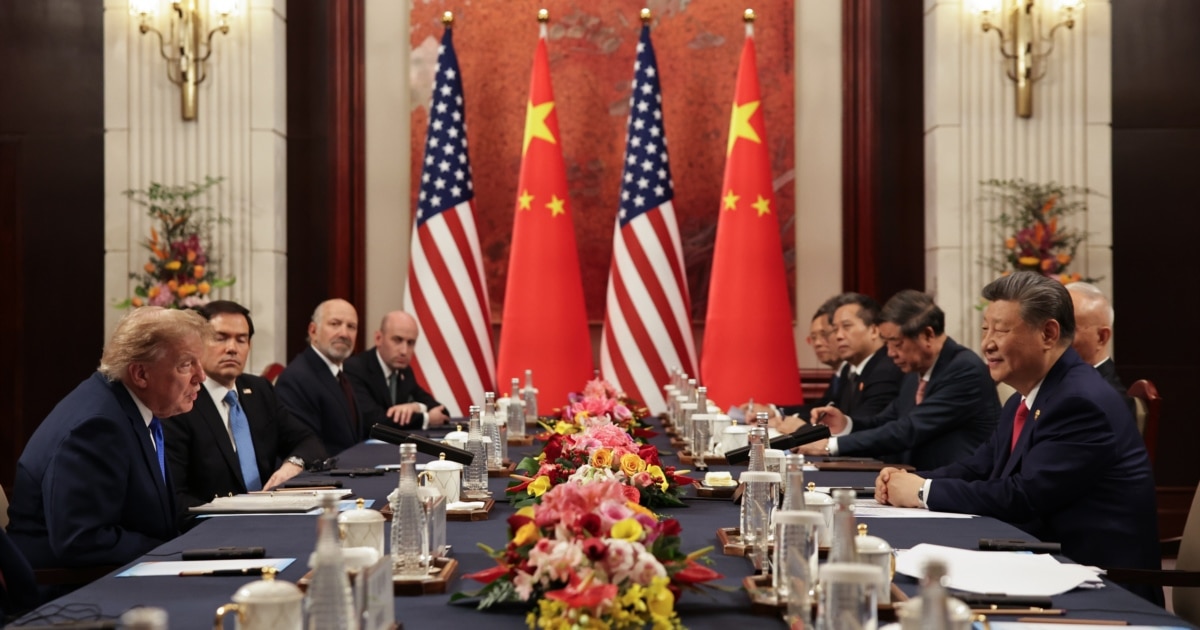
Shenzhen, 19 November 2026. Donald Trump and Xi Jinping stood together at the Qilin Mountain Resort during a bilateral press conference ahead of the APEC summit, speaking glowingly about fairness and partnership. They discussed fentanyl, trade balance, and what Trump called a “very special relationship” with the Chinese president. Then Trump stepped into another room for a shorter meeting with Vladimir Putin — handshake, light touch on Dmitri Peskov’s arm, a joke about doing well.
Thirty minutes later, all three sat at the same table.
There was no joint press statement released immediately after. But what happened inside that room — the first recorded trilateral gathering between the United States, China, and Russia on active conflict management — will reshape how every country from Manila to Busan plans its next decade.
This is not a minor procedural change. It is the birth of a new three-power architecture for global security governance, one that runs parallel to and potentially underneath the existing alliance networks that have anchored Washington’s position in Asia since 1945.
What Actually Got Discussed
According to accounts from both the White House and the Kremlin, the conversation covered three interlocking dossiers: ending the war in Ukraine, securing the Strait of Hormuz against Iranian disruption, and limiting nuclear escalation risks.
Trump told reporters before the trilateral that America and China share a “firm position” on keeping Hormuz open and preventing Iran from acquiring nuclear weapons. Xi echoed the language afterward. Neither leader offered specifics on enforcement mechanisms, but the fact that the two largest economies in Asia-Pacific chose to announce aligned stances on a Middle Eastern chokepoint at an APEC event in southern China is itself a signal worth unpacking.
For context, the Strait of Hormuz carries roughly 21 million barrels of oil per day — about a fifth of global petroleum consumption. Over half of Japan’s crude imports and more than 60% of South Korea’s pass through it. Any power that can credibly coordinate among itself on Hormuz security effectively holds leverage over the energy lifelines of every ASEAN economy except Malaysia and Brunei.
That is not a theoretical concern. Thailand, Vietnam, Indonesia, and the Philippines all import more than 80% of their crude through the Strait. None of them currently has a seat at any table discussing how to keep it open.
The Hedging Crisis
For years, Southeast Asian capitals have practiced a careful form of strategic ambiguity — deepening economic ties with Beijing while maintaining security partnerships with Washington. Vietnam quietly purchases Chinese solar panels while expanding naval cooperation with the United States. The Philippines hosts rotating US military rotations while buying defense equipment from France and Japan. Singapore hosts American submarines without announcing it loudly.
This hedging strategy assumed a bipolar competition: two poles pulling in opposite directions, leaving room to move between them.
What emerged in Shenzhen challenges that assumption directly. If Washington and Beijing are coordinating with Moscow — the very power the US sanctions regime targets — on energy corridors and nuclear risk reduction, the binary framing no longer holds. The architecture is becoming triangular, not bipartite.
Countries that built their foreign policy around picking sides or avoiding alignment now face a different reality: the sides themselves may be redrawn by the people who drew them.
Seoul’s Impossible Calculus
South Korea faces the sharpest dilemma. President Yoon Suk Yeol’s administration has invested heavily in ironclad alignment with Washington, framing US-ROK-Japan trilateralism as the cornerstone of regional security. Seoul’s contributions to Ukraine relief, its restrictions on semiconductor technology exports to China, its deployment of THAAD — each was calibrated to demonstrate loyalty within a US-centric order.
But the trilateral structure emerging from Shenzhen does not exclude Seoul. It bypasses it.
The deal on Hormuz alone creates immediate tension. Japan and South Korea collectively consume roughly 12 million barrels per day from the Gulf. If Washington and Beijing establish a coordination mechanism with Moscow that includes shipping insurance guarantees or naval patrol frameworks, Seoul’s choices narrow dramatically. Continue opposing any arrangement that includes Russia and risk American pressure to accommodate? Or accept a framework where your energy security depends on a tripartite you were not invited to help design?
China’s message in Shenzhen was deliberately inclusive — cooperative, fair, respectful. That is exactly what makes it difficult for allies to resist publicly while being structurally sidelined.
What Comes Next
Several trajectories are plausible, and none are mutually exclusive.
Scenario one: The Shenzhen framework hardens into a regularized consultation mechanism. Subsequent meetings could follow the pattern established here — bilateral pre-meetings between each pair, then a joint session. If this continues, the G7’s relevance to energy and conflict management diminishes precisely because the actual volume of oil passing through contested corridors concentrates decision-making power elsewhere.
Scenario two: The agreement remains declaratory without operational substance. Trump and Xi expressed mutual interest; neither produced a timeline, verification protocol, or institutional body. In this version, the significance is symbolic rather than structural — a signal that the oldest Cold War rivalries are being recompiled for a new era of managed competition.
Scenario three: The framework splinters along fault lines that were always there. China’s relationship with Russia on Ukraine is asymmetrical — Moscow needs Beijing’s economic lifeline, but Beijing does not trust Moscow’s long-term reliability. Trump’s America prioritizes transactional outcomes over ideological consistency. Xi’s China plays a longer game. The triangle is inherently unstable because each vertex calculates time differently.
All three scenarios require Asian capitals to update their contingency planning within weeks, not months.
The Unspoken Loss
The most consequential element of the Shenzhen outcome was not what was announced but what was absent. There was no mention of Taiwan. No reference to the South China Sea. No acknowledgment of the US-Japan or US-ROK alliances as necessary components of regional stability.
Ukraine and Hormuz dominated. Those are Eurasian landmass problems, not Pacific ones — yet their resolution framework excludes the Pacific entirely.
For Southeast Asian governments that have spent a decade building minilateral arrangements — the Quad, AUKUS, the US-Philippines EDCA sites — this gap is not abstract. It is the difference between having a say in the rules governing your strategic environment and discovering that those rules were written somewhere else without you.
The trilateral in Shenzhen did not solve Ukraine. It did not secure Hormuz. But it did something arguably more important: it demonstrated that the two powers most relevant to any future crisis in those regions can now convene a third without consulting their Indo-Pacific partners first.
Every capital from Jakarta to Taipei is reading that same sentence differently depending on which map they live under.