Trump's Military Spectacle for Xi Is a Negotiation Tactic
Trump's airport welcome with F-22 flyovers and a B-2 bomber isn't just courtesy—it's a calibrated display of power before AI and trade talks that will define US-China relations for years.
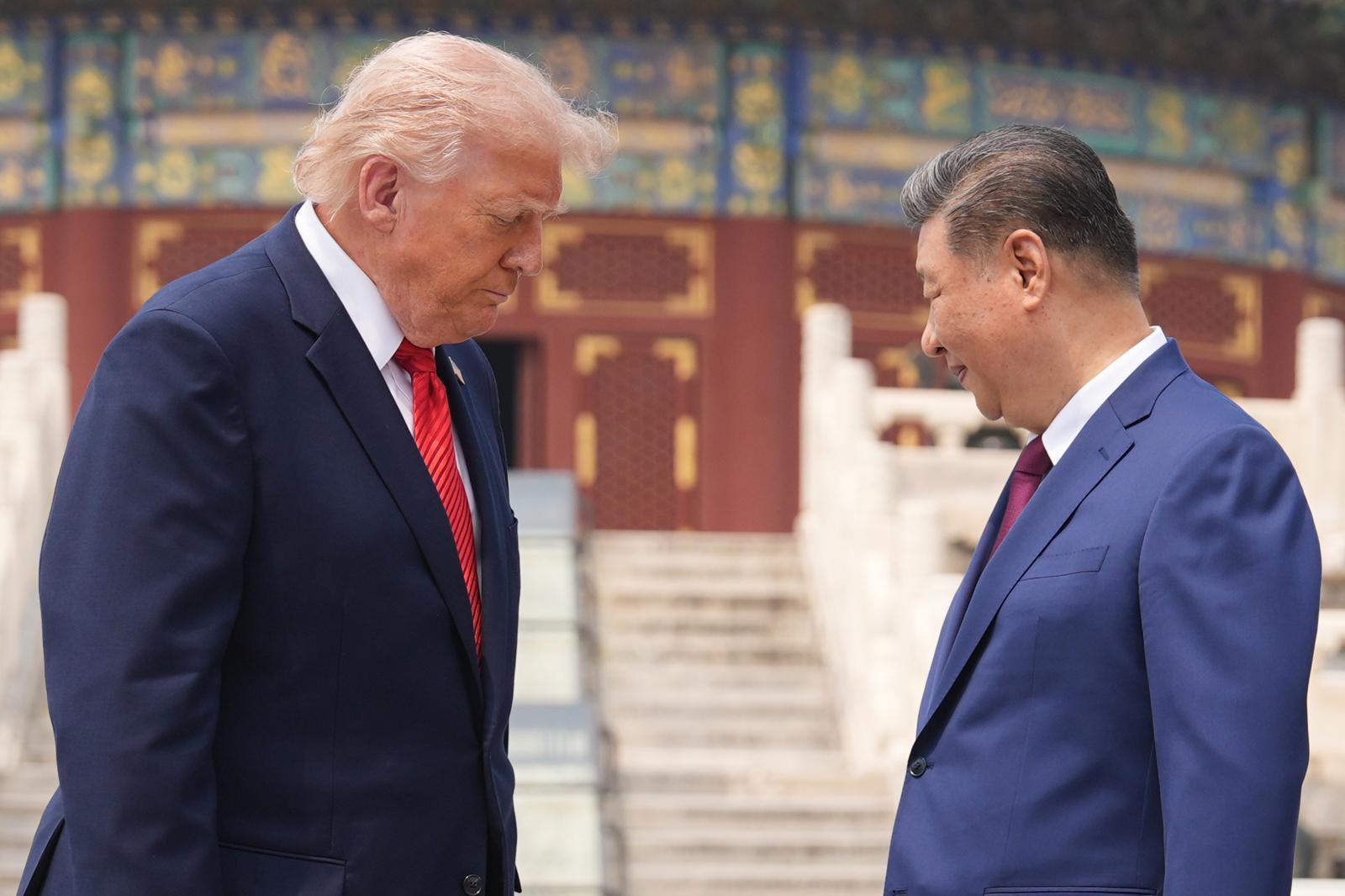
The Theater Was the Message
Trump did not merely greet Xi at Andrews Air Force Base on September 23. He staged a demonstration. F-22 Raptors sliced overhead in formation—four of them, the kind of aircraft Beijing cannot replicate at scale—while a single B-2 Spirit strategic bomber tracked across the DC skyline, a platform so rare it could barely be counted on one hand. Four hundred seventy-nine uniformed service members stood at attention in the White House courtyard the following morning. The Presidential Marines played both anthems. Melania and Peng Liyuan toured the Smithsonian Asian Art Museum afterward.
This is how you receive a visiting head of state from the country your intelligence community has spent a decade warning about. Protocol, yes. But also something more deliberate: a reminder of what happens when the balance of power tips away from Washington. The visual language was unmistakable. Every frame of the flyover circulated instantly across social media and state-run Chinese outlets alike, each side editing the narrative to their advantage. Washington saw a show of technological supremacy. Beijing saw an act of hostility disguised as hospitality. That divergence is itself the point.
The Real Agenda Wasn’t Announced
The itinerary released by the White House on September 21 was thorough to the point of performance. State banquet in the East Room. Afternoon tea on September 25. A visit to the National Archives. But the document said nothing about the substance. No agenda on AI governance, no mention of tariff renegotiations, no framing of what comes after the photographs.
That silence is the story.
Xi’s September 23–25 visit arrives at a moment when the technological and economic architectures governing the 21st century are being redrawn without Beijing’s consent. The United States has tightened semiconductor export controls, reshored critical manufacturing through subsidies, and begun constructing cooperative frameworks with allies on AI safety standards that explicitly exclude Chinese participation. The question hanging over these talks is whether Trump is opening a door or closing one—and whether the closure is intentional or simply the byproduct of an administration that treats diplomacy as transaction rather than institution.
The absence of a published agenda also signals that Trump may prefer the flexibility to escalate or de-escalate in real time, using each session as a live bargaining chip rather than a predetermined negotiation track. In past state visits, even adversarial ones, there was at least a veneer of structured dialogue—working sessions, joint press conferences, publicly stated objectives. This trip offers none of that scaffolding. What remains is pure impression management, which is precisely the point.
The Tech CEOs in the Room
The state banquet guest list, as reported by Donga Ilbo, included prominent American technology CEOs alongside senior business and government figures. This is not incidental. When Trump invites Silicon Valley’s leadership to dine with China’s president, he is merging two arenas that have been sharply separated since the TikTok hearings and the CHIPS Act: the geopolitical and the corporate.
The implication is blunt. China’s dominance in AI infrastructure—data centers, cloud capacity, training compute—is increasingly contested. American firms control much of that stack. The people eating in the East Room with Xi that night are the ones who will define what ‘open’ means for artificial intelligence, who will decide which models get exported and which chips stay confined. Their presence signals that the real negotiation may not happen between ambassadors, but between CEOs and the White House, with Beijing on the receiving end.
This convergence carries second-order consequences that extend well beyond the visit itself. American tech firms have long operated in a gray zone—selling hardware and cloud services to China while publicly distancing themselves from Beijing’s surveillance apparatus. The state banquet forces that ambiguity into the open. Chinese firms will watch closely to see whether American CEOs signal independence from Washington’s strategic restrictions or deference to them. The message they read will shape how those same CEOs navigate the next round of export control enforcement and whether they push back internally against further decoupling.
Who Wins, Who Loses
Trump wins the optics. A F-22 flyover for a Chinese leader costs nothing in policy terms and everything in image. It projects strength without demanding concession. Domestic audiences see deterrence. International audiences see resolve. Xi, for his part, receives the full trappings of a state visit—the highest honor the United States extends—while walking into rooms where the terms of engagement have already shifted in America’s favor.
Beijing loses the narrative. The spectacle of military aircraft shadowing a diplomatic arrival reframes China’s relationship with America as one of adjacency rather than parity. For a government that has spent years insisting on multipolarity and strategic equality, the imagery is quietly corrosive. It undermines the domestic propaganda line that positions China as an equal superpower, and it complicates Xi’s efforts to project confidence abroad.
The middle ground—mutual accommodation on AI oversight, phased tariff agreements, some reset in economic engagement—is the casualty. Trump’s approach appears to be negotiation through dominance, not partnership. Xi’s response will determine whether Beijing accepts a diminished role or escalates. There is a real risk that the visit produces no durable agreement at all, only a reinforcement of existing fault lines dressed in the language of diplomacy. That outcome would be consistent with Trump’s broader style: maximize leverage in the moment, minimize commitment afterward.
What Happens Next
The state visit concludes September 25 with the National Archives visit—a choice of venue that echoes the Founding era, implicitly framing US-China relations as a story still being written by America. After that, the documents will be signed, the photos disseminated, and the actual negotiations will begin in working groups that never make headlines.
The stakes are concrete. AI governance frameworks currently being drafted in Washington will either incorporate Chinese technical standards or explicitly exclude them. Tariff structures on Chinese goods, already in flux, face another round of recalibration. Semiconductor supply chains, partially decoupled, will accelerate further—or stall if Beijing finds leverage in rare earths or critical minerals.
No one inside or outside the White House is yet saying which direction. That is why the theatrical welcome matters. It sets the tone before the substance even enters the room. What follows will be measured in technical memoranda and classified briefings, not flyovers. But the atmosphere established at Andrews Air Force Base will shadow every subsequent exchange. If the opening act communicates that America sets the terms, then the negotiations that follow will operate within that frame—whether or not either side ever formally acknowledges it. The spectacle was never about welcoming Xi. It was about reminding him, and everyone watching, of who holds the advantage.