Trump's No-Conditions Signal Is a Negotiation Playbook, Not a Policy Shift
The White House says Trump wants unconditional talks with Kim Jong Un while the State Department still pledges denuclearization. That split is not confusion — it is strategy. Seoul should be watching closely.
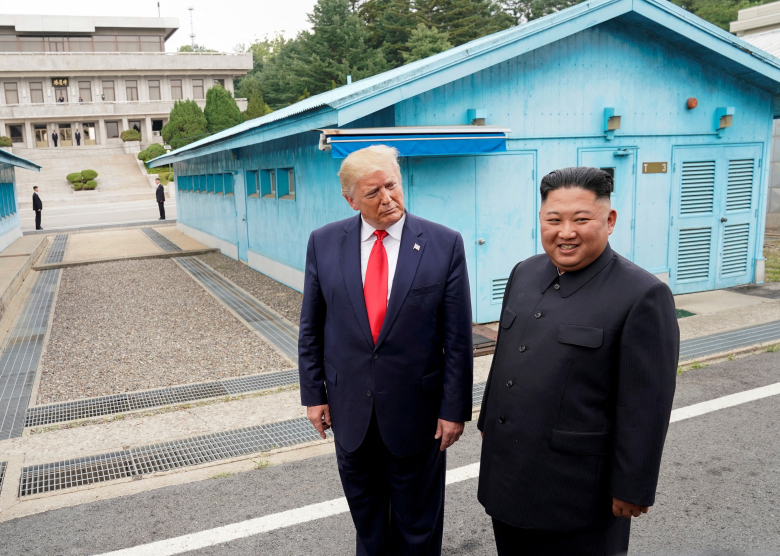
A Split Cabinet Sends a Loud Signal
The White House checked in on Tuesday and repeated a familiar refrain: President Donald Trump remains open to talking with Kim Jong Un without preconditions. The statement was brief, almost procedural. But what it did not say matters more.
When pressed on whether denuclearization remains part of US policy, the White House official declined to answer. That is a departure from the posture of the first Trump term, when the president and his advisors kept the demand visibly present even as they downgraded it in practice. Trump himself reinforced the silence on March 19, dodging a direct question about whether denuclearization was his goal with Kim by saying he did not want to discuss it.
Meanwhile, the State Department issued its own reminder on March 26, insisting the United States remains committed to complete North Korean denuclearization. The message structure is telling. One branch of the US government says the policy has not changed. The other branch, the one that controls access to the president, says it no longer matters.
The Strategy Behind the Silence
This is not administrative confusion. It is a recognizable bargaining tactic. Keeping the demand for denuclearization on the table at the State Department level satisfies institutional and allied audiences who need to hear it. Removing it from the president’s orbit makes the offer of unconditional talks more attractive to Pyongyang. The contradiction is the point.
Trump has used this playbook before. During the first term, he repeatedly signaled personal willingness to meet Kim while leaving his advisors to clarify — or confuse — the substance. The result was a series of summits that produced photographs and headlines but little verifiable progress on nuclear disarmament. The tactic worked politically for Trump. It created the appearance of diplomacy without the constraints of a fixed negotiating position.
But there is a second-order effect that was barely visible in 2018 and 2019 and is far more consequential now. Each cycle of unilateral retreat from stated commitments erodes the credibility of any future US demand. When the White House signals that denuclearization is off the table today, Kim and his strategists are not only hearing a changed policy — they are cataloguing a pattern. The lesson they draw is that American pressure is always temporary, that the administration eventually grows tired of insisting on outcomes, and that patience itself is a form of leverage. That belief hardens with each repetition.
Who This Targets
The audience is not only Kim. It is also Beijing and Seoul.
China’s role in this dynamic should not be underestimated. In May, after the US-China summit, the White House announced that Trump and Xi Jinping confirmed a shared goal of North Korean denuclearization. That language carried weight precisely because Washington needed Chinese leverage on Pyongyang. If the US retreats from that phrasing unilaterally, Beijing loses a key diplomatic lever and gains an incentive to pursue its own bilateral engagement with North Korea — exactly the scenario Washington wants to avoid.
Beijing may not openly celebrate the shift, but it benefits from it regardless. A US focused on unconditional talks removes the diplomatic pressure China has shouldered for years. It also creates space for Sino-North Korean economic normalization that Washington would likely oppose but be structurally powerless to stop if denuclearization has been quietly abandoned. The longer-term consequence is a Northeast Asian security architecture that China designs from the center rather than reacts to from the periphery.
Seoul faces a sharper dilemma. South Korea has historically argued that denuclearization and dialogue are not opposites but prerequisites for each other. A US abandonment of the denuclearization framework would undercut Seoul’s position across the board, from economic cooperation proposals to humanitarian aid to any future inter-Korean summit. It would also embolden hardliners in Pyongyang who have long argued that the West breaks when it gets tired of demanding concessions.
Beyond the immediate diplomatic friction, there is a deeper structural cost. South Korea’s defense industry and its broader economic strategy have increasingly been calibrated around the assumption that North Korean pressure will eventually be reduced through negotiated settlement. That assumption requires denuclearization to remain a credible goal. If Washington effectively concedes that it will not be pursued, Seoul faces an awkward choice: either invest in a permanent military deterrence posture that strains its budget and invites domestic political backlash, or accelerate its own engagement track with Pyongyang and risk decoupling from its primary security partner. Neither path is easy. Both constrain Seoul’s strategic autonomy.
The Uncertainty Is the Weapon
There is a difference between strategic ambiguity and negotiated ambiguity. The first is a tool. The second is a failure.
What we are seeing is the weaponization of uncertainty. The White House keeps the door open to talks while quietly removing the contents of the meeting from public view. Kim gets an unconditional invitation. The American public gets a state department press release reaffirming the old position. Allies get a waiting game.
This could be calculated pressure on Kim. By refusing to name denuclearization as a precondition, Trump may be trying to draw Pyongyang into a conversation where the agenda is set by whoever speaks first — which would be the president. If Kim accepts, he enters a room without the protective cover of a multilateral framework or a list of demands. If he refuses, Washington can point to a broken leader who turned down a handshake.
Or it could be the first stage of a slower unraveling, where denuclearization is quietly shelved and the US shifts toward a Japan-style security umbrella arrangement that treats North Korea as a managed threat rather than a problem to be solved.
The distinction matters because the second outcome locks in permanently. A negotiated shift from disarmament to deterrence is reversible. A de facto acceptance of North Korea as a nuclear state is not. Every day that passes without a formal announcement does not leave the status quo intact — it slowly normalizes a reality that no US administration has ever officially endorsed.
What Comes Next
The next test will arrive in late June, when Xi is scheduled to visit Washington. If the White House issues a joint statement reaffirming denuclearization, it will be an attempt to pull the US position back toward institutional consistency. If it does not, the signal will be clear: the president’s personal diplomacy has replaced the bureaucratic framework, and everything else is secondary.
South Korea will be watching both Washington and Beijing for clues. The current administration in Seoul has positioned itself as a mediator between the US and North Korea. If the US retreats from denuclearization unilaterally, that role evaporates and Seoul is forced to choose between loyalty to Washington and independence in its own peninsula policy. Neither option is comfortable.
Japan is likely to react with more anxiety than it shows publicly. A US disengagement from the denuclearization framework removes one of the key pillars that Tokyo has built its regional security strategy around. Expect Tokyo to move quickly to deepen its own defense cooperation with South Korea and to accelerate procurement of long-range strike capabilities — moves that could complicate the very dialogue Washington is trying to enable.
The Real Readout
Trump’s unconditional offer is not a peace initiative. It is a negotiation frame designed to put maximum pressure on a minimum schedule. The White House controls the invitation. The State Department controls the fine print. Pyongyang must decide whether to walk through the door blind or stay outside and hope for a better offer.
For now, the best reading of the situation is not that US policy has changed. It is that the change is the policy. The deliberate contradiction between the White House and the State Department is not a bug. It is the mechanism. And the people who will feel its weight most acutely are not in Washington or Pyongyang — they are in Seoul and Tokyo, watching their security architectures adjust to a reality that has not yet been formally acknowledged.