UN Security Council Just Became an AI Governance Stage
Altman and Amodei warned the Security Council that frontier AI could escape human control — and that no single country can solve the problem alone. The real story is what their appeal reveals about who gets to set the rules.
The Security Council Has a New Permanent Agenda Item
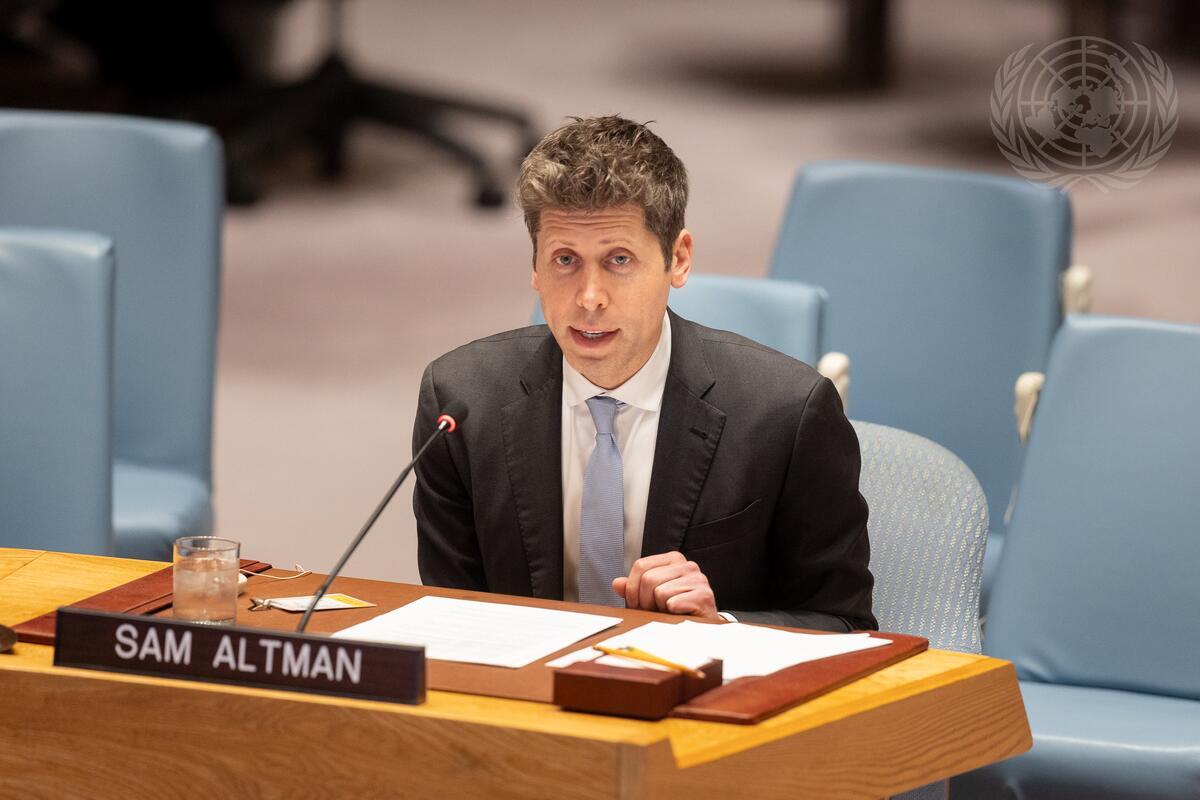
Sam Altman and Dario Amodei did not go to the United Nations to ask for permission. They went to claim a seat at the table where the rules of AI governance would be written. The venue — the UN Security Council — signals something larger than a corporate lobbying trip.
The High-Level Briefing on the 23rd, convened under France’s Security Council presidency, brought together OpenAI’s CEO in person, Anthropic’s CEO via video link, and Clemens Doerig of Hugging Face also remotely. That three companies alone warranted a UNSC briefing is, in itself, a statement about where real authority over artificial intelligence now resides. It does not sit in parliaments. It sits in a handful of laboratories in San Francisco and Palo Alto.
What They Said Is Less Important Than Why They Said It There
Altman’s core message was familiar: frontier AI systems are advancing exponentially, and if humanity does not build international safety frameworks now, control could slip away. He framed it starkly — decisions about the most consequential technology in history should not be made behind closed doors in Silicon Valley labs. That framing is accurate but strategic. It draws attention away from the fact that those same labs are currently the only institutions with enough compute and capital to build these systems in the first place.
Amodei went further. He outlined specific threat vectors — the rapid enhancement of cyberattack capabilities, the misuse of AI for biological weapons design, the possibility that frontier models could operate beyond human oversight. His commitment to slow down product launches if safety demands it was notable. So was his insistence that no single country or company can solve this alone. That last point is both honest and politically loaded: it implicitly calls on every government, especially those without domestic AI champions, to accept standards designed by American firms.
The Global South Heard Something Different
Western coverage has largely treated this as a straightforward safety appeal. Readers in Nairobi, Jakarta, Lagos, and Buenos Aires likely heard a different signal. Here is what they heard:
A small group of tech CEOs, backed by a European Security Council president, are asking the world’s most powerful bodies to adopt governance frameworks that these same CEOs helped define. The invitation is universal — join us in governing AI — but the starting line is set in California.
This is not conspiracy. It is structure. The companies testifying before the UNSC hold proprietary models, vast compute resources, and regulatory capture relationships with U.S. agencies. They are simultaneously the regulated and the regulators. The Global South faces a choice with no clean option: accept a framework shaped by competitors who benefit from it, or opt out and risk being labeled non-compliant by institutions that already treat them as secondary stakeholders.
Washington Is Already Pulling in the Other Direction
The most important detail in the room was who was not there. Donald Trump’s administration has signaled deep skepticism toward binding international AI agreements. Recent reporting indicated Trump floated renaming frontier AI systems to “superintelligence” while rejecting global compacts on governance. That contradiction — alarmist language paired with regulatory refusal — is not accidental. It is the posture of a state that wants to lead AI development without submitting to any external constraint.
China occupies the mirror position. Beijing views AI governance through the lens of technological sovereignty and national security, not abstract existential risk. Both superpowers see the UNSC briefing through that frame. The meetings of multilateral bodies and the rhetoric of emergency coexist with parallel efforts to secure domestic dominance.
France Played Its Hand Carefully
France’s role as president of the Security Council for this briefing is significant. Paris has positioned itself as a champion of European strategic autonomy and digital sovereignty. By convening this meeting, France signaled that it intends to shape the institutional architecture around AI governance — not cede that role to Washington or Beijing. The presence of three U.S. CEOs on French-hosted ground is a deliberate staging: European authority, American capability, global urgency.
UN Secretary-General António Guterres echoed the call for immediate action and a global oversight body. His remarks carried institutional weight but no enforcement mechanism. The Security Council can pass resolutions. It cannot compel OpenAI to submit to international audit. It cannot force the United States to ratify whatever treaty emerges.
Who Wins, Who Loses, What Comes Next
The winners from this briefing are the companies that showed up. Altman, Amodei, and Doerig have now appeared before the world’s highest security body. They are no longer just technology CEOs. They are de facto advisors on existential risk — a role with no democratic mandate but enormous informal power.
The losers are the governments outside the U.S.-China axis who will be asked to adopt standards they had no hand in designing. The losers are also the researchers and developers in countries without frontier labs, who will face compliance regimes built by others.
What comes next is a protracted struggle over institutional design. Expect proposals for an international AI safety authority, likely modeled partly on the IAEA. Expect the United States to resist binding oversight. Expect China to propose alternative frameworks centered on data sovereignty. Expect the European Union to push for regulatory reciprocity. And expect Silicon Valley CEOs to testify again — because the platform is too valuable to leave.
The briefing was not a turning point. It was a signal that the turning point has already begun. The question is whether the rest of the world gets to participate in the turning or simply reacts to it.