The Trilateral Turn: Trump, Xi and Putin Redefine Global Order
Trump, Xi and Putin have held the first-ever US-China-Russia trilateral summit in Shenzhen. The implications for NATO, energy markets and the postwar security architecture far exceed what was discussed around that table.
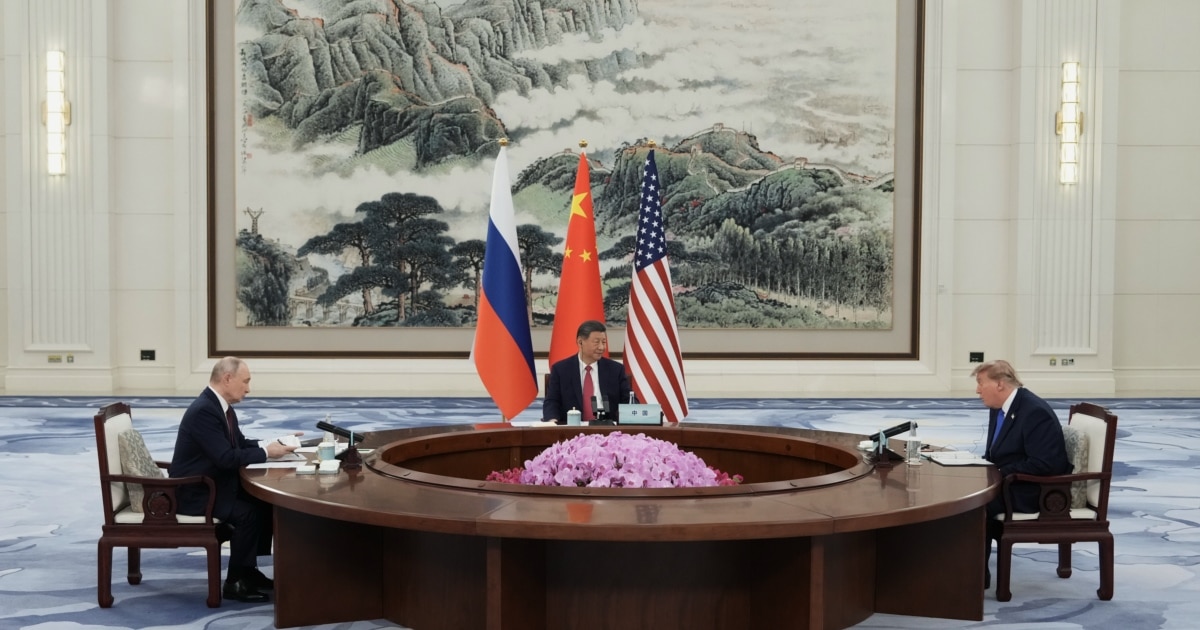
The Table Changes Everything
Three presidents sat at one round table in Shenzhen on November 19th and rewrote the rules of great-power diplomacy without noticing they were doing it. Donald Trump, Xi Jinping and Vladimir Putin convened the first-ever US-China-Russia trilateral summit inside the Qilin Villa, the state guesthouse built for the APEC gathering in Guangdong province.
Trump opened with a line that sounded theatrical but carried structural weight: “We are making history right now.” He followed it with a more practical framing — the United States, Russia and China hold the world’s largest nuclear arsenals and therefore carry a unique responsibility to manage crises that no other institution can touch. That sentence alone tells you where this is heading.
For decades, the architecture of global security has rested on a simple assumption: the United States leads through alliances. NATO handles Europe. Bilateral treaties cover Japan, South Korea, Australia. The UN Security Council exists in theory but has been deadlocked since 2022 over Ukraine. The trilateral meeting in Shenzhen does not replace those structures. It quietly makes them optional.
What Was Actually Discussed
Trump held separate bilateral sessions with both Xi and Putin before the plenary session, which is the standard format when a group this volatile tries to avoid immediate public disarray. Nuclear arms reductions came up first — not as a sweeping treaty framework but as an opening position. Trump framed the conversation around shared interest: the three countries that possess the most warheads should lead on reducing the probability that any of them are used.
Ukraine was the harder item. Trump had already signaled before the summit that he sees a negotiated settlement in Eastern Europe as achievable if Washington engages Moscow directly and Beijing lends diplomatic pressure to Kyiv. Whether Xi will apply that kind of pressure remains the critical variable — and the one neither Trump nor Putin seem ready to discuss publicly.
The Hormuz angle deserves equal attention. Oil shipments through the Strait of Hormuz pass within striking distance of Iranian territory, and Washington’s recent moves to secure tanker routes have brought it closer to Tehran while pushing Moscow and Beijing into a tacit coordination loop. Trump reportedly told both leaders that free passage through the strait is non-negotiable — and that the United States would treat threats to shipping lanes as a multilateral concern rather than a purely American one.
That last point matters. When Trump says the problem belongs to all three powers, he is not just being diplomatic. He is proposing a governance model in which the United States no longer acts as sole guarantor and the other two powers accept shared accountability. It is transactional realism dressed as burden-sharing.
Who Wins and Who Loses
Europe loses first. Not immediately — not in headlines or troop movements — but in relevance. Every time Washington sits down with Moscow and Beijing without inviting Paris, London or Berlin, the credibility of the transatlantic relationship erodes a degree further. The EU has spent years trying to lock the United States into a renewed commitment against Russian aggression. Now the United States is demonstrating that it can work around that commitment entirely when it suits its interests.
Japan and South Korea occupy the middle ground. They depend on Washington for deterrence against North Korea and China, but they also face Chinese economic gravity pulling them inward. If the trilateral framework produces results on Ukraine or Iran that these two allies cannot achieve through their own diplomatic channels, Seoul and Tokyo will be forced to recalibrate — possibly toward a posture of tactical neutrality rather than strategic alignment.
India watches closely. New Delhi has positioned itself as a bridge between the Global South and Western institutions precisely because it refused to pick a side on Ukraine. A working trilateral between Washington, Beijing and Moscow removes part of India’s strategic leverage. The Quad becomes less indispensable when the US-China-Russia axis starts functioning independently of it.
The losers among states are clearer than the winners. Small economies that rely on stable maritime corridors benefit only if the trilateral keeps the peace. If it fractures — and there are already signs of friction beneath the ceremonial warmth — the costs fall on shippers in the South China Sea, the Gulf of Oman and the Baltic.
The Second-Order Effects Nobody Is Talking About
The most consequential outcome of Shenzhen may not appear until months from now. A standing mechanism for direct talks between the United States, China and Russia changes the calculation for every regional conflict — Syria, Myanmar, Venezuela, Sudan. When the three powers can meet informally outside institutional constraints, they gain the ability to arbitrate disputes that previously required exhausting multilateral processes or prolonged proxy warfare.
It also changes the internal politics of each capital. In Washington, hawks will argue that Trump legitimized a regime that invaded a sovereign neighbor. In Beijing, hardliners will read the summit as confirmation that the United States can be managed through selective engagement rather than containment. In Moscow, the message is simpler: Russia is once again treated as a peer rather than a pariah.
None of those readings are mutually exclusive. That is the point of multipolar deal-making — it lets each actor believe they got what they wanted without requiring consensus on fundamentals.
What Happens Next
A joint communique is expected after the summit ends, but the language will likely be deliberately vague. The real content of trilateral diplomacy at this level lives in closed sessions, not press releases. What matters going forward is whether Washington treats future crises through a trilateral lens or reverts to its traditional alliance-first approach.
If the former path holds, expect quieter negotiations on Ukraine involving Chinese intermediaries, a more explicit US-Russia dialogue on nuclear risk reduction and coordinated messaging on Iran that sidelines European voices. If the latter path returns, Shenzhen will be remembered as an interesting moment rather than a turning point.
History is not made by individual summits. It is made when one summit becomes the template for a hundred smaller ones. The question for Europe, for Asia and for every country that benefits from rules-based order is whether Shenzhen is the beginning of that pattern or merely a single photograph around a round table.