Why the US Is Considering MOAB Against Iran — and What It Reveals
The US is weighing a MOAB strike on Iran's energy and nuclear sites before the midterms. But military insiders doubt the weapon's effectiveness against underground facilities — suggesting the real target may be domestic politics, not Tehran.
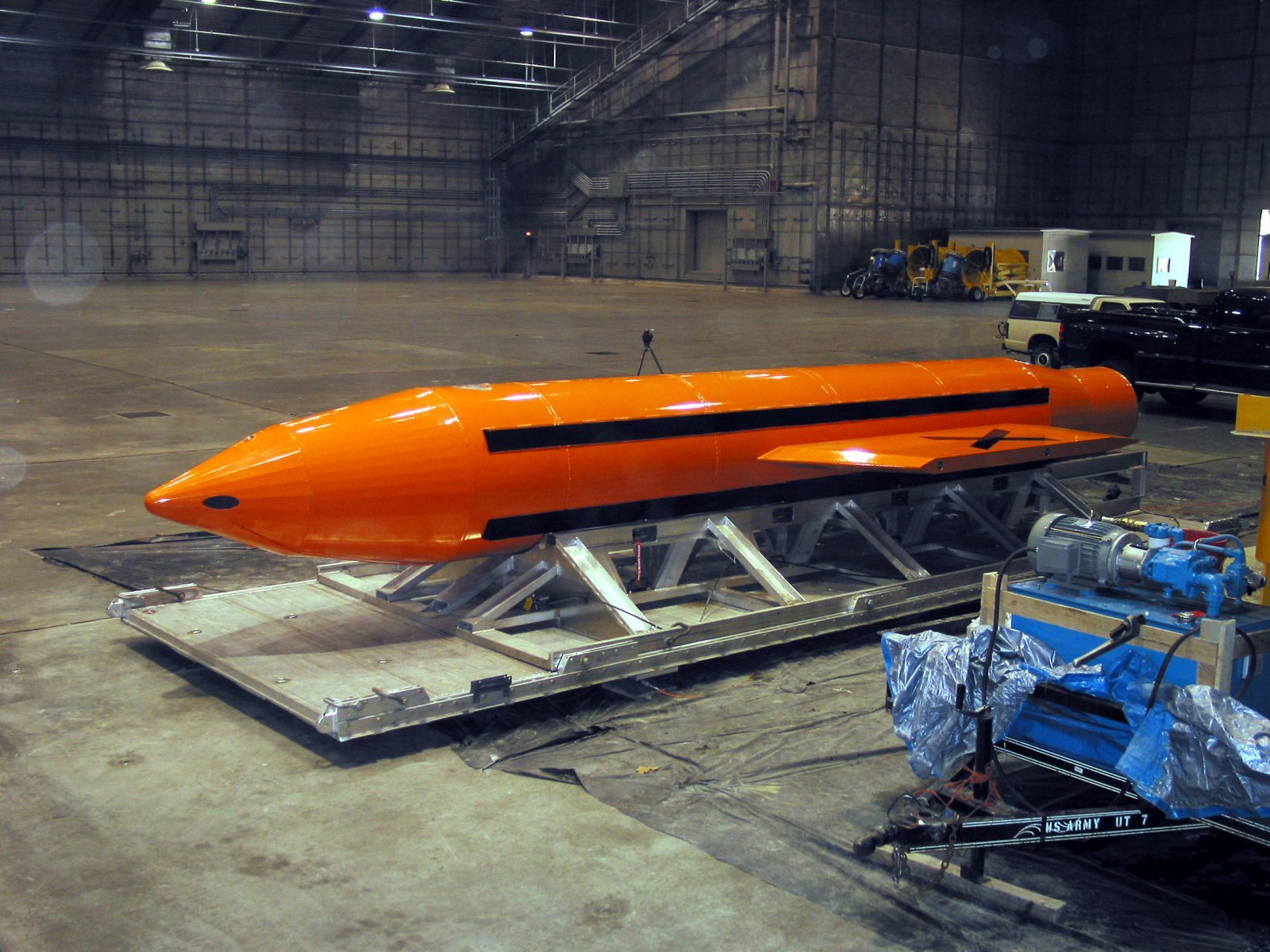
The bomb is real. The plan may not be.
American officials are discussing the use of the GBU-43/B, known colloquially as the Mother of All Bombs, against Iran. That much is confirmed by CNN, citing multiple US officials with direct knowledge of classified discussions inside the Pentagon and the White House. What is less clear — and far more consequential — is why the weapon is on the table at all.
The MOAB weighs roughly 9.8 tons. It is the most powerful non-nuclear bomb in the US arsenal. It has been used in combat only once: in 2017, during Donald Trump’s first term, to destroy ISIS tunnel networks in Afghanistan’s Nangarhar province. It is designed to level terrain, collapse structures, and create shockwaves across wide areas. It is not designed to penetrate deep underground. This is not a subtle distinction — it is the central fact that any serious assessment of this proposal must confront.
The underground problem
Iran’s most critical nuclear infrastructure sits inside the granite mountains at Fordow — known in some reporting as Peok-aek-san, or Pickaxe Mountain, a reference to the facility’s location within a steep, fortress-like ridge. The facility is buried deep beneath rock, shielded from aerial bombardment by design. Intelligence assessments estimate that Fordow’s key enrichment halls lie hundreds of feet below the mountain surface, surrounded by layers of hardened concrete and solid bedrock.
Even the largest conventional bombs in the American inventory struggle to reach targets at that depth. The MOAB, for all its destructive power above ground, lacks the hardened penetration warhead needed to breach such fortifications. Multiple US officials told CNN that Pentagon insiders openly question whether the MOAB can damage the Fordow complex at all — and some believe it would have virtually no effect on the facility’s core operations.
One official described the weapon bluntly to CNN: it is a large-scale psychological operations tool, not a bunker-buster. Its value lies in what it represents, not what it can physically destroy at depth. In other words, the very weapon being discussed as a centerpiece of a new strike plan is militarily ill-suited to the very target it is supposedly meant to hit.
The fireworks theory
Some officials, CNN reports, have compared the proposed operation to a “fireworks show.” The idea is not to achieve a decisive military outcome. It is to display overwhelming force, create the appearance of a winning operation, and give the president political cover to declare victory and withdraw.
The timeline fits that reading. The strikes would reportedly be ordered after Trump’s directive and could occur around early November — close to the US midterm elections. The goal, according to one official’s assessment, would be to launch additional attacks on Iranian energy infrastructure and surface-level nuclear sites, then pull CENTCOM forces out of the region before the political clock runs out.
This is not the first time Washington has contemplated performative strikes with an eye toward domestic timing. The 2020 killing of Qasem Soleimani was similarly assessed by some analysts as timed to maximize political impact. But the MOAB discussion carries a different weight — because the weapon itself is both more spectacular and less effective than the options considered in 2020.
Trump has publicly stated he will not order further action before the midterms. But CNN’s reporting suggests his staff are uncertain whether that stance is fixed or flexible. The gap between the public promise and the private planning is where the real story lives — and it reveals an administration grappling with how to exit a conflict it inherited without looking like it surrendered.
What this reveals about American war strategy
The MOAB discussion exposes a deeper logic at work in Washington’s approach to Iran. The administration wants out of the conflict without appearing to have lost. But it also wants to leave with something it can sell domestically — a moment of demonstrated resolve, a headline that translates into political capital.
A full ground invasion is off the table — at least publicly. Officials acknowledge that defeating Iran decisively on the ground would require thousands of additional troops and likely cost thousands of American lives. No one in the current administration is aggressively advocating for that option. The memory of Iraq and Afghanistan weighs heavily, and the political cost of another prolonged ground war in the Middle East is understood to be prohibitive.
So the alternative is a limited but spectacular air campaign. Hit energy facilities. Hit nuclear sites — or at least the surface-level infrastructure around them. Withdraw. Declare success. The MOAB is the visual anchor of that strategy. It is dramatic. It is terrifying. It carries the kind of symbolic weight that translates into television images and headline cycles. It is, in many ways, the perfect weapon for a war that is as much about American politics as it is about Iran.
But the strategy rests on a precarious assumption: that a single dramatic strike will produce the political effect the administration desires. History offers little comfort on that point. The 2003 invasion of Iraq was sold as a swift, decisive operation that would end quickly and leave America stronger. It did not. The 2011 intervention in Libya was similarly framed as a limited operation. It unraveled.
Second-order effects: what happens after the blast
The human cost on the ground is only the beginning. There is a cascade of consequences that any serious assessment must account for — consequences that the current planning seems to treat as secondary or even incidental.
Strikes on Iranian energy infrastructure would send shockwaves through global oil markets. Iran is a major producer, and any sustained disruption to its exports would tighten supply just as the US faces its own energy price pressures heading into the election cycle. The price of gasoline at the pump is one of the most politically sensitive indicators in American democracy, and a spike driven by Middle East instability could undermine the very political gains the administration hopes to capture.
Regionally, the implications are equally destabilizing. An American strike on Iran would almost certainly trigger retaliatory action from Iranian proxies — Hezbollah in Lebanon, Houthi forces in Yemen, militia networks across Iraq and Syria. Israel would face renewed rocket fire from the north. Gulf states hosting US bases would become immediate targets. The conflict would not stay contained within Iran’s borders, regardless of how limited the initial strike appears on paper.
There is also the question of what Iran does next with its nuclear program. If the US strikes Fordow and fails to destroy the facility — which military experts consider likely — Tehran could interpret the attack as confirmation that its underground program is its only guarantee of survival. The result could be a hardened, accelerated push toward weaponization rather than a rollback. The strike intended to degrade Iran’s nuclear capacity could instead ensure its completion.
The human cost on the ground
There is another dimension that often gets lost in strategic analysis: the civilians living near Iran’s energy infrastructure. Strikes on refineries, storage depots, and petrochemical plants in populated areas would almost certainly cause significant casualties. The MOAB’s blast radius is enormous. It does not discriminate. In a country where urban development has expanded to the edges of industrial zones, the civilian toll would be immediate and severe.
This is not speculation. It is basic physics. And it is a consequence that Washington appears prepared to accept in pursuit of its political objectives — or, more charitably, one that officials believe they can mitigate through precision targeting and warnings. The gap between those assumptions and the reality of urban warfare in a country as complex and densely settled as Iran is where the moral and strategic reckoning will come.
What comes next
The Pentagon and White House have declined to comment on the specifics of any strike plan. That is standard procedure. But the fact that such a plan is being discussed at this level — involving the most powerful conventional bomb in the US arsenal, aimed at a nation that is not formally at war with America — is itself a signal.
It signals that the administration is preparing for an escalation it hopes to control. It signals that military options are being wired for a political exit. And it signals that the line between warfare and performance art is thinner than most commentators are willing to admit.
For allies in the region — South Korea, Japan, Israel, the Gulf states — the implications are immediate and troubling. An American strike on Iran, even a limited one, would ripple through energy markets, security arrangements, and alliance dynamics. The MOAB itself is almost secondary to the question it raises: what does Washington want this war to look like when it ends? And more importantly, does anyone in a position to make decisions have a coherent answer to that question?
If the answer is “a victory that looks like victory,” then the bomb is not the weapon of choice. The timing is. And in a conflict as consequential as this one, timing alone is not a strategy — it is a gamble. The question that remains is whether the American public, and the world, are prepared to live with the consequences of that bet.