US Strikes Near Hormuz Signal a Bolder Iran Strategy
US forces hit two IRGC rocket launch sites on Iran's Larak Island after detecting preparations to lay sea mines in the Strait of Hormuz. The strikes mark the most direct confrontation since late April and risk reigniting a spike in global oil prices.
A Month of Relative Quiet Ends Overnight
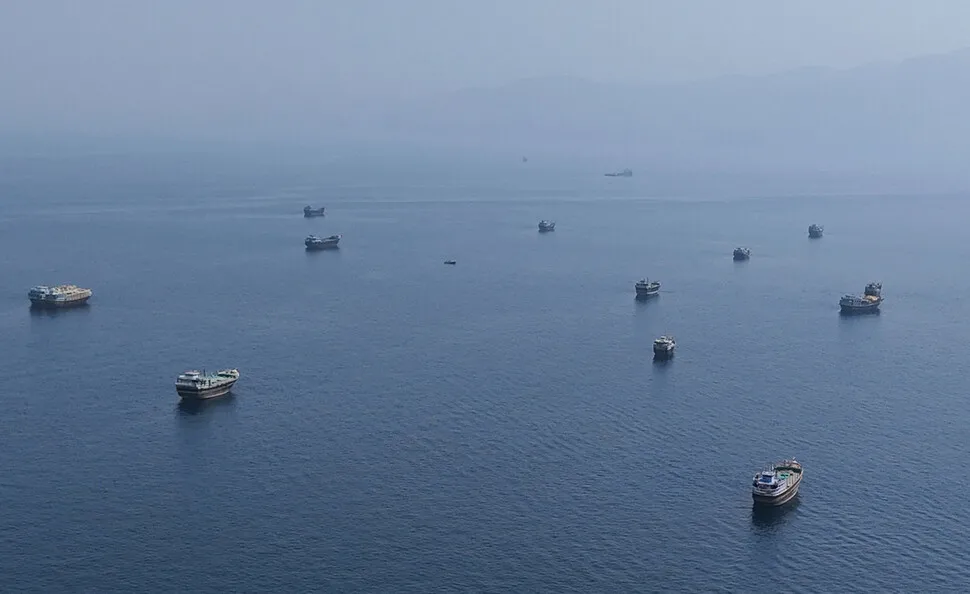
The United States struck two Iranian Islamic Revolutionary Guard Corps rocket launch sites on Larak Island on the 30th — the first direct US-Iran military engagement in over a month. The target choice is not arbitrary. Larak sits at the narrowest approach to the Strait of Hormuz, a waterway through which roughly one-fifth of global petroleum consumption passes every day.
CENTCOM confirmed the operation. Spokesperson Team Hawkins said intelligence showed IRGC personnel preparing to launch sea mines carried on rocket platforms toward the strait. The message, clear and deliberate: Washington will not tolerate mining the chokepoint.
The timing of the strike — executed under cover of darkness by unmanned aerial systems operating from nearby naval assets — suggests a months-long intelligence cycle rather than a reactive decision. Satellite imagery, signals intercepts, and possibly human sources painted a picture of IRGC engineers rigging naval mines onto modified launch rails along Larak’s southern shore. By the time the order came down from the Pentagon, the window for interdiction was narrowing. The strike was both a tactical intervention and a strategic declaration.
Why This Moment Matters
The timing carries more weight than the strike itself. For weeks after the US launched large-scale retaliatory operations on April 29, the Trump administration shifted its emphasis away from kinetic military action and toward economic pressure — freezing Iranian assets, tightening sanctions, and attempting to strangle Tehran’s financial lifelines. The pivot was interpreted by many analysts as a recalibration, a signal that Washington preferred cost-effective coercion over open warfare.
This strike reopens that question. It reveals a tension that has run through Trump’s Iran policy from the start: the coexistence of maximum-pressure economics with intermittent military demonstrations. The administration now faces the same calculus it faced in January, when drone strikes killed a senior IRGC commander in Baghdad — a tactical success that risked strategic blowback.
Trump himself had laid the groundwork five days earlier, telling CENTCOM to report on mine clearance and warning that any vessel attempting to lay mines in the strait would face immediate destruction. Today’s operation appears to be the first test of that threat — and the first concrete demonstration that the administration is willing to follow through with force rather than words alone. But the broader policy question remains unanswered: Is Larak a one-time warning, or the opening move in a sustained campaign to physically guarantee freedom of navigation?
What Was Actually Hit
Larak Island lies just off Bandar Abbas, Iran’s principal port on the Persian Gulf. The two IRGC launch sites targeted are positioned to cover the strait’s shipping lanes. According to preliminary reports from Iran’s Tasnim news agency, two people were killed and two wounded in the drone strike. The IRGC called it a “strategic and fatal mistake” by the Trump administration and vowed retaliation across both economic and military domains.
The casualty count is small by the standards of the exchanges that have punctuated US-Iran relations this year. But the symbolism is enormous. This is not a distant border skirmish. This is a strike on Iranian soil in direct proximity to the world’s most consequential energy chokepoint.
What makes the targeting especially significant is the nature of the installations destroyed. These were not permanent hardened bunkers or deeply buried command centers. They were exposed, semi-mobile launch platforms — exactly the kind of infrastructure designed for quick deployment and rapid withdrawal. Striking them signals that Washington is willing to hit the tools of escalation before they are even fully operational, a pre-emptive posture that departs from the more reactive logic of previous engagements.
The Shipping Threat Is Real
On the same day as the Larak strike, a tanker heading into the Gulf was hit by an unidentified projectile approximately 12 nautical miles north of Muscat, Oman, according to the UK Maritime Trade Operations group. No injuries or environmental damage were reported, and investigations are ongoing. That incident, whether or not it is linked to today’s escalation, underscores the fragility of commercial navigation in the region.
The Strait of Hormuz is not a wide ocean passage. At its narrowest point, it measures roughly 21 nautical miles. Mining operations, even small-scale ones, can effectively block lanes used by supertankers carrying crude from Saudi Arabia, the UAE, Kuwait, Qatar, and Iraq. A single successful mining event could push oil prices higher within days. A sustained campaign could disrupt supply for weeks.
The threat is not abstract. In 2019, Houthi and Iranian-backed attacks on tankers in the strait sent Brent crude spiking nearly 20 percent within a month. In 2021, a flare-up of hostility between Iran and Israel triggered a brief but sharp rally in energy prices before diplomats managed to de-escalate. Today’s strikes come against the memory of those disruptions, and the market has already priced in heightened risk.
Second-Order Effects and Regional Reactions
The ripples from the Larak strike are already spreading beyond the immediate theater. Gulf Cooperation Council states, particularly Saudi Arabia and the UAE, have long relied on US naval presence to secure the strait. A successful deterrence campaign could reinforce their confidence in American security guarantees. A failure — if Iran simply relocates its mining operations or escalates in some other direction — would force Riyadh and Abu Dhabi to reconsider their own posture, potentially accelerating arms purchases and bilateral defense arrangements that bypass Washington.
Israel, already engaged in a multi-front conflict with Iranian proxies, watched closely. Any Iranian retaliation that draws Israeli infrastructure into the crossfire would entangle a third party in a war Washington has so far kept narrowly focused. Tel Aviv has every incentive to prevent that scenario, even as it benefits from the degradation of Iranian military capabilities.
China and India, the strait’s largest consumers of Gulf oil, issued cautious statements calling for restraint but stopping short of condemning the US strike. Beijing’s calculus is complicated. It depends on Iranian oil — nearly 15 percent of its crude imports flow from Iran — but it also depends on the uninterrupted flow of Gulf energy to sustain its economy. Shanghai has every reason to prefer diplomacy over gunfire, but it also has little leverage to impose that preference on either side.
Who Wins, Who Loses
Washington wins if the strike deters further Iranian mining attempts and reassures allies and commercial shippers that the strait remains open. The Biden-era framework for freedom of navigation in the Gulf relied on deterrence through presence; the Trump approach adds deterrence through precision strikes on specific threats. Both aim for the same outcome.
Iran loses face and potentially lives. The IRGC has staked its credibility on its ability to control the strait, and today’s strike shows it cannot defend every position. If Tehran escalates in retaliation — targeting Israeli infrastructure, attacking Gulf-state facilities, or attempting a larger-scale mining operation — it risks drawing in allies of the United States and inviting a broader conflict that would devastate regional economies.
Global energy markets lose either way. A spike in uncertainty premiums is already pricing into Brent and WTI. If the strike triggers a chain reaction of mine-laying and counter-strikes, the premium becomes a crisis. Futures traders are watching the 80-dollar-per-barrel level on Brent with particular anxiety. A breach above that threshold would send shockwaves through inflation-sensitive economies and force central banks to reconsider rate trajectories already calibrated to a soft landing.
What Happens Next
Iran’s leadership has promised retaliation. The question is what form it takes. A direct attack on US forces would risk a full-scale exchange. An attack on commercial shipping would escalate the humanitarian and economic dimensions without a clear military target. Attacks on Gulf-state energy infrastructure would directly threaten the flow of oil — the very thing the US says it is trying to protect.
The Trump administration now faces a harder choice than it did a month ago. Economic pressure alone cannot prevent Iranian tactics that fall below the threshold of open warfare. Mining the strait, harassment of commercial vessels, and proxy attacks are deliberately designed to exploit that gap. Military responses are effective but politically costly.
Domestic politics add another layer of complication. The strike arrives in an election year, and any escalation that drives up gasoline prices at the pump will be weaponized by opponents regardless of who bears responsibility. Conversely, perceived weakness on Iran — especially after the administration’s own public warnings — will be framed as capitulation. Trump has staked his foreign-policy credibility on being tough enough to deter Iran without starting another Middle Eastern war. Larak is a test of that balance.
The Road Ahead
The Larak strike was a tactical success. Whether it achieves strategic deterrence depends on what happens in the days ahead. One thing is certain: the quiet period of relative de-escalation is over. Iran will respond, either through direct military action, proxy activations, or asymmetric measures against civilian targets. The US will have to decide whether to absorb the retaliation or escalate further, and each choice narrows the path back to calm.
The Strait of Hormuz has survived decades of tension precisely because the costs of closing it were understood by everyone involved — including Iran. That shared understanding is fraying. The strikes on Larak proved that Washington can reach Iranian positions it previously treated as off-limits. The more dangerous question is whether Tehran still believes the same about American red lines. The answer will determine whether the next chapter in this confrontation stays contained — or explodes beyond the strait.