Valve's Steam Frame VR Headset Is a $1,300 Gamble on Wireless Future
Valve's first standalone VR headset launches in Japan at ¥200,000 — a premium price that signals the company's bet on wireless immersion over PC-tethered hardware. The question is whether Japanese gamers will pay up.
Valve’s $1,300 VR Bet Lands in Japan
Valve shipped its first standalone VR headset Wednesday, and it costs exactly what you’d expect from a company that just entered the room: a lot.
The Steam Frame launched in Japan, Taiwan, and Hong Kong through KOMODO STATION — Valve’s own online store operated by Japanese distributor KOMODO — at ¥199,980 for the 256GB model and ¥244,980 for the 1TB version. That translates to roughly $1,300 and $1,600 USD respectively, putting it firmly in luxury territory for a VR headset.
The price is the story here. Meta’s Quest 3 started at $499 when it shipped in 2023. Pico’s 4 came in at $399. Apple’s Vision Pro, which Valve is clearly not trying to replicate, launched at $3,499. The Steam Frame sits in an awkward middle ground — premium enough to signal serious ambition, expensive enough to make casual buyers walk away.
But this pricing decision carries implications beyond immediate sales numbers. By positioning the Steam Frame in the $1,300 tier, Valve is effectively ceding the volume market to Meta while carving out a niche for enthusiasts who already own gaming PCs and are willing to pay for wireless freedom. It’s a deliberate narrowing of the target audience that mirrors Valve’s historical approach: build for the people who care most, then let the ecosystem expand outward. Whether that strategy works for hardware — a category where scale matters enormously — remains the open question.
What You Actually Get
The hardware tells the real story. Dual LCD panels at 2160x2160 per eye, 72Hz to 144Hz variable refresh, and a Snapdragon 8-series processor with 16GB RAM running SteamOS. That’s the standalone engine — no PC required for supported titles.
But the real innovation is how Valve handles PC streaming. The headset ships with a dedicated 6GHz wireless adapter that creates a separate connection path from your Wi-Fi, eliminating bandwidth contention with home networks. Combined with foveated rendering — which uses eye-tracking to prioritize detail where you’re actually looking — Valve claims it achieves a tenfold improvement in effective bandwidth for the same visual quality.
That’s not incremental. A tenfold bandwidth efficiency gain changes what’s possible over wireless. It means higher resolutions, lower latency, and fewer artifacts than current wireless VR solutions can deliver. If the claim holds up in practice, it’s significant. Foveated rendering has been theorized for years, but implementing it at consumer VR scale with low enough latency to remain imperceptible is a different challenge entirely. Valve’s eye-tracking system must run continuously, map gaze position, and dynamically adjust rendering quality in real time — all without introducing motion-to-photon latency that breaks immersion.
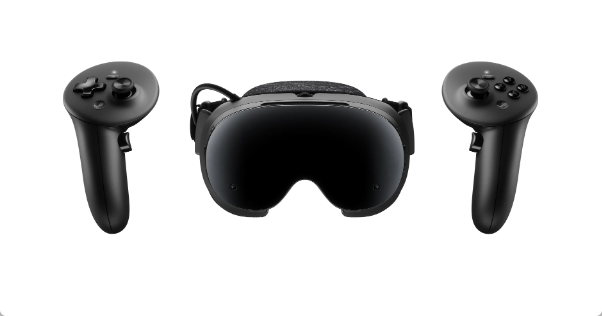
The controller is equally deliberate. It features a d-pad, ABXY buttons, thumbsticks with capacitive finger sensors, triggers, and bumpers — all the inputs a traditional PC gamer expects. Valve chose buttons over hand tracking, which is notable. Hand tracking promised ubiquity but underdelivered in practice, struggling with precision in complex interactions. The Steam Frame’s controller suggests Valve learned that lesson — or at least accepted that tactile feedback and discrete inputs remain essential for the experiences that justify a $1,300 purchase.
Four outward-facing monochrome cameras handle positional tracking, with infrared LEDs for low-light environments. It’s a proven approach that avoids the complexity of inside-out hand tracking while maintaining room-scale accuracy. The monochrome cameras likely enable more precise depth estimation than color sensors, which is critical for reliable room mapping and controller tracking in varied lighting conditions.
The Japanese Context
Japan is an interesting first market. The country has historically been slower to adopt standalone VR headsets compared to Western markets, with PC VR setups and arcade experiences dominating the landscape. Japanese arcades pioneered VR attractions in the 2010s, and the culture of communal, experience-driven entertainment still carries weight. Solo home VR adoption has lagged accordingly — until now.
But Japanese consumers also tend to pay premiums for hardware that signals quality — the Switch OLED launched at ¥37,980 in Japan versus $349 in the US, and it sold well. The ¥200,000 price point is ambitious but not unprecedented. High-end audio equipment, professional cameras, and limited-edition gaming hardware regularly sell at similar prices in Japanese retail. What matters is framing: Valve isn’t selling a toy. It’s selling a piece of computing infrastructure for people who take their virtual experiences seriously.
There’s also a cultural factor worth noting. Japanese gaming culture values precision, polish, and ecosystem integration — all areas where Valve has quietly accumulated deep expertise over two decades. The Steam platform’s game library, while Western-leaning, has invested heavily in Japanese titles and developer relationships. For Japanese gamers who already inhabit the Steam ecosystem, the transition to a Valve headset feels less like a brand switch and more like an extension of an existing commitment.
KOMODO STATION’s role matters too. This is Valve’s first attempt at a direct-to-consumer storefront outside the US. Operating through a Japanese distributor gives Valve local logistics support, language handling, and consumer trust without building infrastructure from scratch. If the model works — and Korean launch details are already being finalized — it could become a template for other Asian markets where Valve lacks the brand recognition to operate independently.
Second-Order Effects
The implications of the Steam Frame extend beyond Valve’s own revenue. Game developers now face a new hardware target with specific performance characteristics. The 6GHz adapter and foveated rendering pipeline mean PC VR games optimized for the Steam Frame could achieve wireless performance that previously required wired connections — potentially unlocking a generation of titles that were designed around cable constraints and now get freed from them.
Conversely, this puts pressure on Meta to justify its own pricing. The Quest 3’s $499 entry point has dominated the market, but if the Steam Frame delivers genuinely superior wireless PC VR experiences, Meta faces a widening quality gap at the premium end. We may see Meta respond with either a higher-tier device or accelerated development of next-generation wireless tech. Either path requires investment that comes from market share, creating a feedback loop that benefits consumers but challenges both companies’ margins.
The arcade industry may feel indirect pressure too. Japan’s VR arcade ecosystem has thrived partly because home equipment couldn’t match commercial-grade experiences. If the Steam Frame closes that gap for high-end PC VR titles, some arcade operators could see demand soften — particularly for experiences that translate directly to personal hardware.
There’s also a software ecosystem dimension. SteamOS on the Steam Frame gives Valve a platform layer that extends beyond games into streaming, desktop VR, and potentially content creation tools. The company has spent years building the software infrastructure — SteamVR, input systems, controller profiles, game libraries — and the Steam Frame is the first hardware that lets all those pieces cohere. If developers recognize a viable installation base, we could see a wave of Steam Frame-optimized titles that wouldn’t have been feasible with a wireless adapter as an afterthought.
Who Wins, Who Loses
PC VR enthusiasts win if the streaming quality lives up to the promises. The 6GHz adapter plus foveated rendering could deliver an experience that actually competes with wired setups — something no wireless solution has achieved convincingly until now. For people who’ve tolerated cables as the cost of quality, the Steam Frame represents a genuine liberation.
Casual VR buyers lose. At $1,300, this isn’t a device for someone who bought a Quest 2 on sale. It’s for people who already own a gaming PC and want a premium wireless upgrade. The addressable market is narrow by design.
Meta is the most obvious competitor, but the Steam Frame isn’t really competing with the Quest 3. It’s competing with the Index — Valve’s own dead product — and asking whether wireless has finally made wired headsets unnecessary. If the answer is yes, Valve just made its own hardware irrelevant by making its best idea work without the cable. That’s a paradox worth sitting with: the Steam Frame’s success could erase the very problem it was designed to solve.
What Happens Next
Korea is next, according to the press release. Then potentially other Asian markets through KOMODO’s distribution network. The SteamOS software platform gives Valve a way to monetize beyond hardware — app stores, subscriptions, and the existing Steam ecosystem all become relevant. But software revenue in VR has historically been thin, and Valve’s track record with hardware margins suggests the company isn’t banking on recurring revenue to make this viable.
The real test is whether the foveated streaming claim holds up when players actually use it. Ten times bandwidth efficiency is a bold number. If it delivers, wireless VR gets a genuine leap forward and the Steam Frame becomes the reference platform for what wireless PC VR should look like. If it doesn’t — if the eye-tracking latency introduces artifacts, or the rendering optimization fails to materialize in real-world titles — the Steam Frame becomes an expensive proof of concept that slows rather than accelerates adoption.
Valve has spent years building software infrastructure for VR. The Steam Frame is the first time that software meets custom hardware. The price says this isn’t for everyone. The specs suggest it’s for the people who matter most — the ones who’ll push the technology forward and create the proof point that makes the next generation cheaper and better.
The question isn’t whether the Steam Frame will sell in volume. It’s whether Valve’s hardware bet pays off when the software ecosystem finally catches up to the ambition. If the company’s patience with player one continues to reward it — and history suggests it will — the Steam Frame may be remembered not as a commercial triumph but as the moment wireless VR stopped being a compromise and started being a choice.