Wall Street to Tehran: How US Banking Sanctions Re-route Asia
The US is targeting banks first in its expanding Iran sanctions campaign, not just blocking transactions but cutting financial institutions off the dollar system entirely. For Korean and European firms with Iran exposure, the calculus shifts from risk management to emergency recalibration.
Banks First, Everyone Else Next
The US Treasury did not start with energy traders or shipping companies this time. It started with a bank.
On August 29, Washington slapped sanctions on Banque Misr’s UAE branches — an Egyptian state lender caught up in allegations of facilitating financial flows to Tehran. The move was specific, narrow, and deliberately calibrated. It sent a signal that was easier to read than the previous round of sanctions, which had focused on Iran’s oil revenue and weapons procurement. This time, the message was unambiguous: if your institution handles Iranian money, even indirectly, you are in the crosshairs.
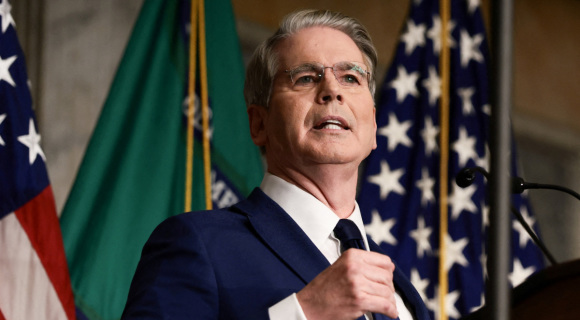
Scott Bessent, the US Treasury secretary, made the strategy explicit the next day at the G20 finance ministers’ meeting in Sydney. He said Washington would release new secondary sanctions on Iran on a weekly basis. Banks are the starting point. The next phase, he said, could involve completely cutting certain financial institutions off from the US dollar-based clearing system — a far more damaging escalation than targeted sanctions on individual entities.
“We’re starting with banks,” Bessent told Reuters. “We’re telling them that holding Iranian funds or supporting the Iranian regime is not acceptable.” He added that companies and institutions in any country that facilitate Iran’s financial transactions would be subject to sanctions, regardless of nationality.
The Dollar Chokepoint
What makes this campaign different from previous US pressure on Iran is the scope and the mechanism. Previous rounds concentrated on Iran’s energy sector — blocking oil exports, punishing buyers of Iranian crude. The secondary sanctions now extend into five commercial sectors: digital assets, gold, technology, aviation, and shipping. But the real weapon is the dollar clearing system. When Bessent floated the idea of cutting institutions out of it entirely, he was describing the financial equivalent of a nuclear option. No dollar access means no access to the global payment system. A bank in Dubai, Seoul, or Shanghai that cannot clear USD transactions is effectively sidelined from international commerce.
The implication for Asian firms is not abstract. Korea’s trade with Iran is not negligible. While exact figures are sensitive, Korean companies have long maintained supply chain links through the Middle East — petrochemicals, construction, automotive parts. European firms face the same exposure. The question is no longer whether to comply with US sanctions but how quickly to unwind relationships that may have been in place for years.
China in the Frame
The most consequential dimension of this escalation involves China. Beijing is widely understood to be the largest buyer of Iranian crude oil, absorbing shipments that would otherwise struggle to find markets. Any expansion of US secondary sanctions to include Chinese financial institutions would represent a dramatic shift — one that could ripple through global trade, US-China diplomatic relations, and the broader architecture of Asia-Pacific supply chains.
For now, Washington has been cautious about directly targeting major Chinese banks. The risk of triggering a broader financial confrontation is real. But Bessent’s framing suggests that caution is conditional, not structural. If Chinese institutions continue to facilitate Iranian financial flows, the precedent set by the Banque Misr action demonstrates that the US is willing to act — and willing to do so iteratively, week after week.
Who Wins, Who Loses
The immediate winners are US Treasury and the enforcement apparatus behind it. A weekly sanctions cadence creates relentless pressure on foreign banks to self-police their Iranian exposure. Losers are any institution — Korean, European, Middle Eastern, or Chinese — that has built revenue streams around Iran-related transactions without adequate compliance infrastructure. The cost of doing business with Iran just moved from a legal risk to an existential one for many firms.
For Asian governments, the dilemma is sharper. South Korea, Japan, and others that depend on Middle Eastern energy imports now face a choice: absorb the economic pain of reduced Iranian supply or risk US financial penalties by maintaining trade links. The usual workaround — routing transactions through third countries or using non-dollar currencies — grows increasingly difficult when the US is explicitly targeting the banking layer of the system itself.
What Comes Next
Expect the next wave of sanctions to follow a similar pattern: specific entity-focused measures announced with public justification, followed by broader systemic pressure on financial institutions that continue to facilitate Iranian trade. The Banque Misr case is likely to become a template — name the institution, cite the violation, demonstrate that geography and ownership do not provide immunity.
Korean companies with Iran exposure should assume they will need to restructure their Middle Eastern operations within months, not years. The weekly sanctions schedule means there is no pause for deliberation. Compliance teams that were previously managing risk are now managing survival. European firms face the same urgency.
The deeper story here is not about Iran alone. It is about the weaponization of dollar clearing as a tool of foreign policy — and the speed with which the US is willing to deploy it against third-country institutions. For Asian businesses, the lesson is blunt: proximity to US financial infrastructure is no longer a shield. It is the very thing that puts you in the line of fire.