Warsh's Hawkish Jackson Hole Speech Clouds Global Rate Outlook
Fed Chair Kevin Warsh's latest inflation warnings are reverberating across global central banks — even as political pressure and internal Fed debates make a September rate hike far from certain. South Korea's Bank of Korea is watching closely, and it may need to recalibrate its own timeline.
A Fed Chair Sits Down, and the Dollar Stands Up
Kevin Warsh did not mince words at Jackson Hole this year. In his keynote address on August 28, he painted a picture of U.S. inflation that was, by his own measure, “more concerning” — a phrase the financial markets interpreted as a clear shift from the deliberate ambiguity of his July FOMC post-meeting press conference. The PCE price index had climbed 3.7 percent year-over-year in July, and the trailing six-month annualized rate sat at 4.1 percent. Both core and headline measures remained stubbornly above the Fed’s 2 percent target.
The market response was immediate. The U.S. two-year Treasury yield climbed 6 basis points to 4.298 percent overnight — a modest but telling signal that bond traders were repricing the possibility of a more aggressive policy trajectory.
But here is what the headlines are missing: Warsh’s hawkish tone is colliding with two powerful countervailing forces — political pressure from Donald Trump and a Fed institution still debating its own governance. The result is a policy environment far more uncertain than the market’s initial reaction suggests.
The Political Elephant in the Fed’s Living Room
No reading of Warsh’s Jackson Hole speech is complete without acknowledging the shadow it casts on an upcoming presidential administration. Trump has been openly hostile to high interest rates, pressuring the Fed for cuts at every opportunity. A Fed Chair who signals readiness to tighten further — even subtly — is not just sending a message to markets; he is picking a fight with a president who controls a significant portion of the American electorate.
Kim Jin-il, a member of the Bank of Korea’s Monetary Policy Committee, captured the domestic mood at the Fed when he told reporters the newly formed task forces — five in total, charged with studying institutional reforms — would keep both hawks and doves within the system in a holding pattern until their results were finalized. Those task forces are expected to deliver final recommendations by year-end, with interim reports likely coinciding with the September FOMC meeting.
In other words: the Fed’s internal structure is in flux. And a Fed that is structurally uncertain is a Fed that is unlikely to move aggressively on rates — regardless of what its Chair says at a symposium in Wyoming.
Economist Ju Won of the Hyundai Research Institute put the odds at roughly 60-40 in favor of a September hold at the current 3.75 percent policy rate. Even a partial pullback from Trump’s position would likely push any rate increase further out, possibly past the November midterm elections, which is political calendar number one for a Fed that still cares about its institutional independence.
South Korea’s Calculus Is More Complicated Than a Rate Follow
For the Bank of Korea, Warsh’s speech is both a risk and an opportunity. On the one hand, the global liquidity squeeze that a more hawkish Fed implies makes the BOK’s own inflation fight harder — a strong dollar and higher U.S. yields tend to drain capital from emerging markets and compress monetary space.
On the other hand, Governor Shin Hyun-song, attending Jackson Hole for the first time since his appointment, made a pointed remark that should be watched closely. “Just because the U.S. raises rates does not mean we must,” he told correspondents in Jackson. “If the U.S. continues to raise rates, the conditions for conducting monetary policy will change, and we will need to reassess then. But mechanically matching the rate differential is not the approach.”
That is a departure from the standard emerging-market playbook. It signals that Shin is willing to differentiate Korea’s policy path from the Fed’s — a significant statement coming from a central bank that has been steadily tightening, having raised rates in both July and August.
The BOK’s dot plot, which Shin himself referenced during a post-meeting press conference on August 27, shows a median projection of 3.25 percent over the next six months — implying one additional hike across four upcoming policy meetings. But that projection assumed a Fed that would move in lockstep. If the Fed holds in September, the math changes.
Ju Won’s assessment is blunt: if the Fed keeps rates at 3.75 percent in September, South Korea’s next hike is likely pushed into next year — and possibly well into it, depending on how the U.S. political landscape evolves heading into the midterms.
What the ECB Should Be Hearing
While the article focuses on the Bank of Korea, the implications for the European Central Bank are equally significant. The Fed’s hawkish pivot — however constrained by politics — sends a ripple through global capital flows. A higher-for-longer dollar environment creates headwinds for European exporters and puts the ECB in an uncomfortable position: fighting inflation at home while managing the currency effects of an aggressive American central bank abroad.
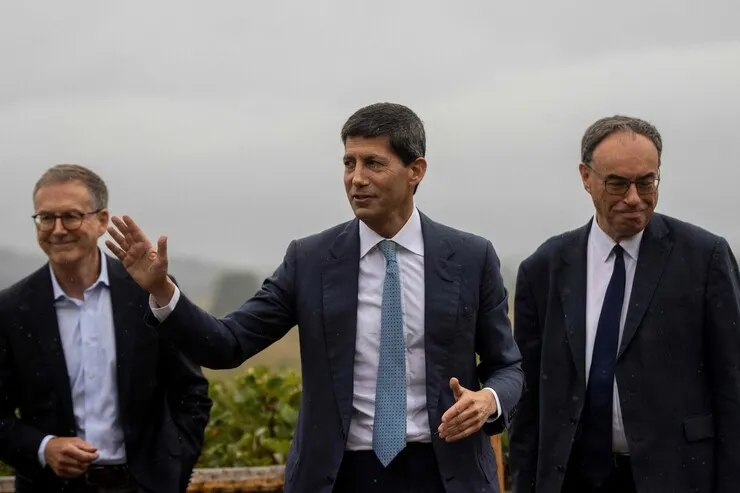
Andrew Bailey, governor of the Bank of England, was also present at Jackson Hole, walking alongside Warsh and Canada’s Tiff Macklem. The triad of Anglo-American central bankers sharing a stage is symbolic of a broader coordination challenge that no amount of joint appearances resolves. Each of these institutions — the Fed, the BoE, the ECB — faces a different domestic political economy, and Warsh’s hawkishness risks amplifying the divergence rather than bridging it.
Who Wins, Who Loses, and What Comes Next
The winners from Warsh’s speech are straightforward: bond holders seeking yield, the dollar, and any emerging-market central bank that needed domestic political cover to justify tightening. The losers are borrowers, speculative capital in rate-sensitive sectors, and any market participant who assumed the Fed’s next move was predictable.
For policymakers in Seoul, Frankfurt, and London, the lesson is clear: a hawkish Fed Chair does not equal a hawkish Fed policy. The institutional reform debates, the political timetable, and the task force timelines all create friction between rhetoric and action. The next data release cycle — especially July and August inflation prints across the G7 — will be the real test.
If Warsh’s Jackson Hole language translates into September restraint, the global rate hike narrative stalls. If it translates into action despite the political pressure, expect a dollar surge and a fresh round of emerging-market volatility. Both scenarios are plausible. Neither is certain.
What is certain is that central banks around the world are now pricing in a Fed that talks tougher than it may act — and that gap between words and deeds is where the next market move will emerge.