Why Minecraft's New Dimension Changes Everything
Minecraft is getting The Sift — its first new dimension since 2011. For a $200M+ creator economy built on infinite gameplay loops, that matters more than any single drop. Roblox and Fortnite are watching closely.
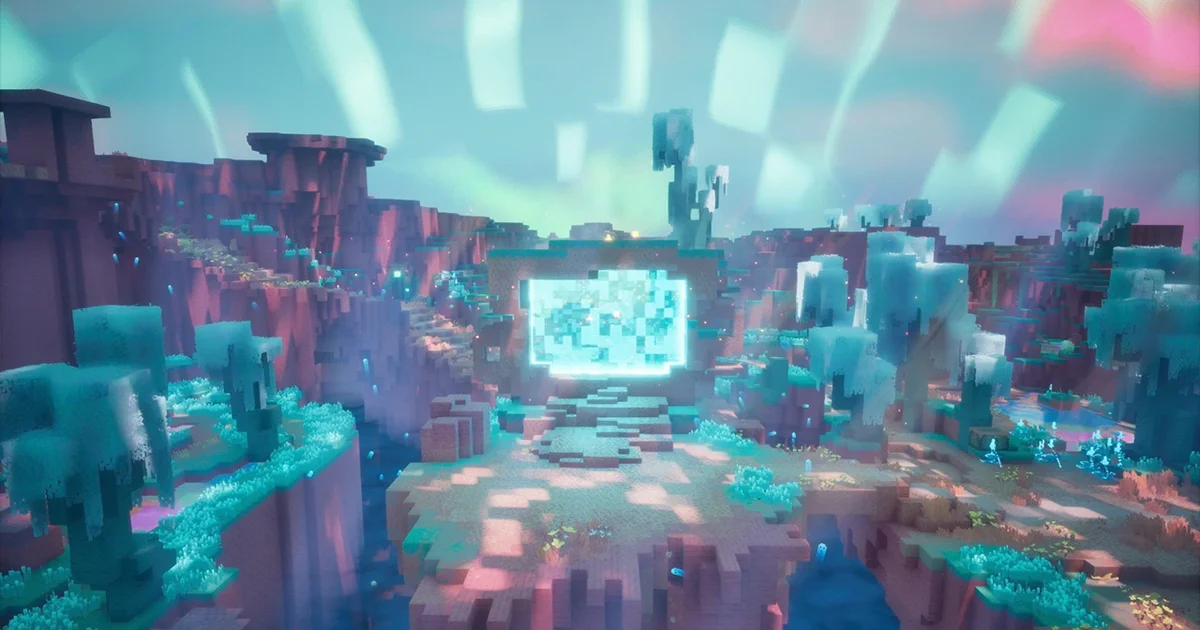
The Sift Is About More Than Blocks
Minecraft is getting its first new dimension in 15 years.
The Sift — announced at Minecraft Live on September 26 and coming to Java and Bedrock in 2027 — is a big deal because it sounds like one. New biomes. New mobs. A fourth explorable realm joining the Overworld, the Nether, and The End. But the real story here isn’t about what The Sift looks like. It’s about what a new dimension unlocks for the massive content-creation economy that has grown up around Minecraft, and why competitors are taking notice.
When Mojang revealed The Sift at Minecraft Live, the chat exploded the way it only does for milestones like the Caves & Cliffs update or the addition of the Warden. This time, the excitement carried a different weight: anticipation isn’t just about a feature, it’s about respiration. Fifteen years is an eternity in gaming. Generations of players have grown up knowing only three realms. A fourth one isn’t just expansion — it’s a homecoming for a community that kept imagining what else could exist beyond the edges of known space.
The Creator Economy Just Got a Major Update
Let’s get a sense of scale first. Xbox CEO Asha Sharma said recently that more than 300,000 players try Minecraft for the first time every single day. The game has sold 425 million copies across 17 years. That means roughly 300,000 new people are encountering its building-and-survival loop daily — and a significant portion of them become content creators, streamers, or server builders. YouTube channels built on Minecraft tutorials, Let’s Plays, and challenge runs generate millions of views per upload. Some of those channels are seven-figure businesses.
The numbers behind Minecraft’s creator economy are staggering and still rising. By some estimates, Minecraft-generated content on YouTube alone accounts for billions of annual views across tens of thousands of channels. The ecosystem includes Notch-era speedrunners, Redstone engineering showcases, roleplay servers with narrative arcs spanning months, and a thriving modding community that has produced titles like OptiFine, Create, and JourneyMap — some of which are essentially standalone games built inside Minecraft’s framework. The revenue generated through ad sharing, sponsorships, and paid communities runs well into eight figures annually, according to industry analysts tracking the space.
Every time Mojang adds a new dimension, the entire ecosystem gets a reset button. The End didn’t just add a new boss fight — it created an entirely new genre of Minecraft content: end-city raids, elytra farming, barter setups. The Nether Update in 2020 reshaped the meta around netherite and ancient debris grinding, spawning a wave of tutorial videos, comparison guides, and optimization strategies that dominated Minecraft search results for years. A new dimension introduces new resources to farm, new enemies to defeat, new strategies to discover. For creators, that’s not a minor patch. It’s a content well that can sustain channels for months or even years.
What makes The Sift particularly significant for the creator economy is timing. The 15-year gap means the community has been running out of novelty. Players have mapped every biome, exhausted most mob farms, and built architectural marvels in every known terrain. The meta is calcified. The Sift disrupts that calcification. It forces a complete reevaluation of strategy, resource management, and building philosophy — the exact conditions that produce breakout content.
The Sift will arrive first in Minecraft Dungeons 2 on September 29, 2026, giving Mojang a 12-month preview period. That head start means content creators will have a full year to build Dungeons 2 gameplay around The Sift before the dimension hits the main game. It’s a smart staggered rollout — like showing a trailer before the movie opens. But it also means the creator economy gets a two-phase windfall: the initial Dungeons 2 surge, followed by the larger main-game reveal. Creators who invest early will have a year of head starts on their competitors when The Sift lands in 2027.
Why Roblox and Fortnite Should Care
Here’s what the rest of the industry sees when Mojang announces The Sift: a game that is still pulling in 300,000 new players daily after nearly two decades. That’s not nostalgia. That’s an active, growing platform.
Roblox faces this every day. Its value proposition is user-generated experiences, and Minecraft has always been its spiritual ancestor — a blocky sandbox where you build whatever you want. But Roblox’s problem is retention. Kids download Roblox, play for a few weeks, then drift. Minecraft’s stickiness is unmatched. A new dimension isn’t just a feature drop for Minecraft; it’s a reminder that the simplest game design — dig, build, survive — is also the hardest to kill.
The dynamics between Roblox and Minecraft are more nuanced than the surface comparison suggests. Roblox positions itself as a platform — a toolbox for creating experiences — while Minecraft is a product that happens to enable creation. But the lines are blurring. Roblox has invested heavily in 3D building tools and physics engines to close the gap on Minecraft’s creative depth. A new dimension announcement from Mojang signals that the gap may actually be widening, not closing. Roblox’s competitive moat has always been its distribution network and social graph, but Minecraft’s creator economy generates content that Roblox can’t replicate natively: curated, high-production gameplay that reaches audiences Roblox struggles to convert into loyal users.
Fortnite operates on a different model, built around live events and seasonal updates. But Fortnite’s creative mode has been trying to become the thing Minecraft already is. A Minecraft dimension drop floods Fortnite’s creative community with a different kind of inspiration: open-ended survival and building, not the tighter, event-driven loop Fortnite relies on. When The Sift arrives, expect a wave of Minecraft-inspired maps on Fortnite Creative — and another reminder that Minecraft owns that space natively.
Fortnite’s Creative mode has seen fluctuating engagement since its launch, with peak periods driven by viral map collaborations and celebrity partnerships. But the core question remains: can Fortnite Creative offer something that feels as alive and endless as Minecraft’s world? A new dimension is a powerful answer to that question, because it demonstrates that Minecraft’s internal engine — the thing that makes digging, building, and surviving feel infinite — is self-renewing in a way Fortnite’s event-driven model cannot match. Every season, Fortnite resets. Every dimension, Minecraft expands.
The 2027 World and What Comes Next
Mojang is also betting big on physical experiences. Minecraft World opens at Chessington World of Adventures Resort in London in 2027 — featuring the world’s first Minecraft rollercoaster and a hotel where you can sleep in themed rooms. This is Microsoft’s playbook: extend the brand beyond the screen entirely.
The physical expansion is more than a revenue diversification play. It’s a cultural statement. When a video game gets a theme park, it has transcended being entertainment and become infrastructure — something you live inside, not just consume. Disneyland, Six Flags, and Universal Studios have built empires on immersive worlds. Minecraft World places a video game game in that lineage, and the economics are compelling. Theme park attendance generates ticket revenue, hotel stays extend visit duration, merchandise sales amplify the brand. But more importantly, these physical spaces generate cultural moments that feed back into the digital ecosystem. A family visiting Minecraft World comes home with a deeper attachment to the IP — and a higher likelihood of purchasing the game, subscribing to Realms, or engaging with creator content.
For the creator economy, the physical world expansion matters more than it might seem. Theme parks and hotels generate mainstream press coverage that pulls in casual players — the same 300,000 daily newbies Sharma mentioned. Each one is a potential content creator. Each one needs guidance, tutorials, and entertainment. That’s the funnel.
Consider the feedback loop: a parent visits Minecraft World with their child, buys the game as a souvenir, the child starts playing, uploads their first build to YouTube, and becomes part of the creator economy. The physical experience lowers the barrier to entry for someone who might have considered Minecraft too abstract or too complex without that tangible anchor. It transforms the game from a digital product into a lived experience, and lived experiences generate more loyal fans than downloaded products ever could.
Mojang is holding back most details about The Sift itself, which is typical corporate strategy for a reveal this early. But the pattern is clear: a new dimension, a new Dungeon’s game, a new physical theme park — all converging in 2026 and 2027. This isn’t just a content update. It’s a reinvestment in Minecraft’s future as a cultural platform, not just a game.
The broader pattern extends beyond Mojang’s immediate announcements. Minecraft’s educational division has been expanding into school curricula worldwide, with Minecraft: Education Edition now used in over 115 countries. The game’s presence in classrooms creates a pipeline of young players who encounter Minecraft not as entertainment but as a tool for learning — a demographic that tends to age into long-term engagement. These students grow up with Minecraft as a foundational experience, and when The Sift arrives, they’ll be the ones driving the largest surge in creator content, because they’re entering the game at exactly the right moment.
The Real Winner and the Real Risk
The winner here is obvious: Minecraft’s creator ecosystem. New dimension means new content, and new content means new revenue for thousands of YouTubers, streamers, modders, and server operators who have spent years mining the same three realms for ideas.
But there are second-order effects worth tracking. A new dimension will likely trigger a wave of competitive modding — players racing to be the first to document every biome, mob, and mechanic. Speedrunners will recalibrate their routing strategies around The Sift’s geography. Technical players will reverse-engineer the new redstone-compatible mechanics. This competitive layer generates its own content cycle, independent of the casual player base, and it tends to attract a different demographic of creators: the engineers, the theorists, the strategists who drive the long-form content that sustains channels during content droughts.
There’s also a risk that Mojang’s staggered rollout strategy could fragment the community. If The Sift’s mechanics are revealed incrementally through Dungeons 2 before hitting the main game, there’s a chance that the surprise and discovery that make Minecraft’s reveals so culturally resonant will be diluted. The magic of a Minecraft Live announcement partly depends on collective first-time revelation — the shared moment when the community learns something together. Spreading that reveal across 12 months risks turning a cultural event into a content drip campaign.
The Sift will be exciting for six to twelve months. Then the novelty fades, and the question returns: what does Minecraft look like in 2030? 15 years between dimensions is a long silence. If the next reveal takes another 15, the conversation shifts — and that’s exactly when Roblox or the next wave of open-world creators will be listening.
The real risk isn’t that The Sift fails. It’s that it succeeds and the success is treated as a permanent solution rather than a temporary reset. Minecraft’s greatest strength has always been its ability to continuously surprise players with what they can build, not just what they can explore. A new dimension expands exploration but doesn’t fundamentally change the creative loop. The next evolution needs to deepen that loop — more sophisticated building mechanics, more complex systemic interactions, more ways for players to leave their mark on the world.
Minecraft doesn’t need to compete with Fortnite or Roblox head-on. It needs to keep reminding people why they started playing in the first place. The Sift is a clean, focused answer to that question. Whether it’s enough to carry Minecraft through its second decade and beyond is the question that will define the game’s next chapter.