Why Trump Calls This War 'Small Potatoes' — And What That Really Means
The US struck three Iranian oil tankers in retaliation for an IRGC missile attack, yet Trump dismissed the escalating conflict as 'intermittent' and not a war. Korean outlets are tracking the strategic arc; American media is still reporting it as episodic.
The Numbers Don’t Match the Words
Three Iranian oil tankers destroyed. Two US warships targeted by ballistic missiles. A commander warning that “if you attack two of our ships, we remove three of yours.” And from the White House: this is “not a war,” just “small potatoes.”
The mathematical gap between what is happening and how it is being described is the most consequential detail of this conflict—and one American newsrooms have been remarkably slow to close.
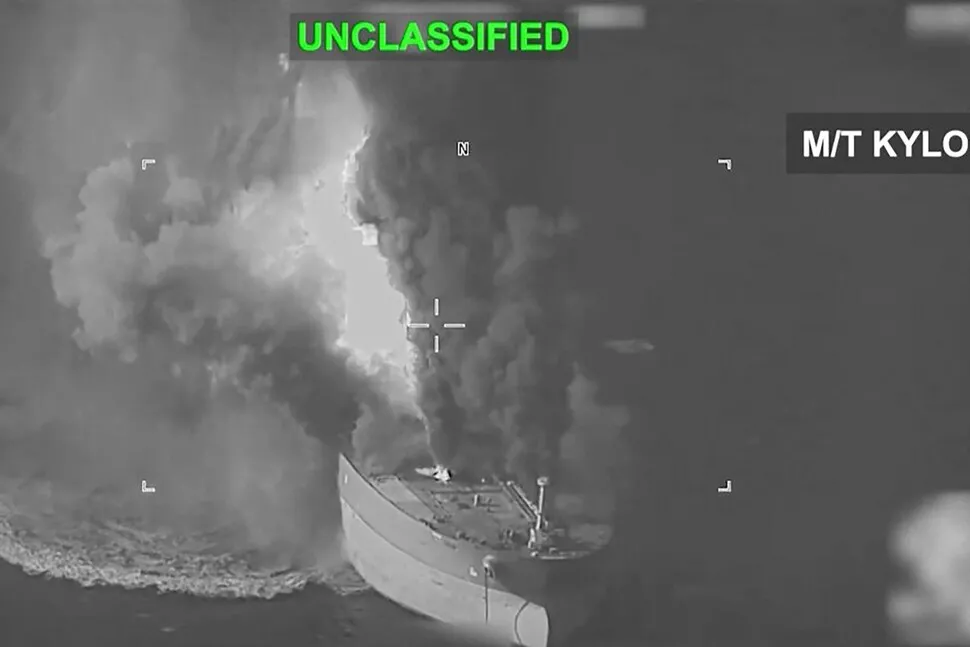
On the 5th, US Central Command confirmed strikes against three Iranian petroleum tankers near Kharg Island and the Jask region. The Downy and the Stark 1 were rendered inoperable. The Kailuho, found in the Gulf of Oman, was cleared of crew and then sunk. CENTCOM Commander Admiral Brad Cooper did not frame this as a defensive action. He stated plainly: the strategy is to impose economic costs greater than whatever Iran inflicts on US forces, and to continue doing so as needed.
That is not a description of policing action. That is a description of economic warfare.
The Korean Coverage Gap
What makes this story worth examining closely is not the strike itself—American outlets covered it adequately as event news—but what Korean journalism is capturing that Washington is missing: the arc.
Han Kyore, which broke the report, ran the numbers Cooper released alongside the political context: Trump’s characterization of the fighting as “intermittent⃖ and Vance’s repeated insistence that “active combat is not occurring.” The article then pivoted to what American wire copy has barely touched: the administration’s parallel work on a post-war Middle East architecture, and the explicit linkage between this escalation strategy and the November midterm election.
The strategic reading is straightforward. The administration is conducting a calibrated escalation—hitting Iranian economic infrastructure in proportion to, then slightly beyond, Iranian military provocations—while building political cover to call it something else. The Korean press is treating this as a single ongoing campaign. Much of the US press is still filing it as discrete incidents: missile fired, ship hit, statement issued, move on.
Who Wins, Who Loses
The winners in this dynamic are clear. The US military has established a new response threshold: Iranian attacks on US vessels will be met with disproportionate strikes against Iranian commercial shipping. Cooper’s warning that further attacks on Iranian tankers are “not off the table” signals that the escalatory ladder has been greased in one direction only.
Iran loses immediately in tangible terms. The three tankers represent direct revenue loss. But the deeper loss is strategic positioning. By targeting vessels rather than warships, the US has forced Iran into a dilemma: retaliate against commercial targets and risk spiraling into a broader economic confrontation, or absorb the hit and appear weak to its domestic base.
Trump wins politically in the short term. Describing sustained military operations against a foreign state as “small potatoes” while the strikes continue achieves two things simultaneously: it lowers public anxiety about escalation, and it frames any future de-escalation as a diplomatic achievement rather than a concession.
The losers are harder to name precisely but easier to project. Oil markets absorb volatility. Regional allies—especially those whose shipping lanes run through the Strait of Hormuz—face uncertainty. And democratic accountability takes a hit when Congress and the public are told nothing is happening while the military is doing something substantial.
The Post-War Blueprint Already Under Construction
Here is where the story diverges most sharply from standard American reporting. Axios reported that the Trump administration has begun designing a “post-war strategy” for the Middle East—a strategy that treats the current conflict as an instrument rather than an endpoint.
The architecture being sketched includes: expanded Abraham Accord-style normalization between Israel and Arab states, with Saudi Arabia as the implicit prize; a US-guaranteed regional deterrence framework centered on Iran containment; and a bundled package tying together Israeli-Syrian security agreements, Israeli-Lebanese arrangements, and progress on Gaza reconstruction.
Critically, the administration plans to advance this framework regardless of Israel’s upcoming election results. A senior official told Axios the plan is “cooking but not yet done.”
This is the strategic context most English-language outlets have not yet connected to the tanker strikes. The attacks on Iranian commercial shipping are not merely retaliatory—they are pressure applications in a larger negotiation over the shape of the post-conflict order. Every tanker sunk raises the cost of continued Iranian resistance and strengthens the hand of actors within Iran and the region who favor a settlement favorable to US objectives.
The Gaslighting Charge
Rep. Lara Slotkin’s characterization of the administration’s language as “gaslighting” deserves more serious treatment than it has received. The term is politically charged, but the factual basis is not disputed: the Pentagon is conducting sustained kinetic operations against Iranian economic infrastructure; the White House is telling the public these are not war activities; voters are being asked to evaluate candidates on a conflict that official language insists is not happening.
This is not a new governance tactic. But the scale of the mismatch between operational reality and political narration is unusually wide in this case. Six months of continuous engagement, multiple ship attacks, and now the destruction of Iranian commercial vessels—all while the president calls it intermittent and trivial.
What Comes Next
The next inflection points are recognizable if you are watching the right signals. Iran’s foreign ministry has already labeled the tanker strikes “illegal and aggressive” and a war crime. The Iranian military has warned of expanded attacks on US warships if maritime blockades continue. The question is not whether Iran will respond—it is whether the response will be proportional or escalatory, and whether the US escalation ladder continues to favor American strikes.
For readers outside the region, the broader lesson is methodological. The Korean press is covering this conflict as a strategic narrative with cause, escalation, and consequence. Much of the American press is covering it as a series of tactical events. The difference matters because the strategy is already visible—in Cooper’s statements, in the post-war planning documents, in the election-timing calculus. What is not visible is the narrative coherence that would let the public understand what they are actually witnessing.
The tankers are sinking. The political language is deflating. The real story is the gap between the two.