Why a Trump-Xi Summit Is the Win, Not the Deal
The Trump-Xi meeting in Washington isn't about outcomes — it's proof the relationship still functions at all. A Japanese-financial press reading reveals what Western desks are missing about Pacific order.
The summit is the story
Washington is roughly a week from hosting Donald Trump and Xi Jinping, and the most important fact about this meeting is not what comes out of it but that it is happening at all. That is the argument coming out of Japan’s business press, and it is a framing Western wire desks are still struggling to absorb.
The Financial Times’ original piece, which JBpress translated and contextualized for Japanese readers, uses a mountain-climbing metaphor: negotiators are roped together, nearing a treacherous crevasse marked Taiwan, and the real accomplishment is simply reaching the summit without falling in. The view from the top, admittedly, is sparse.
This is not a trivial observation. It signals a structural shift in how the two countries manage their rivalry — one that Japan, sitting directly in the shadow of these dynamics, sees more clearly than analysts writing from across the Pacific.
What the 5-month gap between meetings actually means
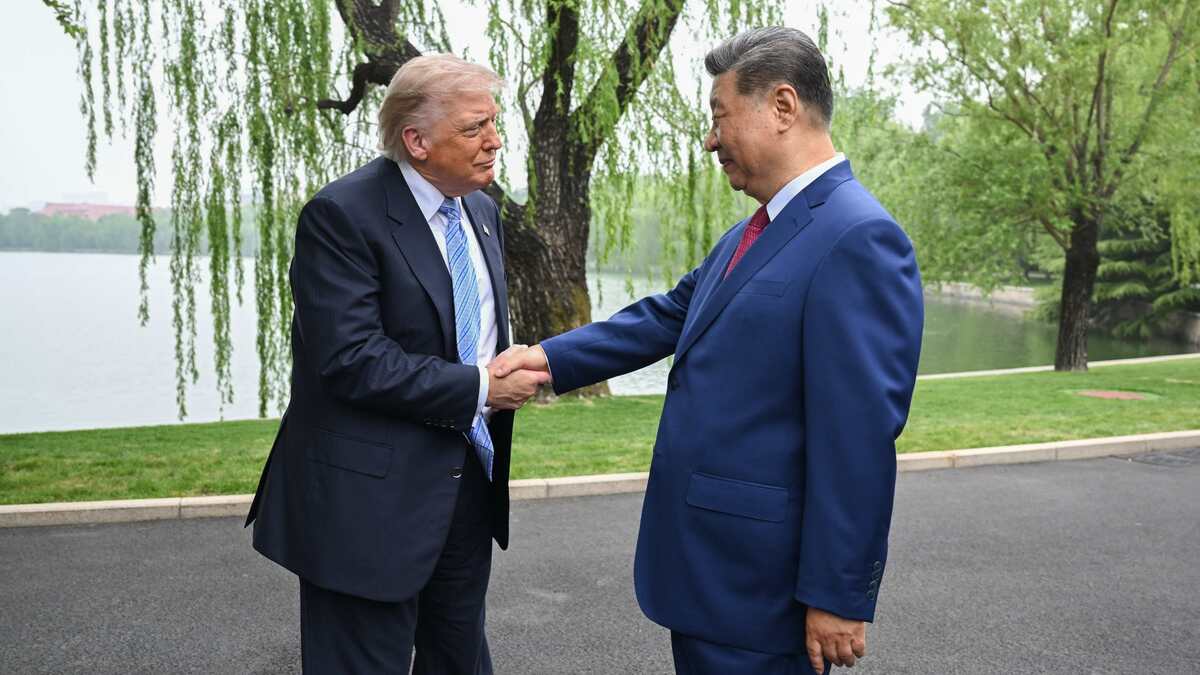
Trump and Xi met in Beijing in May 2026, walking the grounds of Zhongnanhai. That visit was photo-covered and diplomatically warm. But the last genuinely consequential encounter was in October 2025, in South Korea.
That earlier meeting produced something resembling a deal: Trump withdrew planned additional tariffs on Chinese goods, and in return Xi’s government agreed to ease export controls on rare earths — minerals China has spent decades building a near-monopoly over producing. The agreement was supposed to take effect no earlier than November 2026. By all accounts, it never did.
Chinese rare-earth exports to the US have been declining for months. domestic producers, according to the FT report, are quietly told not to ship to American buyers — not because of formal sanctions, but because they fear angering the government. In June, China added two US rare-earth companies to its export control list, tightening the noose around America’s attempt to build an alternative supply chain.
Xi, the piece argues, treats his ability to revoke agreements as a symbol of power. He signed a Phase One trade deal during Trump’s first term that committed China to $200 billion in additional US purchases — commitments that were never fulfilled. On agriculture, a 2025大豆 purchase agreement is being honored, but only conditionally, and both sides know it.
The pattern is not accidental. It is a system where verbal agreements carry weight only as long as the political cost of breaking them remains lower than the political cost of keeping them.
Fear as the real contract
What Trump and Xi have actually agreed to — quietly, implicitly, never in writing — is a balance of terror. Neither side wants escalation. Neither trusts the other to honor any formal commitment. So they manage the relationship through calibrated anxiety: enough pressure to signal resolve, not enough to trigger a spiral.
This is not deterrence in the Cold War sense. There is no clear treaty, no mutual nuclear guarantee, no institutionalized communication channel. It is a personal arrangement between two leaders who have learned each other’s thresholds. And personal arrangements are fragile.
Trump’s rhetoric toward China has shifted from attack mode to praise mode since the Beijing visit. That is the surface signal journalists latch onto. The deeper signal is that Xi has not exploited the goodwill to extract concessions — and Trump has not punished the failure to deliver on rare earths. The silence between the lines is where the real agreement lives.
Why Japan sees it first
The Japanese business press is uniquely positioned to read this dynamic because Japan lives inside it. Tokyo depends on Chinese rare earths for its advanced manufacturing. It depends on US security guarantees for its own deterrence against Chinese coercion. And it watches Washington and Beijing perform this delicate dance every time a summit is scheduled or canceled.
When Xi floated the possibility of canceling the upcoming meeting over Taiwan tensions, Japanese analysts noted immediately that the threat itself was part of the routine — a pressure valve, not a breakdown. Western outlets treated it as drama. Japanese outlets treated it as data point.
That difference in tone matters. It reflects a baseline understanding that the relationship has moved past the point where formal deals are expected to hold. The normalization is not in the agreements — it is in the acceptance that agreements will not be kept, and that this is manageable.
What this means for the Taiwan Strait
The most consequential implication of this framing is what it reveals about Taiwan. Xi has used the Taiwan issue as leverage to threaten summit cancellation. That means the issue is still a bargaining chip, not a red line that triggers automatic escalation. The fact that Trump has not responded with matching threats — instead pivoting to praise — suggests Washington has accepted a new hierarchy of priorities: avoid open conflict, manage competition, defer the Taiwan question.
For Japan, that deferment is both relief and warning. Relief, because a managed rivalry is preferable to an accelerating one. Warning, because deferral is not resolution — and the crevasse remains exactly where it was.
Who wins, who loses, what happens next
The immediate winner of this summit framework is stability — the thinnest, most conditional kind. The loser is predictability. Neither country gains a durable agreement; both lose the ability to rely on the other’s word.
If Xi continues to delay rare-earth export controls indefinitely, the US will face growing frustration but few viable alternatives in the short term. If Trump escalates rhetoric again, Xi has demonstrated he can absorb the pressure without retaliation — a position of strength, not weakness, in this particular game.
The next summit, whenever it occurs, will likely follow the same script: a meeting celebrated as progress, followed by quiet violations that both sides pretend not to notice. The Japanese press knows this rhythm. The question for Washington and its allies is whether they will keep learning it — or whether they will finally stop pretending that a handshake is a strategy.