Xiaomi 18 Fold Is Samsungs Real Foldable Problem
Xiaomi's first mid-size foldable arrives with in-house silicon, a record battery, and a design that actually diverges from Samsung. It lands the same week Apple is expected to announce its own foldable, creating the most consequential moment for the category in years.
The Foldable Market Just Got Messier
Samsung has held the foldable throne for nearly half a decade, but Xiaomi’s 18 Fold, announced at IFA 2026, is the first device from a major Chinese manufacturer that could genuinely disrupt that position. What makes this launch significant is not just the hardware—it’s the timing and the strategy behind it. Xiaomi is entering the foldable conversation on its own terms, with in-house silicon, a proprietary hinge, and a design language that deliberately distances itself from Samsung’s familiar book-style template.
The phone arrives in China the same week Apple is widely expected to reveal its first foldable device. That convergence is not accidental. While the world watches Apple’s move, Xiaomi is already shipping a competitive product at $1,640—roughly half the price Samsung’s Galaxy Z Fold series commands and potentially far less than whatever Apple is planning to charge.
A Design That Actually Dares to Be Different
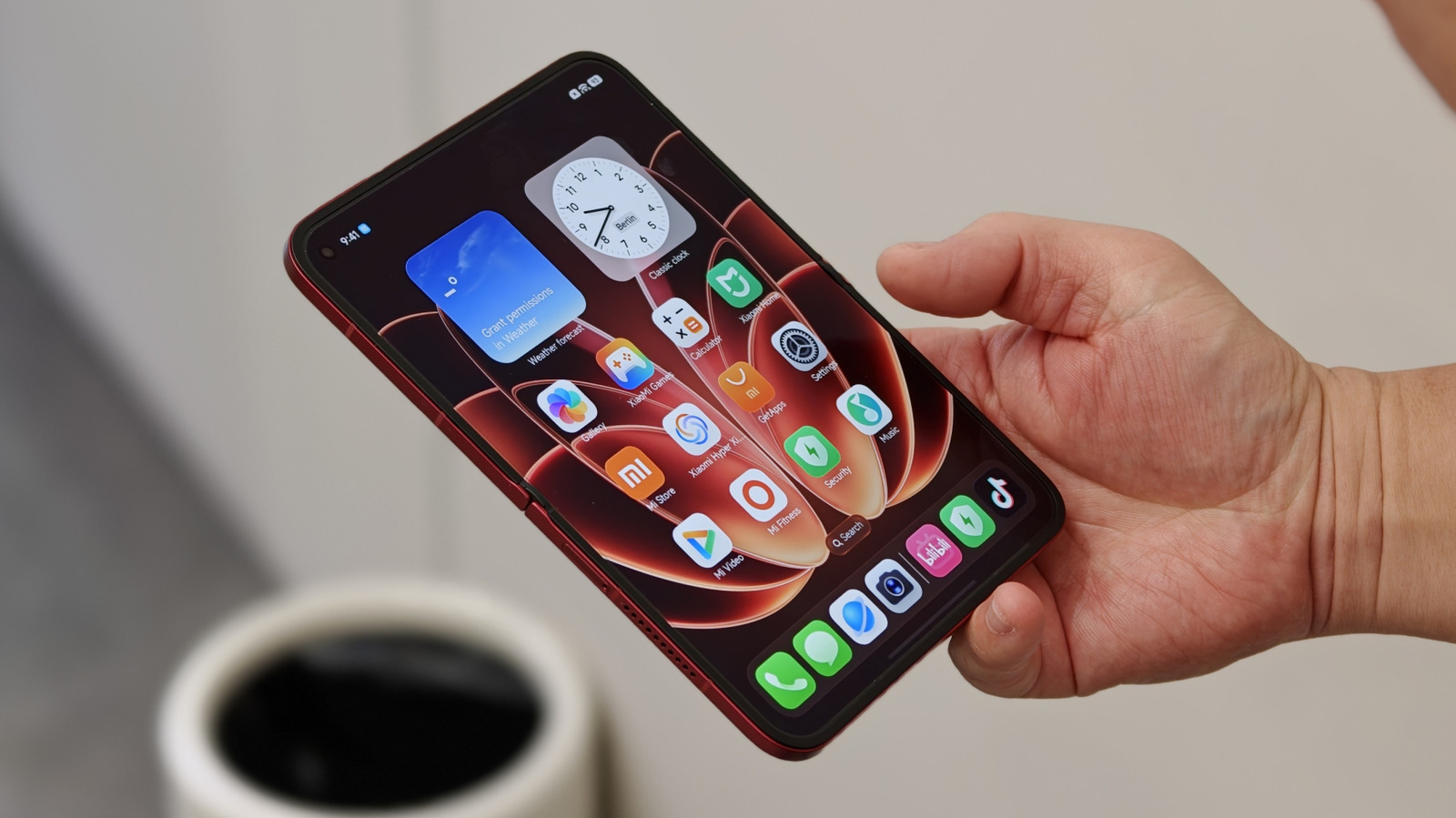
Most foldables today look eerily similar. Samsung popularized the inward-folding slab, and everyone else followed. The Xiaomi 18 Fold breaks from that script. Xiaomi calls it a “mid-size” foldable, which is an interesting way of describing what is essentially a passport-style device with a 7.68-inch inner display and a 5.38-inch outer screen, both sharing an A4 aspect ratio for a more seamless transition between the two panels.
The front display has an asymmetric notepad aesthetic—the corners near the hinge are squared off while the opposite edges curve. It is a small detail, but one that sets the phone apart visually from every other foldable on the market. The device weighs just 219 grams, making it the lightest foldable Xiaomi has ever produced. Samsung’s Galaxy Z Fold 8, by comparison, feels noticeably thinner when held side by side, but the Xiaomi trades that slenderness for a substantially larger battery.
Xiaomi’s new hinge uses a three-link design that wraps around the screen. During a hands-on comparison at IFA, the hinge felt solid—arguably more robust than the one in the Fold 8. The company has also reinforced the frame with a newer aluminum alloy and applied Shield Glass 3.0 protection to both displays. These are incremental improvements, but they matter in a category where build quality has historically been a weakness.
The In-House Chip Change Everything
The most important spec on paper is not the display or the hinge. It is the XRING 03, a System-on-Chip designed entirely by Xiaomi and built on a 3-nanometer process. This is the first flagship device from the company to run on in-house silicon, and it packs a 10-core all-big-core CPU and a 16-core GPU. It also supports the newest LPDDR6 memory standard, which enables faster data access and better performance under load.
Xiaomi claims the XRING 03 delivers 45 percent faster on-device decoding performance on its neural processing unit compared to the previous-generation flagship processor. For a foldable that needs to manage two high-resolution displays simultaneously, efficient on-device AI processing is increasingly critical. Whether those numbers hold up in real-world testing remains to be seen—Pulse has not yet reviewed a production unit—but the ambition here is clear. Xiaomi is no longer relying on Qualcomm or MediaTek for its premium devices. That is a strategic shift with long-term implications.
Battery, Cameras, and the Water Resistance Question
Xiaomi has packed a silicon-carbon battery into the 18 Fold with what the company calls the largest capacity ever seen in a foldable form factor. Exact mAh figures were not disclosed in the source material, but the implication is significant. The phone supports 67 watts of wired charging and 50 watts of wireless charging with compatible chargers, which is competitive even among non-foldable flagships.
The camera system is another area where Xiaomi is refusing to compromise. A Leica-tuned triple-camera array includes a 200-megapixel main sensor with a 1/1.56-inch sensor size and a 50-megapixel Leica periscope telephoto lens. The main sensor is slightly smaller than the one in the Xiaomi 17 Ultra, which remains one of the best camera phones available, but the 18 Fold’s setup is still impressive for a foldable. Initial hands-on time was too brief for thorough camera evaluation, but the hardware promises strong results.
One concern that lingers: Xiaomi has not disclosed an IP rating for water and dust resistance. This is a common gap among foldables, but it remains a meaningful disadvantage against Samsung, which has gradually improved the water resistance of its Galaxy Z series. If Xiaomi wants to compete globally, it will need to address this.
The Ceramic Edition and Color Choices
Xiaomi is teasing a special edition of the 18 Fold made with silicon nitride ceramic, a material that reportedly resists bumps and scratches better than traditional zirconia ceramic while weighing about 50 percent less. That version was not on display at IFA, so its weight, durability, and final price remain unknown. The red version shown at the event looked striking, and the phone will also launch in black and white.
What This Means for Samsung and Apple
Samsung’s dominance in foldables has rested on two pillars: being first and being good enough. The Galaxy Z Fold series established the category, and subsequent generations have refined it. But refinement alone is no longer a moat. Xiaomi’s 18 Fold proves that a competitor can match Samsung on display quality, offer a more distinctive design, and ship a device with proprietary silicon—all at a lower price point.
Apple’s impending entry into the foldable market adds another layer of complexity. If Apple’s foldable launches at a price above $1,500 and follows its usual release cadence, Xiaomi will already have a product in consumers’ hands by the time Apple arrives. The Chinese manufacturer has a window—possibly a narrow one—to establish credibility in the mid-size foldable segment before Apple redefines the conversation.
The 18 Fold is currently China-only. Whether Xiaomi expands it globally remains unclear, but the company’s trajectory suggests it will. The XRING 03 chip, the proprietary hinge, the in-house display technology—these are investments that only make sense if Xiaomi plans to compete internationally. Samsung learned that lesson years ago. Xiaomi is learning it now.
The Bigger Picture
The foldable market is approaching an inflection point. Three major players—Samsung, Apple, and Xiaomi—are converging on the same form factor within the same quarter. Samsung has the experience. Apple has the brand. Xiaomi has the momentum and, increasingly, the ability to innovate independently. The 18 Fold is not a copycat device. It is a statement that Xiaomi sees itself as a leader in this space, not a follower.
Consumers will decide whether that statement resonates. But for the industry, the message is unmistakable: the foldable market is about to become a lot more competitive, and Samsung can no longer assume it will win by default.