Xiaomi Just Jumped the Queue Before Apple's Foldable iPhone
Xiaomi released its XRING O3 chip and a horizontal foldable phone days before Apple's rumored September 9 debut. The timing isn't coincidence — it's a direct shot at control of the narrative.
The announcement that wasn’t supposed to happen yet
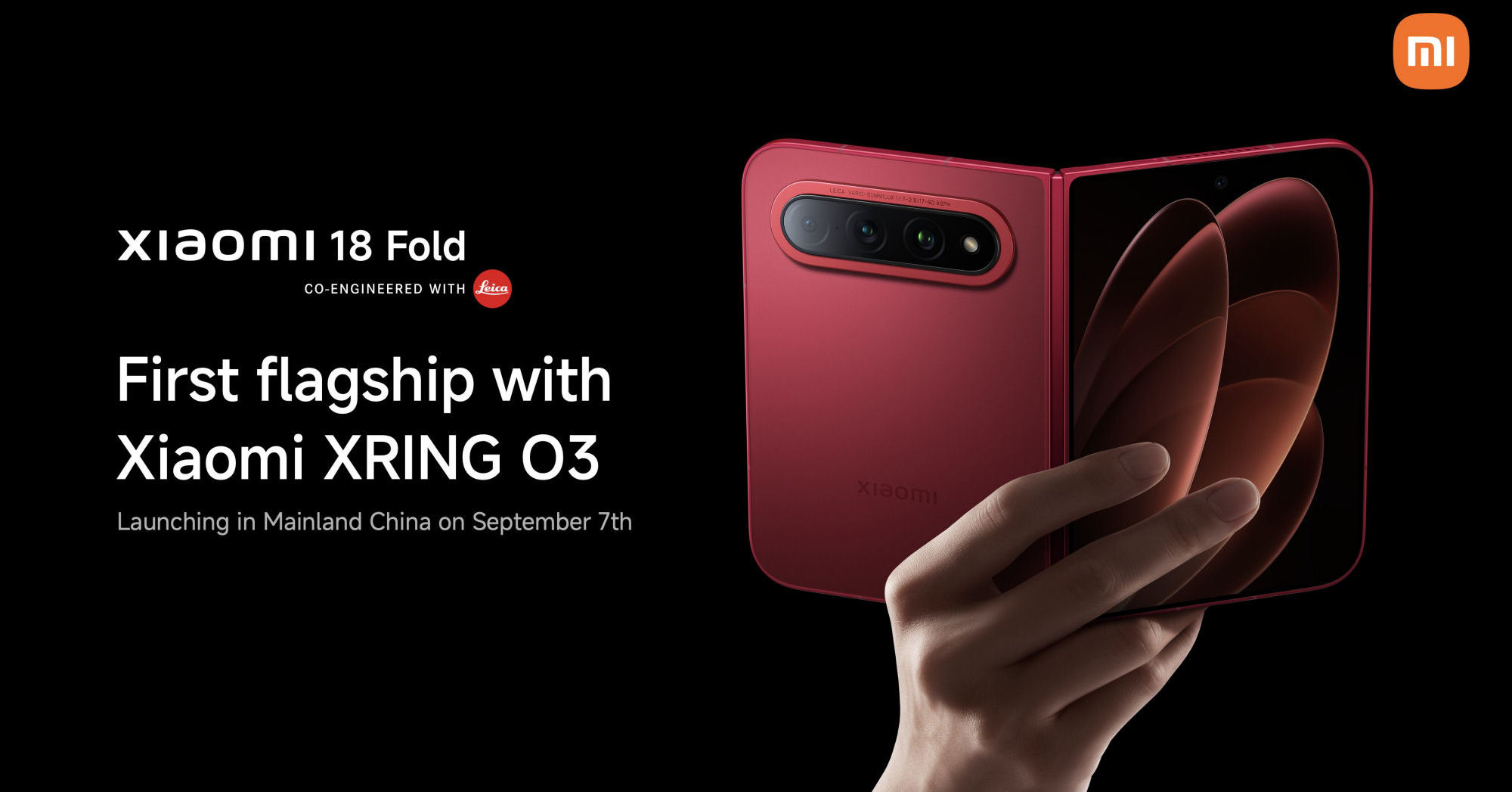
Xiaomi posted a teaser on X on September 4 for a device called the Xiaomi 18 Fold, set to launch in China on September 7. Two days later, Apple is expected to reveal its first foldable iPhone. The gap between those two dates is not an accident.
This is a deliberate act of agenda-setting. Xiaomi is forcing Apple into a reactive position on a hardware form factor that defines the next chapter of smartphone competition.
A chip that carries more weight than the fold
The real story inside the 18 Fold is the XRING O3 processor. Xiaomi’s own custom silicon, built on a 3nm process, is the first mobile chip to support LPDDR6 memory. The numbers are aggressive: memory bandwidth of 113.8 gigabytes per second, a 48% jump over the XRING O1 that debuted in the Xiaomi 15S Pro last year. CPU performance is up 60%. GPU is up 85%. The NPU handling on-device AI tasks runs 45% faster. AnTuTu benchmark score: over 5.22 million.
For context, that benchmark places the 18 Fold well ahead of current flagship competition. But the significance goes beyond raw numbers. Xiaomi has spent years developing in-house chips — the XRING O1 was a modest step, but the O3 signals a company that now views silicon design as a core differentiator, not a cost-saving exercise. The O3’s LPDDR6 support is particularly notable: it suggests Xiaomi is engineering for workloads that don’t exist on current devices. AI processing, real-time translation, complex media rendering — these are the things the phone will be able to handle that competitors cannot, at least until their own supply chains catch up.
The LPDDR6 detail matters because memory bandwidth has been a bottleneck for on-device AI for years. Every generation of large language models demands more throughput. Qualcomm’s Snapdragon 8 Elite and Apple’s A-series chips are approaching the limits of what LPDDR5X can deliver. Xiaomi skipping a generation by going straight to LPDDR6 is a bet that the next wave of compute-heavy features won’t wait for the industry to slowly upgrade memory standards. If that bet pays off, the 18 Fold gains a generational edge that isn’t visible in any press event keynotes — it’s invisible infrastructure, but it determines what software can actually run smoothly.
There is also a supply chain implication. Samsung already manufactures its own chips through its foundry business, and Huawei has relied on SMIC’s mature process nodes for years. Xiaomi now joins them as a company designing both silicon and systems integrations. That consolidation of control over the stack is rare among Chinese manufacturers and gives Xiaomi a structural advantage in how quickly it can iterate. When the O3 needs a revision or the next iteration, Xiaomi doesn’t have to negotiate with a third-party foundry’s schedule.
The horizontal fold is now the default shape
The 18 Fold unfolds into a wide, passport-sized rectangle. Huawei pioneered this form factor with the Pura X Max. Samsung adopted it with the Galaxy Z Fold8 in July. And now, according to leaked reports, Apple’s first foldable iPhone will follow the same layout. Three major manufacturers converging on one shape in a single year is rare. It tells you something about where the industry thinks the ceiling for foldable screens is — wide enough for productivity use, compact enough to carry.
Xiaomi releasing its version two days before Apple does not make the form factor superior. But it makes the timing superior. The first mover in any category controls how journalists describe it, how reviewers compare it, and how consumers understand what they are buying. Apple will inherit a market where the horizontal fold is already normalized, discussed, and benchmarked — because Xiaomi and Samsung did the groundwork.
The horizontal fold itself carries strategic implications. Vertical foldables like the original Galaxy Z Flip were novelty products — fun, compact, but not clearly productive. Horizontal foldables force a different design calculus: a wider crease, a larger inner display, a device that competes with small tablets rather than standard smartphones. Companies that nail this form factor are signaling that they view foldables as a productivity tool, not a fashion accessory. Xiaomi’s decision to go horizontal rather than vertical reinforces that positioning. It also raises the bar for Apple, which has historically entered categories with a refined product rather than a first attempt.
Who wins, who loses
Xiaomi wins the narrative. It also wins early adopters in China who were waiting for a foldable that did not require a premium tax over Samsung’s offering. The XRING O3 gives Xiaomi a feature that Apple, using off-the-shelf Qualcomm or custom AMD-derived silicon, will not match at launch. That is a meaningful gap.
Apple loses the surprise. Its first foldable iPhone arrives as a follower, not an innovator. That matters more than it should. Apple’s market power partly derives from its ability to define categories before others enter them. A foldable iPhone that mirrors a design already on shelves weakens that dynamic, even slightly.
Samsung occupies an ambiguous middle ground. It was first with the horizontal fold in the Galaxy Z Fold8, but it now shares the stage with a Chinese competitor offering comparable or better specs at a lower price. In China, that competition is existential. Globally, it is pressure.
Huawei gains nothing from this particular moment but confirmation that its bet on horizontal folds was correct. The Pura X Max loses some exclusivity, but gains something larger: the shape itself is validated as the future direction of the category.
There is a secondary effect worth noting. Apple’s supply chain dependencies are about to be tested in new ways. A foldable iPhone requires flexible OLED panels, advanced hinge mechanisms, and likely a new display coating to manage crease visibility. Samsung Display dominates flexible OLED supply. If Apple enters the foldable market through Samsung’s production lines, it deepens a dependency on a company that is simultaneously its closest rival in the smartphone space. Xiaomi, by contrast, is building its own chip stack and has been working closely with BOE and other Chinese display manufacturers. The structural independence is not absolute, but the direction of travel is different.
What comes next
Xiaomi will display the 18 Fold at IFA 2026 in Berlin next month. That is the real test — not the Chinese launch, but whether the company can translate domestic momentum into global relevance. Japanese carriers and retailers are already watching. OPPO, Motorola, Google, and ZTE have all introduced horizontal foldables in recent months. The market is no longer a novelty segment. It is becoming a mainstream one, and Xiaomi is positioning itself as one of the few companies that can compete on both hardware design and silicon.
Apple’s foldable iPhone, whenever it ships, will face a crowded field. Consumers will compare it directly against devices that have already been reviewed, used, and discussed for months. The company’s traditional advantage — arriving late but definitive — is harder to pull off when the latecomer is competing against products that defined the category’s shape.
The broader implication extends beyond any single product launch. Smartphone innovation has plateaued in incremental upgrades: better cameras, brighter screens, slightly faster chips. Foldables represent one of the few genuine form-factor shifts in a decade. Whoever controls the conversation around that shift controls the next cycle of consumer interest and carrier partnerships. Xiaomi’s September 7 launch, preceded by the XRING O3 announcement on September 4, is a calculated move to own that conversation before Apple even enters it.
Xiaomi did not invent the horizontal fold. But it invented the timing. And in smartphone markets, timing is the difference between setting the standard and chasing it.