Zelensky's Gratitude Hides Ukraine's Precarious Lifeline
Zelensky's public thanks to Trump for restored intelligence is a calculated performance masking Ukraine's desperate dependency. When the US controls both the information pipeline and the satellite internet that keeps Kyiv online, strategic sovereignty is an illusion.
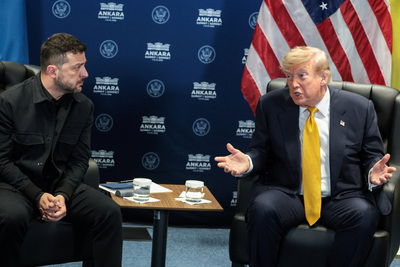
The Choreography of Gratitude
Volodymyr Zelensky stood before American television cameras on October 18 and thanked Donald Trump’s administration for something that should never have been withheld in the first place: the basic intelligence that allows a nation to defend its skies. He called it a normal operating procedure restored after an inconvenient blackout. He also called the prior cutoff a deliberate act of coercion designed to force Ukraine into submission. Both statements were true. Both were necessary. That he had to deliver them simultaneously — gratitude and accusation wrapped into one — is the story of Ukraine in 2026.
The interview on NBC’s Meet the Press was not a candid exchange between allies. It was a calibrated performance by a leader who has no alternative audience large enough to reach. Zelensky needed American politicians and American voters to understand two things at once: that the United States is indispensable to Ukraine’s survival, and that Washington is actively using that indispensability as leverage.
What Three Days Without Eyes Costs
The intelligence gap lasted roughly seventy-two hours during a period of sustained Russian ballistic missile attacks. Without American satellite-derived warnings, Ukrainian air defenses were flying blind until incoming warheads were one or two minutes from impact. That is not a tactical disadvantage. It is an existential one.
Ballistic missile defense is a mathematics problem with zero margin for error. The window between detection and interception is measured in seconds. American intelligence assets — reconnaissance satellites, signals intelligence platforms, early-warning systems — had been providing Kyiv with real-time tracking of Russian missile launches from bases inside Russia proper. When that flow stopped, Ukraine’s defensive architecture developed a gap wide enough to drive an artillery battalion through.
Zelensky did not mince words about the consequence. “America is the only country with this unique intelligence capability,” he told the interviewer. The implication was unmistakable: no other patron on Earth could fill that role. China would not. The European Union lacks the satellite constellation and the integration infrastructure. NATO as an institution has no independent early-warning system comparable to what Washington fields.
This is the structural reality behind Zelensky’s gratitude. The thank-you is real. The anger is real. The dependency is the constant.
Starlink as a Control Valve
If ballistic missile intelligence is the nervous system of Ukraine’s war effort, Starlink is its circulatory system. The satellite internet network operates SpaceX terminals across the country, powering everything from frontline troop communications to hospital equipment to civilian banking. When those connections were throttled in late October, the effect was not technological failure. It was policy enforcement.
Zelensky stated plainly that the speed restriction was decided by the Trump administration and executed technically by SpaceX. Whether that chain of command is fully accurate in every detail matters less than the political signal it sent. Kyiv understood the message: access can be adjusted, and the adjustment can be punitive.
Elon Musk’s company occupies a position no corporation should hold in a conflict zone. It controls infrastructure that a sovereign state depends on for basic operations, and the parent government retains the ability to influence that infrastructure through regulatory and contractual leverage. That arrangement is unprecedented in modern warfare and deeply uncomfortable for anyone who cares about strategic autonomy.
Zelensky’s insistence that the throttle was intentional — not a glitch, not a capacity constraint, not a commercial decision — places the blame squarely on the White House. He is telling his domestic audience that the United States is not a reliable partner but a conditional patron. He is telling the American audience that gratitude should not be unconditional either.
The Sanctions Paradox
Beyond intelligence and communications, Zelensky confronted a broader strategic retreat. The Trump administration has moved to ease sanctions on Russian diesel imports, a decision Kyiv views as directly subsidizing Moscow’s war machine. Zelensky called it a wrong judgment that helps no one — not Ukraine, not the United States.
The timing is significant. Sanctions relaxation and intelligence withholding are not separate policy tracks. They form a coherent strategy: reduce costs for America, reduce pressure on Russia, and let Kyiv adjust to a lower-intensity conflict on its own territory. The message to Zelensky is implicit but legible — the era of full-throated American support is over, and the new arrangement will be managed incrementally.
Zelensky’s response has been to perform the impossible task of thanking the architect of that arrangement while simultaneously describing the architect’s intentions as hostile. It is a diplomatic tightrope walk with no safety net.
Who Wins, Who Loses
The winners are clear. Russia gains time, reduced economic pressure, and a weakened deterrent. The Trump administration gains leverage over Kyiv’s negotiations without committing American resources. SpaceX maintains its revenue stream and its strategic relevance.
The losers are also clear. Ukraine loses sovereignty in the most practical sense — the ability to control its own information environment, its communications infrastructure, and ultimately its diplomatic posture. Zelensky loses room to maneuver. Every public statement must now serve two audiences: Americans who need reassurance that their money is well spent, and Ukrainians who need to believe their president is not surrendering.
The longer-term loser may be the transatlantic security order itself. If the United States treats intelligence sharing and critical communications infrastructure as negotiable instruments rather than commitments, every American ally will quietly recalibrate its risk calculations. The precedent matters more than any single decision about Ukrainian warfighting capability.
What Comes Next
Ukraine’s intelligence architecture is now partially restored. That buys breathing room but not strategic security. The three-day blackout demonstrated how quickly the lifeline can be cut, and Zelensky’s public acknowledgment of that vulnerability may embolden Washington to use the threat again — not necessarily to force surrender, but to shape the terms of any eventual negotiation.
Kyiv’s diplomatic recalibration is already underway. Expect quieter outreach to European capitals, more visible engagement with Global South governments, and careful language about the possibility of territorial compromises. Zelensky cannot afford to alienate Washington completely, but he also cannot afford to appear passive. The performance of gratitude with teeth will continue.
For American policymakers, the lesson should be uncomfortable. Managing a ally through the threat of withheld support is cheaper than defending it directly, but it produces exactly the kind of contradictory messaging that undermines credibility. Zelensky’s interview achieved both objectives simultaneously — it thanked the donor and accused the manipulator in the same sentences. That is not confusion. That is clarity under constraint.
Ukraine’s strategic sovereignty was always illusory while the war depended on American bullets and bandwidth. The question now is whether Kyiv can construct something durable from the fragments left behind when those supplies become conditional.