Zelenskyy Blames White House for Starlink Cuts as Ukraine Crisis
Zelenskyy's public accusation marks a dramatic rupture in Ukraine-US relations. The Starlink restriction story reveals how commercial satellite policy has become a frontline tool of alliance diplomacy — and who pays when that leverage tightens.
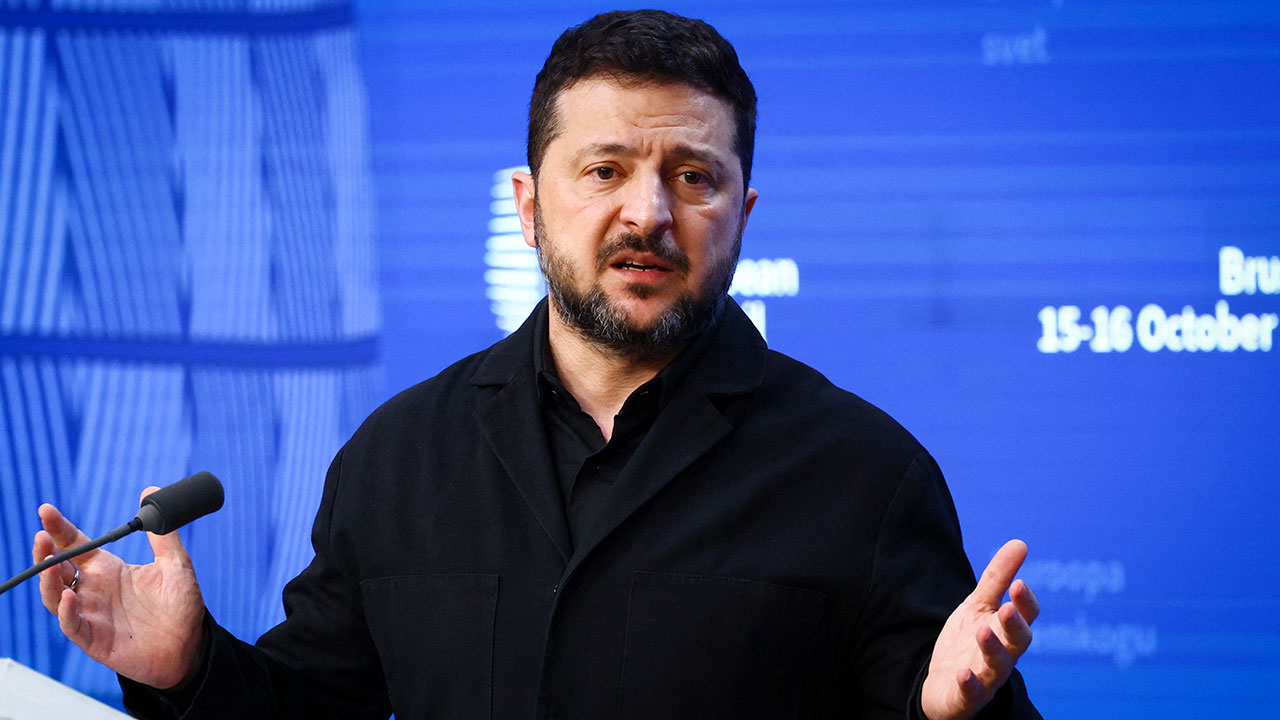
The Day Ukraine’s Leader Pointed at the White House
Volodymyr Zelenskyy did not mince words in a Bloomberg interview on October 18. He accused the Trump administration of deliberately restricting Starlink internet speeds for Ukrainian forces and cutting Patriot missile deliveries to a quarter of their previous rate. This was not a private diplomatic complaint leaked through channels. It was a public indictment from a leader who has spent three years anchoring his country’s survival to American promises.
The timing is consequential. Ukraine’s military situation has been deteriorating for months along the Donbas front, where Russian forces have methodically advanced through fortified positions around Chasiv Yar and Pokrovsk. The US political calendar is approaching midterms that could reshape Washington’s posture toward Kyiv, and Zelenskyy’s decision to go public suggests he no longer believes behind-closed-doors appeals will alter the calculus in Washington.
Zelenskyy’s framing — that these are not logistical failures but calculated moves to force a surrender — reframes the entire conflict’s second act. What was previously understood as the natural ebb and flow of coalition aid has been recast, at least by Kyiv, as an active strategy of attrition through neglect.
Starlink as a Chokepoint
The Starlink angle is where this story departs from routine alliance friction. SpaceX’s constellation has become indispensable to Ukrainian battlefield communications, drone operations, artillery coordination, and civilian infrastructure. Satellite-based internet replaced damaged fiber-optic lines and jammed radio frequencies after Russia’s initial electronic warfare campaign in 2022. Today, an estimated 30 percent of Ukrainian military communications flow through Starlink terminals deployed across the front lines.
When Kyiv relies on a single commercial provider for critical military-grade connectivity, that provider — and its home government — holds enormous leverage. Musk himself has already demonstrated willingness to restrict service on operational grounds, blocking Starlink terminals in Crimea in 2023 after reports that Ukrainian drones were using them for strikes on Russian-occupied territory. The Trump administration’s restriction of Starlink speeds, as Zelenskyy describes it, represents a new category of warfare tool. This is not sanctions policy or aid conditionality. This is the deliberate throttling of a network that Ukrainian soldiers depend on for real-time coordination — adjusting fire, relaying drone feeds, coordinating defensive positions under aerial bombardment.
No previous US administration has used commercial satellite access as an explicit pressure mechanism in a hot conflict. The precedent cuts in multiple directions. If the United States can restrict a commercial service operated by a US company to influence a partner nation’s military decisions, every ally dependent on American technology now faces that same vulnerability. NATO cohesion will be tested not by Russian missiles but by API restrictions, bandwidth caps, and subscription terms written in Silicon Valley boardrooms.
The second-order effects are already emerging. European defense ministers have quietly begun accelerating indigenous satellite programs, including the EU’s IRIS² constellation, but those systems will not be operational at scale before 2027. In the interim, European forces deployed to Ukraine face the same dependency dilemma. Polish and Baltic units coordinating with Ukrainian counterparts through Starlink relays are exposed to the same chokepoint, creating a cascade of strategic vulnerability across the eastern flank.
The Patriot Math
Zelenskyy’s claim about Patriot missile deliveries is equally stark. Twelve per month versus the roughly forty-eight per month under Biden represents a generational slowdown in air defense supply. For a country under sustained Russian aerial bombardment, that gap is not abstract — it is measured in intercepted drones, damaged hospitals, and civilian casualties. Ukraine’s air defense apparatus has absorbed over two thousand missile and drone strikes since the escalation intensified in the spring of 2025, and Patriot batteries are the only system providing reliable layered interception at altitude.
Moscow has reportedly pre-paid for its weapons systems through commodity deals and state-backed financing arrangements with Iran and North Korea. Zelenskyy framed the American cuts accordingly: Russia is buying what it needs; the West is stopping its shipments. The contrast is deliberate and damaging to the Western narrative of unwavering support. It also raises an uncomfortable question about asymmetric economic warfare — when one side finances its munitions through resource exports and the other through legislative appropriations subject to partisan veto points, the comparison favors the authoritarian economy.
Beyond the immediate ballistics, the Patriot shortfall has tactical consequences. Lower-altitude interceptor coverage has shrunk, pushing Ukrainian forces to rely more heavily on older Soviet-era systems and short-range portable defenses. That shift increases exposure to precision-guided munitions and allows Russian aircraft to operate with greater impunity at the margins of Ukrainian air space, complicating troop movements and supply line security.
Who Wins, Who Loses
The immediate winner from Zelenskyy’s public escalation is political transparency. He has forced the issue into open discourse, removing the cushion of diplomatic silence that has protected US-Ukraine relations for two years. The loser is the careful ambiguity that both sides previously maintained — the understanding that Washington would provide sufficient aid without dictating Kyiv’s negotiating position.
Russia benefits most from the public rift. Even if the Starlink restrictions are driven by US domestic policy rather than a coordinated push for Ukrainian surrender, the perception matters. Putin’s propaganda apparatus now has a confirmed grievance from a Western leader to amplify. State television has already picked up the story, framing it as evidence that the “Kyiv regime” is a pawn whose patrons will abandon it once electoral convenience demands restraint.
NATO loses the coherence of its eastern flank messaging. Individual member states will recalibrate their support calculations based on whether the United States is an unreliable guarantor. European defense spending plans, already under revision, will accelerate — but acceleration is not the same as capability. Procurement cycles run years, not months, and the gap between political will and deployed hardware will widen before it narrows.
There is also a quieter loser: commercial trust. Ukrainian institutions and private companies that built operational dependence on Starlink now face a fundamental question about infrastructure sovereignty. The same logic applies to any client state relying on American commercial technology for national security functions — from Thai fisheries monitoring satellites to Kenyan telecommunications relay networks.
The Midterm Wildcard
Zelenskyy acknowledged that relations could improve after the US midterm elections. That single concession reveals the strategic calculus beneath the outrage. He is buying time, not declaring a permanent rupture. The message to Washington is clear: this hurts, but we understand your electoral calendar. The subtext is equally clear — Kyiv recognizes that it has no viable alternative patron and that public anger must be calibrated against the practical necessity of preserving the relationship.
What that means in practice is uncertain. Midterm losses could produce a Congress more hostile to Ukraine aid or, paradoxically, one that imposes stricter conditions that the executive branch cannot ignore. Either outcome risks further constraining Kyiv’s options at exactly the moment Moscow appears to be gaining momentum on the battlefield. Congressional hawks may demand territorial concession benchmarks before resuming funding; progressive factions may condition aid on ceasefire commitments. Both tracks pull Kyiv in opposite directions simultaneously.
The wildcard variable is Elon Musk himself. His public statements on the Ukraine conflict have shifted unpredictably over the past eighteen months, and his personal relationship with the Trump administration remains undefined. If Musk views the Starlink restrictions as an infringement on SpaceX’s operational autonomy, he may find ways to circumvent them — through firmware adjustments, relay rerouting, or public advocacy that makes overt throttling politically costly for the White House.
The Bigger Picture
This episode signals something larger than a bilateral spat. Commercial technology infrastructure — satellite internet, undersea cables, cloud data centers — has become the central nervous system of modern warfare. The side that controls that infrastructure, or can threaten to throttle it, holds asymmetric power over its allies. That power is unprecedented in scope because it is exercised through market mechanisms rather than military command structures, making it harder to identify, harder to counter, and harder to attribute.
The Starlink restrictions expose the vulnerability of a security model built on private-sector dependency. Ukraine fought its war with tools designed in Silicon Valley boardrooms. When those tools become leverage, the line between commercial competition and geopolitical coercion dissolves entirely. There is no treaty violation, no formal breach of alliance obligations — only a bandwidth cap adjusted at the discretion of a private CEO and a federal administration that sees strategic advantage in applied pressure.
For English-language readers accustomed to framing this conflict as a straightforward great-power confrontation, the complication is domestic American politics. The weapon is not a Russian tank but a bandwidth cap imposed by a White House calculating midterm advantages. That is a different kind of threat — less visceral, more insidious, and far harder to mobilize against. It does not announce itself with artillery fire. It arrives as a gradual degradation of capability, measured in delayed drone feeds, fragmented command networks, and the quiet realization that the infrastructure holding a nation’s defense together was never truly its own.
The longer-term consequence will be a fragmented technological order. Allies will diversify away from American commercial infrastructure not out of ideological preference but structural necessity. European satellite programs, Japanese deep-space relay networks, and Indian telecommunications sovereign initiatives will accelerate. The result will not be decoupling from the United States overnight — it will be a slow, uneven drift toward multipolar digital infrastructure that weakens American leverage precisely when Washington is attempting to reassert it. Zelenskyy’s public accusation may well be the catalyst that turns a tactical dispute into a structural realignment.