Why the Abudhabi Talks Leave Europe Off the Map
The US-Russia-Ukraine trilateral talks in Abu Dhabi signal a dramatic shift in who sets the peace agenda. With Europe sidelined and Trump framing both sides as equally war-weary, Kyiv faces a reckoning over what peace terms look like when Washington calls the timetable.
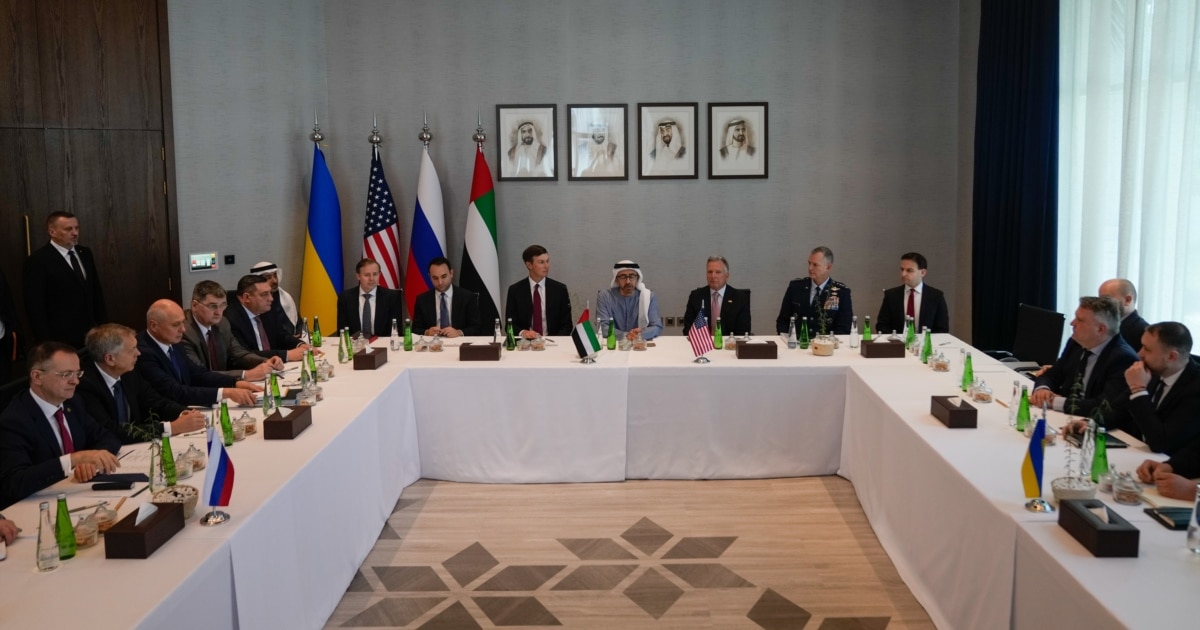
The Room Where It Happens — and the One It Doesn’t
The three-way peace talks between the United States, Russia, and Ukraine opened on the 10th in Abu Dhabi, marking the first high-level trilateral meeting since February. But the location itself is a message. This is not Geneva. It is not Brussels. It is not even Paris. The choice of an Emirati city — one with established ties to Moscow and a pragmatic stance toward Washington — signals whose architecture frames this negotiation now.
On the American side, special envoy Steve Witkoff and Jared Kushner, Trump’s son-in-law and a figure with no formal government title, are doing the heavy lifting. Kushner told reporters before the talks began that there were viable pathways to close the gap between Kyiv and Moscow, and that his team was working to build a new framework for sustainable peace. The language was deliberately open-ended. That is not an accident.
Trump’s Framing Changes Everything
A day earlier, Trump made a surprise appearance in the White House briefing room and delivered a line that reframed the entire conflict: both Russia and Ukraine are exhausted by war. He did not single out Putin. He did not catalogue Russian atrocities or occupied territory. He placed both capitals on the same plane of war fatigue and presented American mediation as the only path to stopping casualties.
That framing matters more than most observers realize. For years, Western policy has been built on a clear moral and legal hierarchy — Russia as aggressor, Ukraine as defender. Trump’s rhetoric does not deny that hierarchy outright, but it neutralizes its political utility. When both sides are described as equally tired, the bargaining table looks very different. Territorial concessions stop being painted as surrender and start being discussed as pragmatism.
The European Proposal Dies on Arrival
Compounding the isolation is the public rebuff Russia gave to Europe’s post-ceasefire security initiative. Whatever concrete proposals Paris and Berlin had floated — likely involving multilateral guarantees, peacekeeping deployments, or institutionalized security architectures for a postwar Ukraine — were dismissed by Moscow before they reached the negotiating table in Abu Dhabi. The message from Kremlin officials was unmistakable: Europe does not set the terms. America does.
This is the oldest story in European strategic history repeating itself. The continent builds a policy paper; Washington brings the leverage; Moscow deals with whoever holds the leverage. What makes this moment distinctive is not the pattern but the speed at which it collapsed. In previous rounds of Ukraine diplomacy, European frameworks at least delayed American unilateralism. Now they are being treated as irrelevant before the first round of talks begins.
Who Wins, Who Loses
The winners on day one are obvious. Trump gets to claim the mantle of dealmaker — a role that plays well domestically and positions him ahead of his Asia trip, which begins on the 16th with stops at the ASEAN summit in the Philippines and the APEC meeting in China. A diplomatic headline before that itinerary reinforces his narrative of American centrality across every theater.
Kushner and Witkoff gain operational space. Without a detailed European blueprint constraining them, they can float flexible proposals that neither side has publicly rejected yet. That ambiguity is their advantage.
Kyiv loses ground it cannot easily recover. The absence of European co-sponsorship means there is no secondary diplomatic architecture to fall back on if American priorities shift. Kyiv has spent three years building institutional partnerships across the EU, NATO, and individual capitals. Those relationships are not disappearing overnight, but their practical influence on ceasefire and peace terms has been sharply curtailed by the structure of these talks.
Moscow gains recognition as an equal party at the table. That alone is a strategic victory worth more than any territorial gain it might negotiate in the immediate term. The Kremlin has spent years fighting to break the Western consensus that treats Russia as a pariah in diplomatic settings. Abu Dhabi delivers that breakthrough on a silver platter.
What Peace Terms Actually Look Like
The hardest question is not whether a deal emerges but what substance it contains. None of the participants have outlined specific parameters yet. But the arithmetic is clear: any agreement reached without robust European security guarantees will be thinner than Kyiv and its allies have long demanded. Territorial questions will dominate. Prisoner exchanges and humanitarian provisions will follow. Security assurances for a settlement state will be whatever the Americans and Russians can agree to deliver — which is less than anything Europe has historically pledged.
Trump’s comments about the Iran conflict ending soon and his repeated emphasis on American readiness to act elsewhere suggest he is managing multiple crises simultaneously and wants Ukraine resolved quickly enough to free up political and diplomatic bandwidth. That timeline pressure cuts in two directions. It could accelerate a freeze that locks in gains but also pushes for a deal before either side has time to fortify its position.
What Comes Next
The immediate aftermath of these talks will reveal more than the talking points. If the two-day session produces a joint statement or a narrow agreement on prisoner swaps or a temporary halt to strikes, that is a floor, not a ceiling. If it stalls entirely, the absence of European participation becomes even more damaging to Kyiv’s diplomatic posture.
Either outcome carries the same structural implication: the architecture of European security is being redrawn without European input. The question for Brussels, Paris, Berlin, and their eastern partners is no longer how to strengthen their proposal for Ukraine’s future. It is whether they still have a seat at the table where those futures are decided.
Trump’s Asia itinerary adds another variable. Reports that he may seek a meeting with North Korea’s Kim Jong Un alongside scheduled discussions with Xi Jinping suggest the administration is treating diplomatic engagement as a portfolio strategy — resolve one theater, pivot to the next. Ukraine may be one line item in a much wider calculus.
For Kyiv, that calculus offers no comfort. The war began as a fight against Russian expansion. It is now being negotiated in a room where the terms are shaped by American priorities and Russian concessions, with European security visions already dismissed at the door.