Acoustic Levitation Breaks 40cm Barrier, Upending Contactless Manufacturing
A Japan-UK team has shown that a single ultrasonic transducer can trap and maneuver objects at 40cm—six times farther than ever achieved. The leap from enclosed acoustic traps to open-air contactless handling could reshape precision assembly and lab automation worldwide.
The Quiet Revolution in Contactless Handling
For decades, acoustic levitation has been a laboratory curiosity—a neat trick where sound waves suspend small objects between opposing transducers. The catch was structural: you needed a chamber, a reflector, or at minimum two speakers facing each other. That geometry limited where and how the technique could be deployed outside specialized labs.
A joint team from Tsukuba University and the University of Bristol has just broken that constraint. Their results, published in Physical Review Letters on August 24, 2026, demonstrate stable levitation and three-dimensional manipulation of objects at a distance of 40 centimeters from a single ultrasonic transducer—roughly six times the previous record for one-sided acoustic trapping.
The significance goes well beyond the number itself. It is a shift from enclosed acoustic traps to open-air contactless handling, and it arrives at a moment when precision assembly lines and automated laboratories are desperate for tools that can move delicate or hazardous materials without touching them.
How They Did It
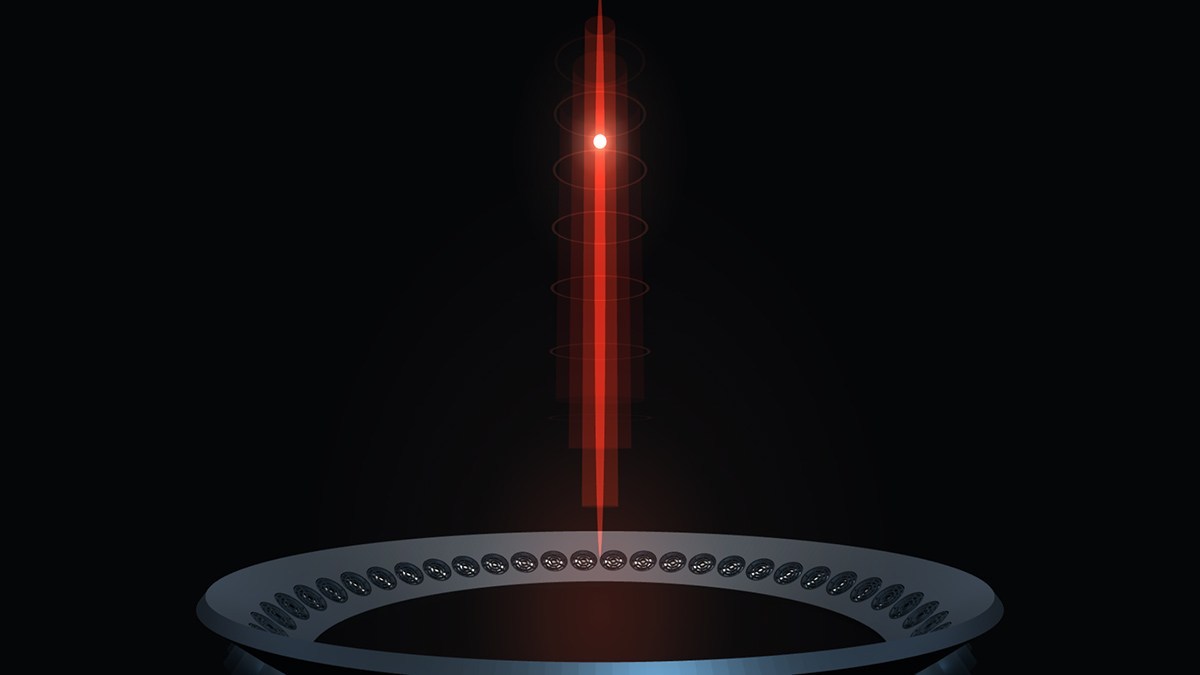
The breakthrough rests on a well-known but underutilized wave shape: the zero-order Bessel beam. Ordinary ultrasonic waves spread out as they travel, their intensity dropping with distance. A Bessel beam, by contrast, maintains a narrow, high-intensity core over a comparatively long range. It does not form a perfect cylinder—no physical wave ever does—but it resists the kind of rapid diffraction that has long limited one-sided levitation.
The researchers also flipped the traditional trapping strategy. Conventional acoustic levitation works by enclosing an object in a region of near-zero pressure surrounded by higher pressure—an acoustic bottle, essentially. Tsukuba and Bristol instead trapped objects directly within the high-pressure core of the Bessel beam. This approach had been predicted theoretically, but this is the first time it has been demonstrated in air at a meaningful distance.
Using a single transducer emitting the specialized beam, the team stably levitated polystyrene spheres with diameters of 1.5 millimeters at 40 centimeters. They manipulated those spheres in three dimensions. They levitated multiple objects simultaneously. They suspended irregular shapes—fragments of dried tea leaves and aerogel, both roughly a millimeter across. And they showed that the beam could recover its trapping shape even after passing behind a physical obstacle, allowing objects to be levitated on the far side of a barrier.
Who Wins—and Who Loses
The winners here are any industry that moves fragile, reactive, or valuable materials in clean or automated environments. Semiconductor fabrication is the most obvious candidate. Wafers and micro-components are routinely damaged by contact with manipulators; even the finest mechanical grippers leave microscopic scratches. An acoustic handler that can pick, place, and reposition a component from 40 centimeters away without any physical enclosure is a fundamentally different proposition than the close-range tray-based robots currently used in many clean rooms.
Pharmaceutical and chemical handling stands to gain as much. Many active compounds and intermediate substances are hygroscopic, oxidize on contact with surfaces, or are simply too valuable to waste on residue left by gripper jaws. A contactless transfer line that keeps a sample suspended in its own acoustic field during transport eliminates a whole class of contamination pathways.
Lab-on-a-chip and microfluidics developers are another clear beneficiary. Current digital microfluidics mostly rely on electrowetting or mechanical pumps. Acoustic propulsion of individual droplets through open channels—something this technology makes plausible at scale—could replace complex valve networks with fields of transducers patterned onto a board.
The losers are more abstract but real. Companies that sell enclosed acoustic levitation systems—those chamber-based setups that require matched transducer pairs and precise alignment—face a market that may contract. The economics of a single transducer array that works at 40 centimeters in an open environment are dramatically better than a full bilateral rig, and the footprint is a fraction of what it is today. Any vendor whose product line depends on the necessity of enclosing the levitation volume will feel that pressure first.
There is also a subtler competitive dimension. Japan has long been a leader in precision robotics and automation hardware. If Tsukuba’s approach becomes the basis for next-generation contactless handling platforms, the intellectual property around Bessel-beam transducer arrays and the control algorithms that steer them will sit at the center of a new supply chain tier. That is precisely the kind of foundational technology where early movers build durable moats.
What Happens Next
The paper demonstrates proof of principle with lightweight plastic spheres and low-density solids. Several questions remain before this reaches factory floors or production-line labs.
Mass is the first. The 1.5mm polystyrene sphere used in the experiment weighs fractions of a gram. Raising the levitated mass to the gram or tens-of-grams range—which is where useful industrial components live—requires substantially more acoustic power and likely larger transducer arrays. The physics does not forbid it, but the engineering cost is real.
Second is speed. Three-dimensional manipulation has been shown, but the paper does not describe how quickly an object can be moved from one point to another. Acoustic handlers are inherently slower than magnetic or robotic ones because they rely on wave propagation and pressure gradients rather than direct force transmission. If cycle times remain in the seconds-per-move range, the technology will find its niche in processes where contamination matters more than throughput.
Third is integration. A single transducer in a lab proves the concept. A production line requires dozens of coordinated arrays, each with its own power supply, cooling, and control interface, all synchronized to avoid destructive interference. That integration work is where the real engineering challenge lies, and it is also where the real value will be captured.
The obstacle-passing demonstration is worth watching closely. The fact that the Bessel beam reconvenes on the other side of a barrier means acoustic handlers can operate in environments where line-of-sight access is impossible—inside sealed enclosures, around crowded workstations, or through protective barriers in biosafety contexts. That capability alone could justify deployment in settings where conventional robots cannot operate at all.
Why This Matters Outside Japan
Japanese universities routinely publish incremental advances in applied acoustics. What makes this one notable is the combination of distance, simplicity, and generality. Six times the range is not a marginal improvement; it crosses a threshold where open-air acoustic manipulation becomes practically viable rather than theoretically interesting. And the single-transducer architecture is easy to scale, which means the barrier to entry for anyone wanting to build on this work is lower than for most precision-manufacturing technologies.
The timing matters too. Global supply chains are under pressure to reduce waste, eliminate cross-contamination, and automate handling of increasingly delicate materials—from perovskite solar cells to mRNA lipid nanoparticles. Each of those sectors is looking for a way to move things without touching them. This research offers a physically grounded path toward that goal.
Whether it becomes a mainstream industrial tool or remains a specialized solution depends on the answers to the mass, speed, and integration questions above. But the direction of travel is clear. The era of acoustic levitation confined to aligned transducer pairs in enclosed chambers is ending. The next phase—one transducer, open space, 40 centimeters and beyond—has already begun.