Japan's Phobos Mission Signals a Quiet Shift in the Space Race
Japan is launching the world's first mission to return samples from a Martian moon. The MMX probe is more than a scientific first—it's a statement about where power in the solar system is heading.
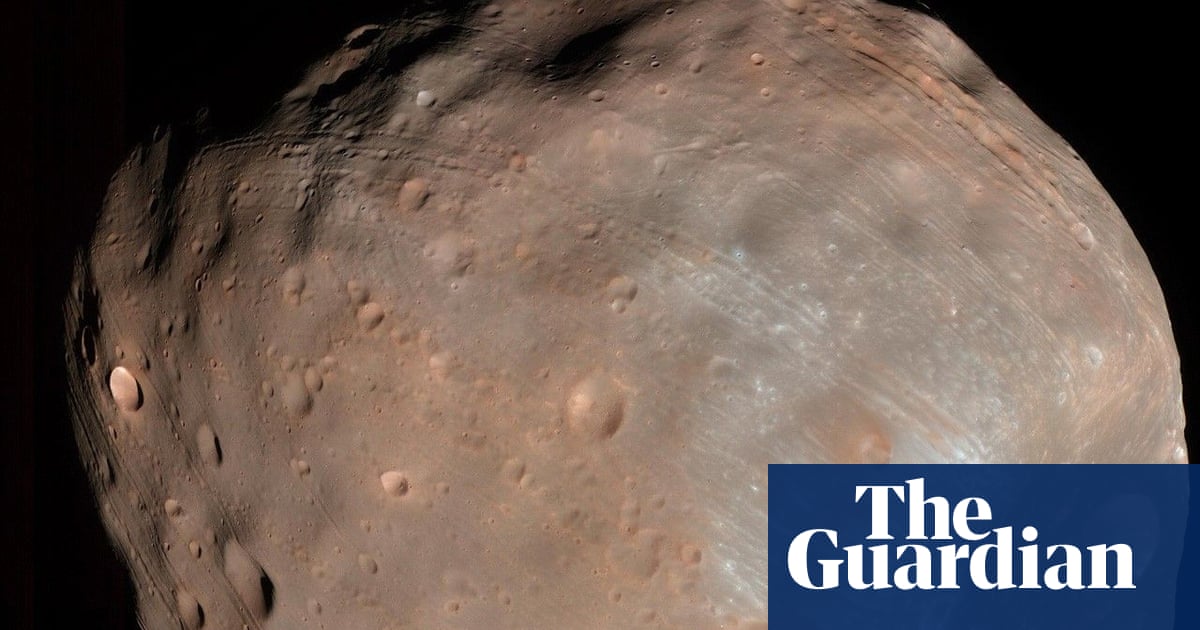
The world’s first Phobos sample return is launching Tuesday — and it says something about who’s taking space seriously now.
Japan is about to do what no one has managed before: bring home soil from a Martian moon. The Martian Moons eXploration (MMX) mission lifts off on the H3 rocket from Tanegashima Space Center, and if everything goes according to plan, a capsule will touch down in Australia in 2031 carrying at least 10 grams of Phobos material.
The science is genuine. The geopolitics are perhaps more interesting.
Why Phobos matters more than you’d think
Phobos is a lumpy, crater-pocked rock roughly 27 kilometers across, orbiting Mars at just 6,000 kilometers — close enough that it races across the Martian sky three times a day. Its smaller sibling, Deimos, hangs further out. Both have puzzled scientists since their discovery in 1877.
Are they captured asteroids? Leftover debris from a colossal impact on Mars? The leading theory suggests a violent collision billions of years ago flung material into orbit, which coalesced into the two moons. If that’s true, Phobos holds clues not just to Martian geology but to the early solar system’s violent adolescence — and potentially the delivery of organic material that seeded life.
Yasuhiro Kawakatsu, the mission’s project manager at the Japan Aerospace Exploration Agency (JAXA), put it starkly: “They are known as the most important unclimbed mountains in the solar system.” The metaphor is deliberate. Phobos isterra incognita, and Japan is about to plant a flag there — metaphorically, at least.
A mission stitched together from global spare parts
MMX is Japan’s lead, but it would be wrong to call it purely Japanese. The spacecraft carries 13 instruments and three international partners are embedded in its architecture:
- NASA is providing a sampling device that uses pressurised gas to lift surface dust — a technique never tested on a celestial body before.
- France and Germany jointly built Idefix, a small rover that will land on Phobos first and scout landing sites during a 100-day surface campaign around 2029.
- The European Space Agency is contributing deep-space communication capability.
- Japan’s own contribution is a coring instrument designed to drill roughly two centimetres underground — shallow by terrestrial standards but significant when gravity is one-two-thousandths of Earth’s.
The sampling strategy is methodical. The first landing will use both the American and Japanese extraction methods simultaneously, collecting surface and subsurface samples. A second landing targets additional underground material. Scientists hope multiple collection points increase the odds of finding traces of past microbial life — either native to Phobos or, more likely, spattered onto its surface from Mars itself.
JAXA estimates that about 0.1 per cent of the material recovered from Phobos could be Martian in origin — ejecta thrown off the Red Planet by impacts and gradually swept into Phobos’s orbit over eons. That tiny fraction could contain preserved biosignatures far better than anything rovers on the surface have found so far.
Japan’s growing confidence in deep space
This mission lands at a moment when Japan is recalibrating its posture in space. The H3 rocket, developed to replace the workmanlike H-IIA, has been a troubled programme — plagued by delays and a failed launch in 2023. Getting MMX off the pad on schedule would be a vindication for JAXA and a signal that Japan’s new heavy-lift capability is maturing.
More broadly, MMX represents Japan’s boldest interplanetary act since the Hayabusa programme returned samples from the asteroid Itokawa in 2010 and the asteroid Ryugu in 2020. Those missions proved Japan could design, build, and execute precision sample-return operations — something only the United States and China had attempted at planetary scale.
Now Japan is attempting something neither Washington nor Beijing has done: a sample return from a Martian moon. China is focused on its Tianwen-3 mission, also targeting Phobos, but that probe is not expected before the early 2030s. If MMX succeeds, Japan becomes the first nation to deliver Phobos material to Earth — and the third country (after the US and USSR) to return samples from beyond the Earth-Moon system.
The quiet intensification of the Mars race
The headline叙事 around Mars has been dominated by the question of human exploration. NASA’s Artemis programme aims to return humans to the Moon as a stepping stone; SpaceX’s Starship is being designed explicitly for Mars; China has announced ambitions for crewed Mars missions by the 2040s. Through all of this, the moons of Mars have been treated as ancillary — interesting but not central.
Japan is reframing that calculus. Kawakatsu explicitly linked Phobos samples to future human exploration, noting that data from MMX could inform plans to use a Martian moon as a staging base for crewed missions to the planet’s surface. The logic is sound: Phobos’s low gravity makes it an easy target for landing and launch, and its proximity to Mars means short transit times for surface operations.
This is a subtle but significant shift. The space race is no longer just about who can land on Mars first — it’s about who can build the infrastructure for sustained presence. Japan is positioning itself as a provider of critical intelligence for that future architecture.
Who wins, who loses, and what happens next
The immediate winner is science. Phobos samples will fill gaps in planetary science that orbital observations simply cannot address. We now know enough about the Martian moons from flybys and orbiters to know how much we don’t know. Return samples change that equation fundamentally.
Japan also wins — reputational capital, industrial experience, and a stronger case for continued investment in deep-space infrastructure. The international collaboration on MMX reinforces Japan’s role as a reliable partner for agencies that sometimes view it as a component supplier rather than a mission architect.
The losers are harder to name. Russia’s repeated failures on Phobos — including the notorious Phobos-Grunt mission that burned up in 2012 after a stuck engine — stand as a cautionary counterpoint. China’s Tianwen-3 will compete for the same prize but arrives later. The United States has no sample-return mission to Phobos in development, leaving a gap that Japan is filling.
What happens next is straightforward: after the 2031 return, the samples will undergo years of analysis in JAXA’s clean facilities and in partner laboratories worldwide. The questions MMX aims to answer — formation history, composition, potential biosignatures — will generate thousands of papers and reshape textbooks.
But the larger story is one of trajectory. Japan entered the space age as a follower. Haybusa proved it could innovate in sample return. MMX is the next step: a world-first mission that asserts Japan’s place among the deep-space pioneers. The Red Planet may get the headlines, but the moons are where the next chapter of solar-system exploration is being written — and Japan is already turning the page.