When Banks Fall, Your Password Is No Longer Enough
AI-powered credential stuffing has breached major South Korean banks. The attacks reveal a fundamental shift: stolen passwords alone are no longer the only threat — stolen identities chained across services are.
The Attack That Proved Passwords Alone Aren’t Enough
Three of South Korea’s largest banks — Shinhan, KB Kookmin, and Hana — found their defenses rattled by coordinated account takeover attacks powered by generative AI. What made this incident worth watching internationally is not the breach itself, but the mechanism: credential stuffing, amplified by AI, weaponized at scale against the very infrastructure people trust most with their money.
Credential stuffing is nothing new. For years, cybercriminals have harvested username-password pairs from data breaches and run them through automated login attempts against other services. The logic is blunt — people reuse passwords across sites, and if one site falls, dozens follow. But generative AI has changed the mathematics of this attack. It is no longer just about volume. It is about precision.
AI tools now help attackers stitch together fragmented personal data from multiple sources, identify which credentials are most valuable, and tailor login attempts to bypass detection systems. The result is a campaign that is simultaneously broad enough to flood banks with thousands of attempts and narrow enough to target high-value accounts with customized tactics. That combination is what makes this particular wave of attacks different from previous waves.
The Real Vulnerability Is the Web of Accounts, Not a Single Door
The most important insight from these attacks is structural, not technical. Most people treat each online account as a separate vault. In reality, accounts are nodes in a single graph — and email is the central hub.
When a breach occurs at one site, the attacker does not need to crack your bank. They need your email. Most web services use email as the recovery channel. Reset the password for your email, and you hold the master key to every account that trusts that address to verify your identity. The Korean security firm AhnLab flagged this exact chain reaction, noting that a single compromised email can cascade into drained bank accounts and emptied shopping profiles.
This is why the traditional advice — change the password on the breached site first — is dangerously incomplete. If you used the same password elsewhere, or if your email was also compromised, changing one site’s credentials does nothing to stop the spread. The correct sequence is email first, then every account that shares that email’s recovery path.
What Multi-Factor Authentication Actually Changes
The industry consensus, echoed by AhnLab and other security researchers, is blunt: password reuse must end, and multi-factor authentication must be non-negotiable. But the nuance matters.
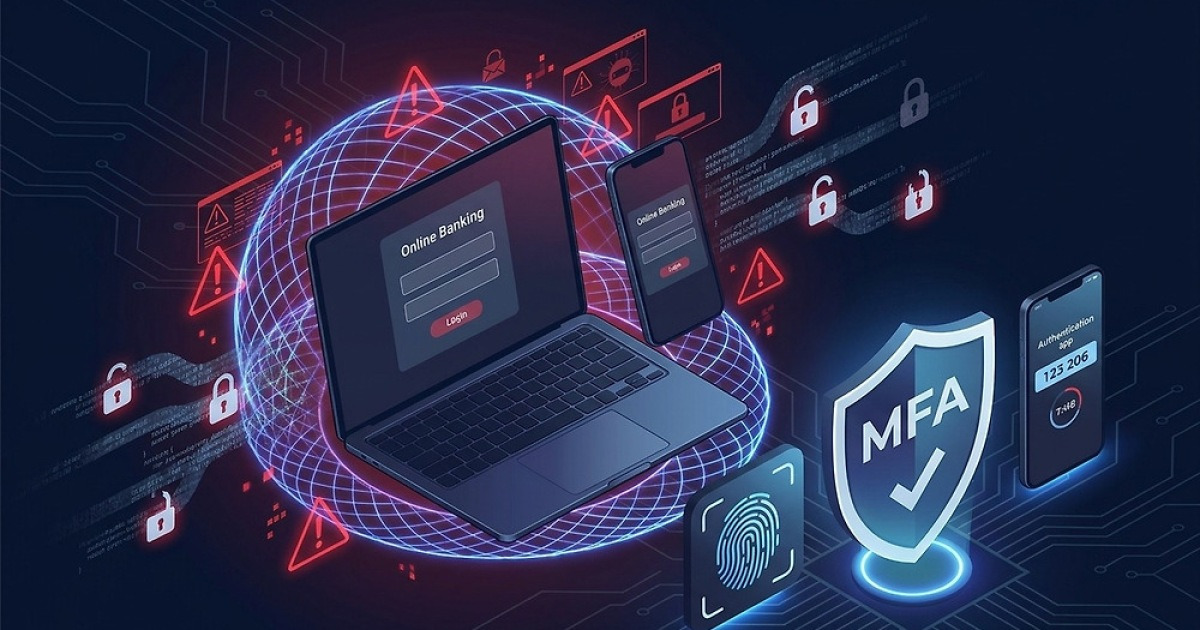
MFA is not a magic wall. It is a friction layer. When an attacker has your password and your email, the second factor — a push notification to your phone, a code from an authenticator app — is the thing that stops the breach from becoming a theft. The absence of MFA is what turned previous credential stuffing campaigns from nuisances into catastrophic losses.
The attacks on Korean banks demonstrate this clearly. When MFA was in place, many login attempts failed at the second checkpoint. When it was not, accounts were accessible. The difference between a near miss and a drained account is often as simple as whether a user enabled a second verification step.
But MFA fatigue — the tactic of flooding a victim with approval requests until they impatiently accept one — is a known countermeasure. Attackers have used automated tools to generate hundreds of login prompts per hour, banking on the assumption that most users will approve one just to make it stop. This is where awareness becomes a security control: any approval request you did not initiate should be treated as an active intrusion, not an inconvenience.
The Phishing Fallback When the Front Door Fails
When credential stuffing hits a wall of MFA, attackers pivot. The Korean incident reports describe a wave of smishing and phishing messages following the bank breaches, spoofing official communications from financial institutions. The messages reference real names, real phone numbers, and real account details pulled from leaked databases — making them indistinguishable from legitimate notices at a glance.
These messages typically carry one of three hooks: a link to verify whether your data was exposed, a prompt to claim compensation, or a request to update your account for security reasons. Each link leads to a credential-harvesting page designed to look identical to the bank’s official login portal.
The countermeasure is mechanical, not behavioral. Do not click links in unsolicited messages about data breaches. Open the bank’s app directly or type the URL into your browser. If you receive an unexpected password-reset notification, log in through the official channel and review your session history for any devices or locations you do not recognize. Log out of all sessions immediately if you find anomalies, and verify that your recovery phone number and backup email have not been altered.
What Banks and Fintech Platforms Must Fix
Individual vigilance is necessary but insufficient. The attacks exploited gaps that no amount of user caution can fully close — specifically, the API layer that connects bank systems to third-party services and internal networks.
AhnLab’s analysis stressed that financial institutions need stricter API authentication, real-time monitoring for abnormal request patterns, and expanded visibility into administrator networks and third-party vendor connections. Customer data should be minimized to what is strictly necessary, reducing the blast radius of any single breach.
This is not a Korean problem. It is a structural feature of modern banking: every API endpoint, every partner integration, and every legacy system with access to customer records is a potential entry point. AI lowers the skill floor for exploiting those points, meaning attacks that once required specialized knowledge are now automatable. The defensive response must match that speed.
Who Wins, Who Loses, and What Comes Next
The winners in this dynamic are the attackers, who benefit from lowering infrastructure costs and increasing success rates through AI automation. The losers are individual users, who inherit the burden of securing accounts whose underlying systems they do not control.
Regulators will respond. South Korea’s Financial Services Commission has already begun reviewing authentication standards across major banks, and similar scrutiny is likely in the EU, the US, and elsewhere. Expect tightened requirements for MFA enforcement, mandatory breach-notification timelines, and potentially stricter rules on how long financial institutions can retain customer credentials.
For users, the practical takeaway is narrow but urgent. Stop reusing passwords. Use a password manager. Enable MFA everywhere, preferably with an authenticator app rather than SMS. Treat every breach notification as a cascading event, not an isolated one. And when in doubt, go through the app, not the link.
The era of password-only authentication is not ending because banks want it to. It is ending because the attacks have finally outpaced the old defenses.