AI Cheating Scandal Shakes South Korea's Exam Faith
A tax accountant exam fraud case has exposed vulnerabilities in South Korea's high-stakes testing system. Officials scramble for solutions before the national college entrance exam draws half a million students.
The Meritocracy Crack
South Korea operates one of the world’s most unforgiving academic pressure cookers. A single standardized exam — the Suneung, or College Scholastic Ability Test — determines university placement, which in turn shapes employment prospects, social standing, and even marriage markets. For decades, the system’s legitimacy rested on a simple premise: those who cheat are exposed; those who study hard succeed.
That premise is unraveling.
A month before more than 500,000 students are scheduled to sit for the Suneung, authorities confirmed that a candidate had used artificial intelligence to illegally pass a national tax accountant certification exam. The revelation has sent shockwaves through a system that cannot afford another crack.
How the Fraud Worked
Han Won-seok, a 34-year-old man, scored 397.5 out of 400 on the multiple-choice section of the tax accountant exam in April and 663 out of 800 on the essay portion in July. One Korean newspaper described the performance as “running a 100-meter sprint in under five seconds” — a result so far outside the norm that it drew immediate scrutiny.
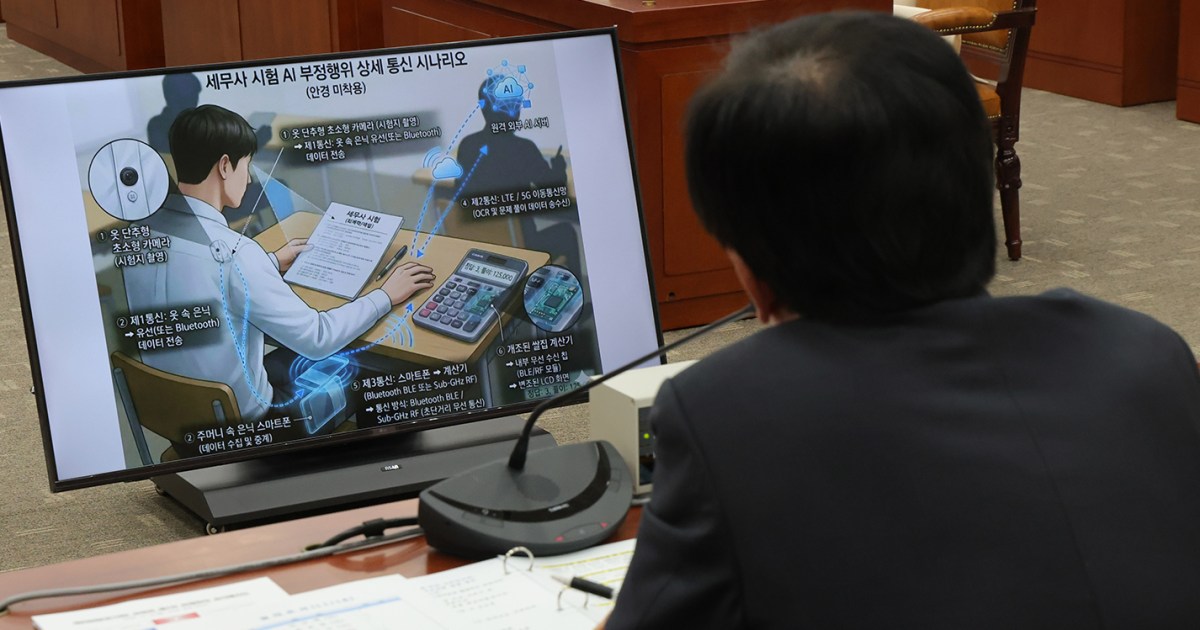
According to a video posted by his lawyer, Han placed a hidden microcamera near the test venue, captured images of the questions, transmitted them to a smartphone, and fed them into a generative AI tool that produced answers he submitted during the exam.
The method is crude compared to what technologists envision as the next generation of cheating tools — wireless earpieces, augmented-reality contact lenses, subdermal implants capable of receiving coded signals in real time. But the simplicity is also the danger. The equipment costs less than $200. It requires no specialized training. And it bypasses every traditional anti-cheating measure built over decades.
What Comes Next
Education Minister Choi Kyo-jin told lawmakers Monday that he would not delay the Suneung despite calls from some legislators to postpone the exam until stronger safeguards were in place. A postponement, he argued, would create “even a larger disruption” for students.
The ministry is responding anyway. At each of the country’s 1,300 test sites, officials will deploy at least one specially trained supervisor to identify devices including AI-powered smart glasses, which typically have thick horn-rimmed frames. Proctors have received new guidance on detecting concealed cameras, with instructions to watch for suspicious movements involving sleeves, collars, buttons, and certain hand gestures.
Prime Minister Han Seongsook’s office said authorities are considering requiring test-takers to surrender smart devices and shutting down public Wi-Fi at exam centers. Vice Education Minister Choi Eun-ok confirmed discussions with the Ministry of Science and Information and Communication Technology about temporarily restricting telecommunications at test sites.
Here lies the central contradiction. South Korea cannot jam cell phone signals — existing law prohibits electronic signal jamming, and authorities worry about interference with emergency communications in surrounding areas. Metal detectors and radio-frequency detectors face their own limitations. Thermal cameras are deemed impractical due to privacy concerns. Supervisors cannot search belongings without consent.
Song Geun-hyeon, a senior official at the Education Ministry, acknowledged the gap directly. Officials are debating whether manufacturers should be required to design smart devices that emit flashing lights or sounds when in use — a policy resembling the approach taken in some European countries for body-worn cameras.
Why This Matters Beyond Korea
The Han case is not isolated. In June, test-takers were caught wearing AI-powered smart glasses on an English-language standardized exam. In October, university essay exams reported similar incidents. Each case followed the same pattern: a device small enough to conceal, powerful enough to solve problems faster than any human student could, and invisible to every detection method currently employed.
The implications extend well beyond South Korea’s borders.
Japan administers the Center Test for university admissions, China relies on the Gaokao, and India depends on engineering and medical entrance examinations — all high-stakes, all intensely competitive, all sharing the same assumption that exams produce merit-based outcomes. AI cheating threatens each system with equal force.
What distinguishes East Asia from other regions is the cultural weight given to these examinations. In societies where Confucian traditions elevate educational achievement as the primary path to social mobility, a single exam can determine life trajectory. When that legitimacy is questioned, the consequences go beyond individual scoring disputes. They strike at the social contract itself.
Who Wins, Who Loses
Those who can afford the technology win. Han reportedly scored at levels considered impossible by conventional standards — scores that a decade ago might have been dismissed as statistical outliers. His success demonstrates that wealth and technical literacy can substitute for years of preparation.
Students who studied honestly lose. Not only do they face compromised competition, but they also inherit a system whose credibility erodes with each new scandal. Universities may begin second-guessing admission decisions. Employers may question the validity of degrees earned through institutions whose entrance exams proved vulnerable. The long-term cost falls on everyone who believes the system was fair.
Governments lose most of all. South Korea already suspends flights during the English listening section of the Suneung. Police officers escort late test-takers on motorcycles. The stock market delays opening. The military sometimes halts training near testing sites. These extraordinary measures exist to protect exam integrity. When the integrity fails, the effort appears absurd rather than noble.
The Hard Truth
The technological arms race between cheating and detection favors cheaters. Smart glasses grow thinner every quarter. Generative AI models improve faster than any institution can rewrite exam protocols. Cameras shrink while battery life extends.
South Korea’s response — enhanced proctor training, possible device bans, discussions about mandatory device signaling — represents the best of a limited set of options. None of these measures address the fundamental problem: AI-assisted cheating does not require sophisticated equipment or insider access. It requires only a smartphone, a camera, and internet connectivity — tools available to anyone willing to risk disqualification.
The government will announce additional measures Tuesday. Officials are working urgently. But no announcement can change the underlying reality: the very notion that a single day of testing produces reliable meritocratic sorting is now in doubt across East Asia.
Whether South Korea, Japan, China, or India decides to reform or merely reinforce their examination systems remains unclear. What is clear is that the era of unchallenged faith in standardized testing as a proxy for ability has ended.