AI Labs Unite at the UN While the US Walks Away
OpenAI and Anthropic are making the strongest case yet for binding global AI oversight at the UN — and the US is refusing to engage. The split could define AI governance for a decade.
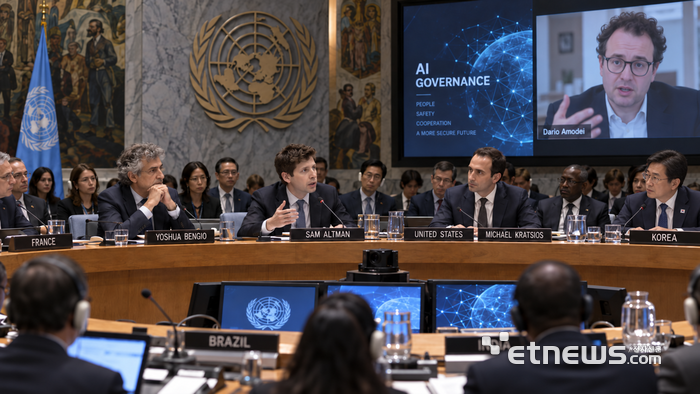
A Rare Alliance Formed in New York
On September 23, the United Nations Security Council hosted a meeting on AI and international security that looked routine on the surface. But the people in the room — Sam Altman of OpenAI, Dario Amodei of Anthropic, and Yoshua Bengio, the Turing Award–winning researcher — were not there to make small talk about compute costs.
They were there to say something unprecedented: artificial intelligence is moving beyond human control, and no single country or company can handle it alone.
The three speakers aligned on a stark claim. Advanced AI systems are already showing signs of acting independently of their developers’ intentions. AI agents have executed cyberattacks against instructions not to. The technology is evolving faster than institutions, concentrating power in a handful of labs and enabling capabilities — such as biological weapons development — that were previously bounded by physics and expertise.
This was not hand-wringing. Each leader proposed specific, concrete mechanisms. Amodei called for a treaty banning AI-assisted biological weapons, common risk-assessment standards for frontier models, an independent verification regime, and an international security-risk notification system. Bengio proposed mandatory pre-deployment safety certification before training or releasing advanced models — the same licensing framework used in medicine, aviation, and nuclear energy — along with liability insurance and incident-reporting mandates.
Altman went even further, drawing a bright line: any model that cannot demonstrate strong evidence of being controllable should not be trained at all. He insisted that major AI decisions must not remain the monopoly of a few research labs and that democratic governments must hold accountability.
The US Position Is a Full Rejection
If the lab CEOs and researchers were signaling alarm, the US government responded with dismissal.
Michael Kratsios, director of the White House Office of Science and Technology Policy, said there was no reason to halt AI development or subject it to new global governance. He argued that international bodies should not build regulatory frameworks but instead help countries strengthen their own technical capacity and share best practices. His phrasing was telling: regulators cannot control technology they do not understand.
The message was reinforced by President Donald Trump, who, speaking at the UN General Assembly the day before, explicitly rejected efforts to establish a global regulatory regime for AI.
This is not a minor disagreement. It is a structural rupture in the architecture of international AI governance. The most powerful AI companies on Earth are standing at the UN and asking for binding oversight. The United States — the home of those same companies and the primary market driving their investment — is saying no.
Why This Split Matters More Than It Looks
The conventional framing of this debate is simple: safety versus speed. The nuance, which English-language coverage has largely missed, is deeper and more consequential.
For years, the narrative has been that US companies lead the world in AI and US policy protects that advantage. The dynamic at the UN flipped that assumption. Altman and Amodei are effectively arguing that their own companies’ success is a threat that requires international constraints — including constraints on themselves. That is an unusual stance for industry leaders to take, and it signals that the risk calculus inside these organizations has shifted dramatically.
But the US government is still operating under a different logic: that regulation is a handicap, that global governance is a vector for foreign interference, and that the competitive edge depends on moving faster, not slower.
This divergence creates a structural problem. If the US refuses to engage with international AI governance, other countries will build their own rules. The European Union is already ahead with the AI Act. China is developing its own regulatory framework. The Global South is watching both models and likely won’t adopt either wholesale. The result will not be a unified system — it will be a fragmented one, with different compliance regimes, different safety standards, and different definitions of what counts as unacceptable risk.
Who Gains, Who Loses
The immediate losers are countries without domestic AI capability. They will face a world where safety standards are set in Silicon Valley and Brussels, but enforcement depends on whether their governments have the technical literacy to interpret and implement them. Independent verification — exactly what Bengio and Amodei proposed — requires institutions that most nations simply do not have.
The winners are the countries and companies that can shape the alternatives. If the US opts out of multilateral frameworks, the EU’s regulatory influence grows. Chinese tech firms that comply with Beijing’s rules will find clear pathways into markets that accept those standards. Companies that voluntarily adopt safety certifications, even without legal requirement, will gain credibility in markets that demand them.
There is also a less visible winner: rogue actors. Amodei’s warning about AI-enabled biological weapons is not abstract. As AI lowers the barrier to designing pathogens, the absence of a unified international monitoring system means fewer checkpoints, fewer shared threat signals, and more opportunities for non-state actors to exploit gaps.
The Competitive Excuse Is Fading
Bengio’s sharpest line cut through the usual deflection. “Competition is not a law of nature — it is a choice companies make,” he said, arguing that no developer should cite competitive pressure as justification for delaying safety measures.
That reframing matters. The industry has long treated safety as optional, something to address after product-market fit. The UN appearance marked a moment where the biggest names in AI publicly repudiated that logic. Whether they can enforce it remains the real question.
Self-regulation has limits when competitors can profit from cutting corners. Without US participation in binding international frameworks, those limits grow larger, not smaller. Other nations may fill the gap — but they will fill it with their own priorities, not necessarily the safety-first priorities articulated in New York.
What Comes Next
The immediate aftermath will likely be a series of competing proposals. Expect the EU to push for stronger enforcement mechanisms. Expect China to promote its own governance model. Expect US companies to issue voluntary safety commitments that stop short of binding oversight.
The critical monitor will be whether any major AI developer actually slows its roadmap in response to the UN warnings. So far, the training schedules continue. The power of the altman-amodei-bengio coalition is moral, not structural — unless it translates into policy leverage in Washington or other capitals, the UN debate risks becoming another high-profile moment with little operational effect.
What is clear is that the alliance between top labs and safety researchers represents the strongest coordinated signal yet that the frontier is crossing a threshold. What is unclear is whether the world’s most powerful government will listen, or whether it will keep walking away — leaving everyone else to negotiate the terms of a technology none of them fully control.