AirPods 5 Makes Translation the New Sleep Mode
Apple's AirPods 5 brings real-time translation and Siri AI to its mainstream earbuds for the first time. The move signals that personal AI hardware is finally taking shape—and the language market is the battleground.
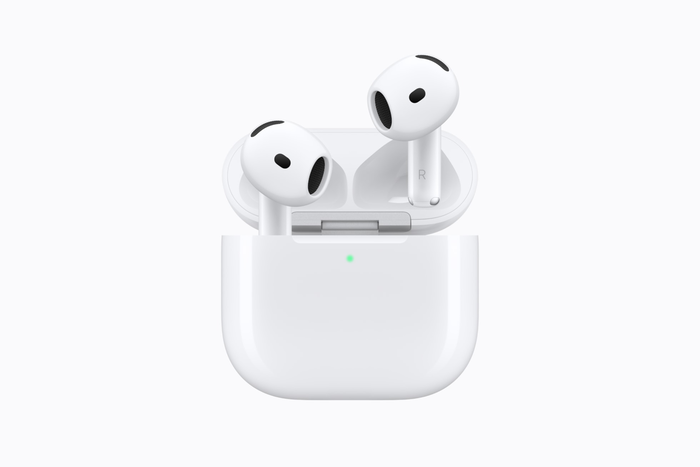
Apple Just Turned Its Cheapest Earbuds Into a Translation Machine
Apple revealed the AirPods 5 on September 9 at its Cupertino campus, and the most interesting detail wasn’t the headline specs. It was the one that nobody outside Korea will immediately understand why it matters: real-time translation built directly into the earbuds, paired with Siri AI that can respond to a head nod or a shake.
The device starts at 199,000 won—under 200,000 won for the first time in Apple’s open-style lineup. That pricing alone is strategic. Apple has historically kept its most ambitious AI features locked to premium tiers. Dropping them to the base model signals that the company no longer views AI as a luxury upgrade. It views it as infrastructure.
The Noise-Canceling Arms Race Has a New Metric
The AirPods 5 deliver up to 50 percent more noise reduction than the AirPods 4 ANC, according to Apple. The architecture is new—multi-port acoustic design borrowed from the AirPods Pro 3, tuned for an open-fit form factor. Adaptive EQ, personalized spatial audio, conversation detection that automatically lowers media volume when you start speaking. The hardware polish is real.
But the hardware is table stakes now. Every major earbud maker—Sony, Samsung, Bose—has ANC at this level. The differentiator is what Apple is doing with the processed audio stream: feeding it into an on-device AI pipeline that can translate speech in real time.
That is the product now. Not the driver. The pipeline.
Translation as the Killer Use Case for AI Earbuds
Real-time translation in earbuds is not new. Google’s Pixel Buds did it years ago. Samsung has pushed conversational translation through Galaxy AI. But Apple’s approach is distinct because it is tightly coupled with Siri AI and the broader Apple Intelligence ecosystem. The translation does not live in a separate app. It runs through the same contextual understanding that handles messages, emails, photos, and app commands.
The implications are larger than convenience.
When translation becomes ambient—always-on, always-available, always-personalized—the entire category of language-learning apps, travel translation tools, and even some aspects of remote work shift. You no longer need a separate device, a separate app, or a separate subscription. The tool is already in your ear.
Apple is betting that the marginal value of adding translation to an earbud you already own exceeds the friction of learning a new workflow. That bet is reasonable. It is also late.
Who Won, Who Lost, Who Is Still Trying to Catch Up
The immediate winners are Apple customers who travel, work across languages, or simply want to watch foreign content without reading subtitles. The AirPods 5 with wireless charging case—priced at 229,000 won—extend battery life to 22 hours total, with up to 5 hours on a single charge with ANC on. The wireless case model adds stem-swipe volume control. These are refinements, not revolutions.
The losers are the companies that built their earbud narratives around either pure audio quality or pure translation. Nobody wins on audio alone anymore. Nobody wins on translation alone anymore. The winning position is the integrated one, and Apple now occupies it at the mainstream price point.
Samsung is the most obvious competitor. The Galaxy Buds series already supports Korean-language AI features ahead of English rollouts—a reversal of Apple’s current sequence. Samsung will likely respond with tighter Galaxy AI integration in its next iteration. Google is in an even harder position: the Pixel Buds Pro exists, the translation pipeline is mature, but Google has never had Apple’s install base or pricing power at the mass end.
Chinese manufacturers—Xiaomi, Huawei, Oppo—are closing the gap quickly and at lower price points. Their translation models are improving. Their hardware integration is sharper. But they face a different problem: lack of deep ecosystem lock-in outside China and limited iOS compatibility for AI features.
The Siri AI Rollout Is the Real Story
Apple Intelligence, and specifically the Siri AI overhaul available in iOS 27, is still early. English is the priority language. Korean arrives in October. The head-nod-and-shake gesture interface for Siri is a small but meaningful design choice—it makes the AI feel embodied rather than abstract. You do not tap a screen. You respond the way you would to a person.
This is a subtle but important direction for the entire AI-wearable category. The best AI assistant is not the one with the most capabilities. It is the one that disappears into the interaction. Siri’s new gestural responses, combined with always-listening translation, push Apple toward that ideal faster than any other platform.
What Happens Next
The AirPods 5 go on sale September 18. That date is meaningless in isolation. What matters is the trajectory: Apple is moving AI features from Pro-only to mainstream, from app-bound to hardware-native, from English-first to multilingual-on-a-timeline.
The real-time translation feature will have limits. Supported languages and regions are restricted. It requires the latest iPhone and software. Apple is being careful about overpromising. But the direction is clear.
Earbuds are no longer about sound. They are about context. The device that knows what you hear, what you say, and what you mean—then acts on it without a screen—is the one that wins the next decade of personal AI.