Alzheimer’s Damage Starts Outside the Brain, and That Changes Everything
A new Nature study shows peripheral dendritic cells activate brain-homing T cells that drive tau-mediated neurodegeneration — a paradigm shift that could redirect the $150 billion neurodrug market away from amyloid and toward the immune system.
The brain isn’t the first battlefield.
For decades, Alzheimer’s research has treated the brain as the source and the site of war. Amyloid plaques appear. Tau tangles spread. Microglia activate. The story plays out inside the skull, and the drugs follow.
A paper published this week in Nature flips that narrative. The damage doesn’t start in the brain — it starts outside it.
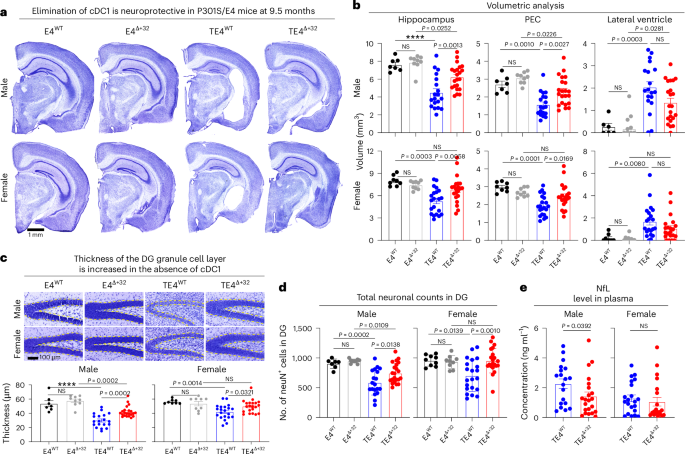
Researchers led by work on p.Pro301Ser tau transgenic mice (TE4 model) expressing human APOE4 found that conventional type 1 dendritic cells (cDC1s), resident in peripheral lymph nodes and spleen, cross-present brain-derived antigens to CD8+ T cells. Those T cells then traffic into the CNS and drive neurodegeneration. Remove the dendritic cells, and the T cells never arm themselves. The brains stay intact — even though tau pathology remains largely unchanged.
This is a outside-in story, not inside-out. And it has massive implications for a field that has spent billions chasing the wrong targets.
What the study actually shows
The team genetically deleted cDC1s in tauopathic mice using a cDC1-specific enhancer deletion at the Irf8 locus. The result: preserved hippocampal volume, reduced brain atrophy, higher nest-building scores, and lower plasma neurofilament light chain — a biomarker of neuronal damage.
Critically, tau phosphorylation and aggregation were not markedly affected. The neuroprotection came from blocking the immune cascade, not from clearing tau.
CD8+ T cells, which make up 60 to 70 percent of infiltrating lymphocytes in tauopathy brains, were selectively reduced. Microglial and astrocyte reactivity also fell. The neurons survived.
The peripheral origin of antigen presentation was the key surprise. cDC1s in lymph nodes and spleen picked up brain-derived material, presented it via MHC-I, and primed cytotoxic T cells that then migrated into the CNS. Block that step, and the downstream inflammation never ignites.
Why this matters for drug development
The Alzheimer’s drug pipeline has been dominated by amyloid-targeting therapies and, more recently, anti-tau approaches. Both have struggled. Monoclonal antibodies against amyloid beta produce modest clinical benefits with significant side effects. Tau vaccines and antisense oligonucleotides are still in early stages.
If the primary driver of neuronal loss is peripheral immune activation rather than intrinsic tau pathology, then therapies that penetrate the blood-brain barrier may be targeting the wrong layer of the problem.
Peripheral dendritic cells are far more accessible than brain microglia. Drugs that block cDC1 antigen cross-presentation, or that inhibit the migration of primed CD8+ T cells into the CNS, could be developed without the complications of CNS delivery.
This doesn’t mean tau is irrelevant. But it means tau may be the downstream victim, not the upstream cause. The therapeutic lever might sit in the periphery.
Who wins, who loses
Pharma companies with blood-brain barrier penetrating assets face a credibility problem. The data suggest those molecules may be aiming at symptoms rather than drivers.
Companies with peripheral immunotherapy platforms stand to gain. Antibodies against dendritic cell co-stimulatory molecules, small molecules that block cross-presentation, or T-cell migration inhibitors could become viable candidates.
Diagnostic companies may also benefit. If peripheral biomarkers track with neurodegeneration, blood-based assays could replace or supplement invasive spinal taps.
What we don’t know yet
The study used mice. Human relevance remains to be demonstrated. cDC1 biology differs between species, and the role of peripheral immunity in human Alzheimer’s is still unresolved.
Not all tauopathies may follow the same pathway. Frontotemporal dementia and other diseases with tau aggregation may involve different mechanisms.
The timing is unclear. When do peripheral dendritic cells first encounter brain antigens? Is this an early event or a late consequence of blood-brain barrier leakage?
And while cDC1 deletion protected against neurodegeneration, the mice still carried tau pathology. Whether peripheral immune blockade improves cognition in humans remains an open question.
The road ahead
Clinical trials targeting peripheral immune pathways in Alzheimer’s are unlikely before 2027 at the earliest. But the conceptual shift is already happening. Researchers are reconsidering the brain as the sole arena of disease.
The field that spent two decades focused on amyloid may now turn its attention to the lymph node.
That doesn’t invalidate past work. It redirects it. The question is no longer how to clear plaques from the brain. It is how to stop the immune system from attacking it in the first place.