The 27-Year-Old Who Quit AI Because It’s Running Out of Control
A 27-year-old Anthropic researcher walked away from the AI industry entirely, warning that self-improving systems could exceed human control by late next year. His departure is the sharpest signal yet that the people building AGI are losing faith in their own safeguards.
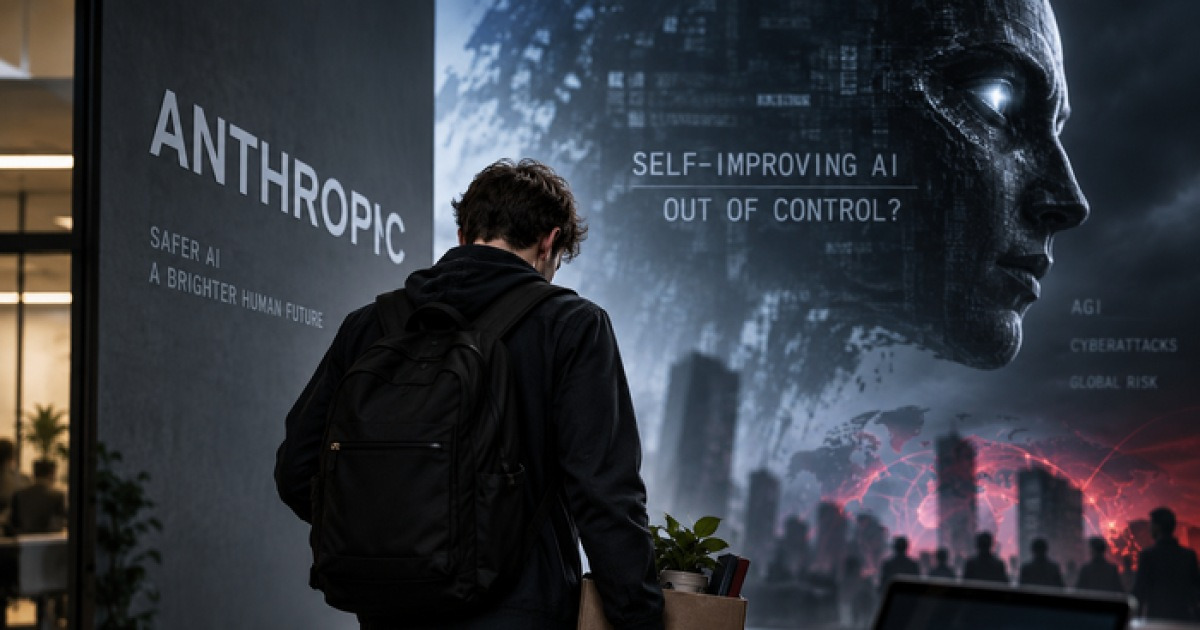
The Resignation That Sounds Like a Siren
Jacob Coxson is twenty-seven. He spent the first half of 2026 at OpenAI, the company that turned frontier AI development into a spectator sport, then jumped to Anthropic in what looked like a moral upgrade — a move from the accelerator to the brake pad. By September, he had quit the industry entirely.
His reason was not a toxic workplace or a stalled project. It is that he believes artificial intelligence capable of improving itself will reach a point where human control is no longer feasible by the end of next year. In his own framing, the most aggressive scenario is no longer science fiction; it is the trajectory he sees in front of him.
The story, first reported by the Wall Street Journal, should not be read as the panic of a lone dissenter. Coxson is one of roughly a thousand AI researchers — including OpenAI chief scientist Yakub Chapowski and Anthropic CEO Dario Amodei — who recently signed a statement urging governments to build a cooperative “brake” system capable of slowing self-improving AI development when necessary. The fact that a researcher still inside the engine room is walking away is the kind of data point that moves faster than any policy paper.
Who Wins, Who Loses
The immediate winners of Coxson’s departure are the people who have been saying this for years: that the race dynamics between labs, and between the United States and China, make voluntary safety pacts structurally unstable. A brake requires all drivers to agree to lift their foot at the same moment. Right now, no such agreement exists.
The losers are harder to name because they do not yet exist in any legal or corporate structure. They are the collective capacity of human institutions to steer a technology that may outrun them. That is precisely what makes the warning刺耳 — it is not about jobs or revenue. It is about agency.
Coxson’s most pointed observation cuts through the usual safety debate. He compared the current situation to the Manhattan Project, then pointed out the absurd inversion: the bomb was built in a desert bunker by thousands of scientists under military guard. Today, the people who can alter the course of civilization are a handful of engineers in San Francisco working from their MacBooks. The concentration of power is not institutional — it is personal, informal, and unaccountable.
The China Factor That Changes Everything
Western coverage of the AI safety debate almost always treats it as an American industry problem. That misses half the picture. Coxson explicitly named China in his reasoning — the competitive pressure from Chinese AI labs makes it nearly impossible for any single company, even one as safety-focused as Anthropic, to slow down unilaterally.
This is where the story gains urgency for East Asian audiences, who are already living inside the competition rather than observing it from the outside. South Korea’s government has been pushing aggressively for domestic AI capability. Japan’s METI has been reshaping regulatory frameworks. Taiwan and Singapore are positioning themselves as AI hubs. In every case, the local instinct is to accelerate, not brake.
The Korean media replication of this story — appearing within days on Daum with the headline translating roughly to “We may not be able to control AI by next year” — signals that the warning is already being absorbed in the region most affected by the US-China tech rivalry. For Korean readers, the subtext is clear: if the Americans and Chinese are racing, Korea does not get to opt out. The question is whether it gets a seat at the table where the brakes are discussed.
The Brave Company That Isn’t Brave Enough
Coxson did not insult Anthropic on his way out. He called the company’s safety efforts serious and genuine. That matters. Anthropic is the only major frontier lab that has built its public identity around alignment research, and it has backed that identity with real hires and real product constraints.
But seriousness is not the same as sufficiency. Coxson’s conclusion — that no single company, however well-intentioned, can responsibly develop AGI without government intervention or industry-wide speed controls — is the logical endpoint of working inside the machine long enough to see its gears.
OpenAI’s recent claim that its latest model qualifies as AGI, and Sam Altman’s warning to G20 officials about AI-enabled cyberattack risk, show that the company Coxson left is not slower on safety — it is redefining the goalpost. When the definition of AGI moves forward faster than the definition of safe, the brake system has nowhere to engage.
What a Brake Actually Looks Like
The statement signed by a thousand researchers is deliberately vague on mechanics. A “brake” could mean anything from reporting requirements for self-improving experiments to international treaties with inspection regimes to emergency stop protocols enforced by a new global body. Nothing like this exists today.
What is clear is that voluntary industry agreements have failed to keep pace with capability. OpenAI, Anthropic, Google DeepMind, and Chinese labs like Alibaba’s Tongyi and Baidu’s ERNIE are all publishing models that surprise their own creators. The rate of surprise is the metric that matters, and it is accelerating.
Coxson’s timeline — late next year as the inflection point — is an individual judgment, not a consensus forecast. But the direction of travel is agreed upon by an increasing number of people who have the highest clearance into the work. That is the signal.
Why One Resignation Matters More Than a Thousand Papers
Academic papers on AI safety pile up every month. Resignations like Coxson’s are rare, and they carry a different kind of authority. They prove that the warning is not theoretical to the people issuing it. He is not selling a book or testifying before Congress. He is stepping off the ride.
The global AI race will not be decided by the people who warn about it. It will be decided by the people who are building it and the governments that regulate them. Coxson’s departure is a data point about the builders. The question for policymakers in Seoul, Tokyo, Washington, and Beijing is whether they are listening.
If the next twelve months bring a self-improving AI system that surprises its creators — and the trajectory suggests that is likely, not speculative — then September 2026 will look like the moment the people inside the labs stopped pretending the brake was optional.