Apple's A20 Pro Leak Shows a Chip Designer Stretched Thin
A Japanese-language chip leak suggests the A20 Pro gains a seventh GPU core and wider memory bandwidth. The numbers reveal Apple's silicon strategy under pressure from the AI arms race.
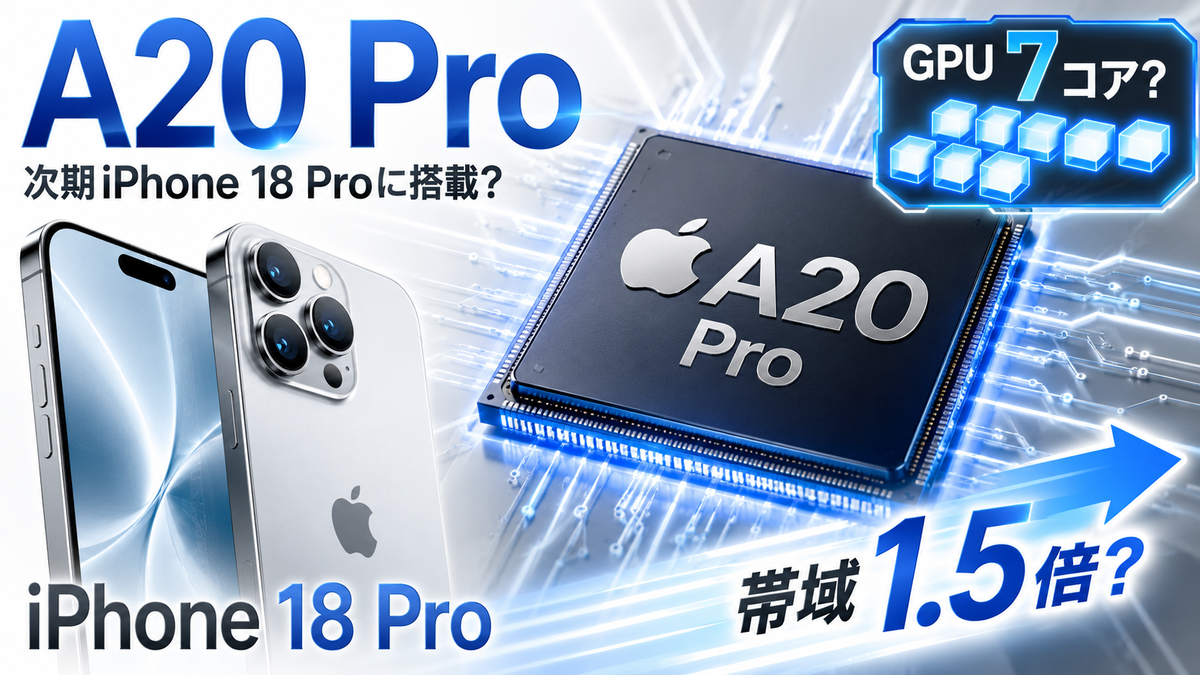
The A20 Pro rumor that tells a bigger story
A post by a Weibo user known as 白饭炒白米饭 — translated loosely as “Stir-fried White Rice with White Meal” — landed quietly on August 30. To anyone scrolling Chinese social media, it looked like another grainy teardown with speculative labels. To someone who follows the flow of information from Japan into Western tech media, it was a mirror of a pattern Apple’s supply chain has increasingly used to send signals: leaks from East Asian forums, picked up by outlets like ASCII.jp and MacRumors, arrive days or weeks before Cupertino’s official launch event.
This one is worth looking at not for the numbers alone but for what the numbers suggest about where Apple is being forced to move.
The poster overlaid an image of the A20 Pro package against a pinout diagram and reasoned through component placement by matching solder pad patterns to likely die regions. Their conclusion: the GPU occupies the upper portion of the chip, the CPU sits in the middle, and the core configuration is six total — two performance cores paired with four efficiency cores.
The more important finding concerns the GPU. The user tested dozens of configurations across 6, 7, and 8 cores and found that seven cores produced the most geometrically plausible layout. That would be a single-core increase over the A19 Pro’s six, which translates to roughly a 16% bump in raw graphics throughput if clock speeds hold.
Apple doesn’t publish per-core GPU benchmarks, but a 16% gain is meaningful in a generation where competitors like Qualcomm and MediaTek have been pushing eight-core Adreno and Immortalis designs into the same device class. Apple is closing the gap, not widening a lead.
Cache numbers tell a clearer story
The cache figures are where the leak gets specific and arguably more revealing. The high-efficiency cluster’s L2 cache is reported to grow from 6MB to 8MB. The performance cluster’s L2 remains at 16MB. That asymmetry is intentional — it signals Apple is rebalancing toward energy efficiency rather than chasing peak clock speed, a strategy that has defined TSMC-node transitions since the A14.
The reasoning the poster gave is consistent: Apple is expected to ship a new image signal processor and a redesigned neural engine in this generation. Both demand higher on-die bandwidth. Keeping the performance L2 flat while expanding the efficiency L2 preserves thermal headroom for sustained workloads — the kind of sustained workloads that define mobile AI inference, not short benchmark bursts.
SLC capacity — the shared last-level cache — was not disclosed in the leak. Apple has historically kept this figure opaque, and there is no independent confirmation yet. But given the architectural pressure from the new ISP and neural engine, it would be surprising if Apple reduced it. Cache shrinking in this context would be a red flag, not a refinement.
The bandwidth jump is the real signal
MacRumors picked up the post and highlighted a detail that matters more than the core count: the memory interface is rumored to widen from 64-bit to 96-bit. That is a 50% increase in theoretical bandwidth between the RAM and the SoC.
Graphics performance scales with bandwidth as much as with core count, especially on Apple’s unified-memory architecture where the GPU and CPU share the same pool. A wider bus means the extra GPU core actually has something to work with. Without the bandwidth bump, the seven-core GPU would starve under heavy loads and the gains would be marginal. With it, the improvement becomes structural rather than cosmetic.
This is also the first time Apple has pushed past 64-bit on an iPhone SoC. The A-series line has used 64-bit interfaces since at least the A13, and some might read the 96-bit shift as a catch-up move against the wider 128-bit buses common in Android flagships. That framing would be wrong — Apple’s unified memory model achieves different efficiency at 96-bit than a split architecture does at 128-bit. But the competitive pressure is real, and the direction is clear.
Why a Japanese-source leak matters now
ASCII.jp, which originally published the roundup in Japanese, tends to report chip and component-level rumors months before Western outlets do. The reason is structural: Japan’s electronics press maintains deeper relationships with component distributors and TSMC-adjacent supply-chain sources. When ASCII reports a pinout analysis, it is often echoing a conversation that started in a Fab-related channel in Taiwan or Korea weeks earlier.
For Western readers, the takeaway is simple: these leaks are not noise. They are early readings of a supply chain that communicates through intermediaries because Apple itself will not confirm anything until the keynote. The Weibo post, filtered through ASCII and MacRumors, carries the kind of specificity — exact core counts, cache sizes, pin arrangement — that usually comes from people who have handled the actual package.
Who wins, who loses, and what comes next
The winners are users who game on iPhone and developers building on-device AI models. A 7-core GPU with 96-bit bandwidth makes the machine genuinely usable for heavier workloads without throttling as aggressively. Apple’s decision to retain the foldable iPhone rumor alongside this leak is notable — the first foldable will need a silicon platform that can sustain higher sustained loads from two screens, and the A20 Pro appears designed for exactly that constraint.
The losers are benchmark hunters. This is not a generational leap. A 16% GPU increase and a 50% bandwidth increase are incremental by Apple’s historical standards — the A17 Pro to A18 Pro transition saw similar pacing. What is changing is the architecture’s direction, not its speed.
The real question is whether Apple can convince consumers that a chip with modest headline gains is worth the upgrade cycle. The answer will come in next week’s event, when Apple either confirms these specifics or reveals a design that diverges entirely from the leak. Given how precise the pinout analysis is, divergence is unlikely — but confirmation is what will matter.
If the A20 Pro ships as described, it will be Apple’s most balanced iPhone silicon in years. Not the fastest on paper. But engineered for the workload that actually defines the device: sustained AI inference, on-device imaging, and graphics that no longer throttle after three minutes.