Apple's Foldable Delay Is a Strategic Opening China Isn't Waiting For
While Apple prepares its first foldable iPhone, Huawei and Xiaomi are already rewriting the rules of the category. China's hardware rivals are using Apple's hesitation to capture premium market share and accelerate supply chain independence.
The Foldable Race Just Changed
Apple has spent years getting it right — or at least, getting it late. Its first foldable iPhone remains a long-awaited revelation, one the company treats like a nuclear option rather than a product launch. Meanwhile, Huawei and Xiaomi are treating foldables like a daily breadwinner.
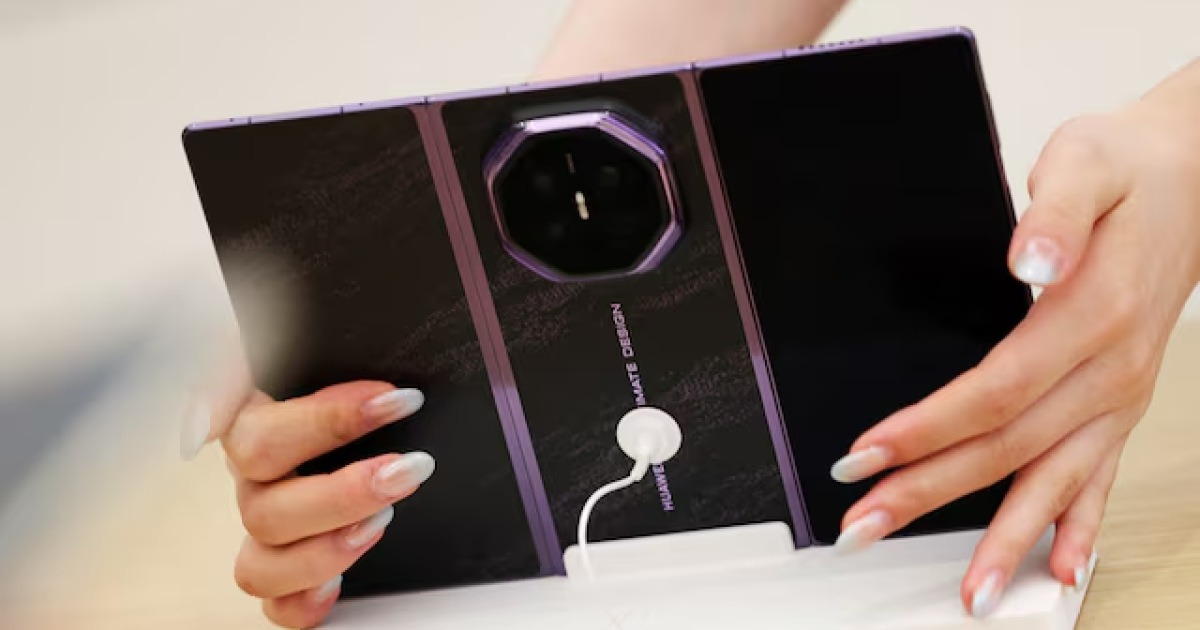
Huawei unveiled its Mate XT2 in Guangzhou on September 7th, a tri-fold phone that bends twice and opens into something closer to a small tablet than a smartphone. It starts at 19,999 yuan and climbs to 24,999 yuan — roughly $2,750 to $3,450 — positioning it squarely in the ultra-premium tier where Apple still sits alone in most markets.
Xiaomi is responding with the 18 Fold, a device built around its own 3-nanometer Xring O3 processor and LPDDR6 memory from China’s CXMT. The design — narrow when folded, almost passport-shaped — mirrors the form factor Apple is reportedly considering for its own entry. That alone is not coincidence; it is strategy.
What Huawei Already Controls
The numbers tell the sharpest story. In the second quarter of this year, Huawei captured 68 percent of China’s foldable smartphone shipments, according to market research firms cited in reporting. That is not a promising start for a competitor — it is a dominant position in the world’s largest smartphone market.
The Mate XT2 is not a rough prototype either. Huawei claims a 42 percent performance improvement over its previous foldable, with redesigned hinges, enhanced water resistance, upgraded cameras, and a privacy display that darkens the screen for viewers at angles. These are incremental improvements layered onto a product that already exists and already sells at prices most consumers would call absurd — until you remember that Chinese premium buyers have been paying similar sums for years.
This matters globally because foldables are no longer a China-only question. Samsung opened the category, yes, but the pace of iteration coming out of Shenzhen and Shanghai has shifted the competitive geometry. The tri-fold phone is no longer a concept video floating around tech media. It is a product sitting in stores.
Xiaomi’s Play Is Different — And Also Dangerous
Xiaomi’s approach to the 18 Fold signals something more structural than a single product launch. The company is stuffing the device with components sourced entirely from within China — a 3nm processor it designed itself, and memory chips from CXMT, a domestic supplier that has been under U.S. pressure to the same extent as its semiconductor peers.
This is supply chain independence as a selling point. When Xiaomi launched the 18 Fold, it was not just showing a phone; it was demonstrating that the company can build a premium foldable without relying on the component chains that sanctions and trade restrictions have tried to strangle.
The passport-width design of the 18 Fold also deserves attention. If Apple follows through on the narrow-folded form it is rumored to be pursuing, Xiaomi’s device is not just a rival — it is a preview of the exact product Apple will be trying to match.
Apple’s Calculated Silence
Apple’s delay is not ignorance. The company understands the category better than almost any competitor. What it does not have is urgency. Samsung spent years refining foldables through generations of broken hinges, creased displays, and consumer frustration. Apple has watched. It has also waited for the price to come down, the durability to improve, and the software to adapt — all legitimate concerns, but concerns that have already been resolved for Chinese buyers.
The cost of waiting is becoming clearer by the week. Every quarter Apple spends without a foldable is a quarter in which Huawei consolidates its dominance in China and Xiaomi deepens its grip on the premium segment worldwide. By the time Apple enters, it will not be entering an empty room.
There is also a psychological dimension. Huawei’s tri-fold phone is an answer to the question “what comes after the fold?” — and it answered first. Apple is still preparing to answer “when?” That asymmetry matters in a market where momentum is everything.
Who Wins and Who Loses
In the short term, Chinese consumers and early adopters everywhere win. The Mate XT2 and the 18 Fold give buyers genuine choices in a segment that has historically offered only Samsung’s iteration. Huawei is no longer playing catch-up to Apple — it is setting a pace Apple must follow.
Apple loses market share in the segments where it already relies on premium loyalty. If a Chinese foldable can persuade a Mac or iPhone buyer to switch, even partially, the damage compounds across Apple’s ecosystem.
Samsung is the quiet loser here. The company invented the modern foldable and still holds significant global market share, but it is being squeezed from above by Apple’s upcoming entry and from below — and from the side — by Chinese competitors who are willing to move faster and invest more aggressively in domestic supply chains.
What Happens Next
Apple is expected to announce its next iPhone lineup later this month. Whether the foldable will be among the reveals remains uncertain, and no credible source has confirmed a date. But the writing is on the wall: whatever Apple unveils, it will be a response rather than an introduction.
Huawei and Xiaomi have already made their moves. The tri-fold is real. The all-Chinese component stack is real. The market share is real. The question for Apple is whether it can close a gap that has been widening since Samsung first bent a phone screen in 2019.
The foldable market is no longer about who arrives first. It is about who arrives on their own terms — and right now, those terms are being written in Guangzhou and Shenzhen, not Cupertino.