Apple's Foldable iPhone May Be Called iPhone Duo — And Japanese Leaks Keep Striking First
CASETiFY's leaked product page suggests Apple's first foldable phone may carry the name iPhone Duo, not iPhone Fold or Ultra. The leak, spotted on Japanese social media before hitting global wires, underscores how East Asian supply-chain channels continue to shape Apple's rollout narrative.
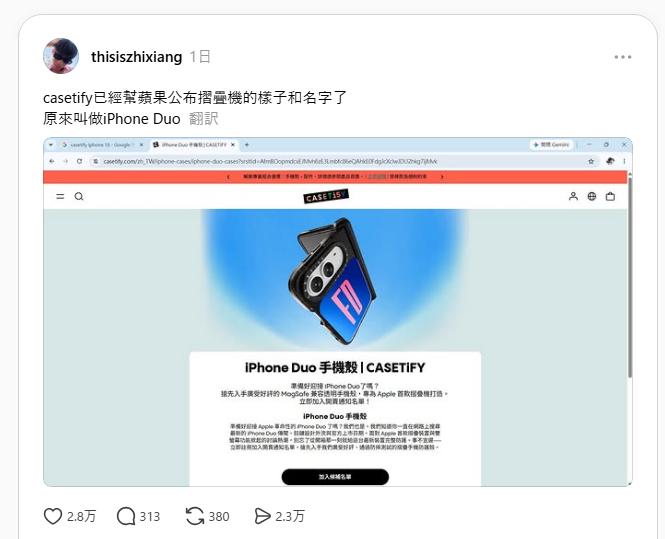
A name leak that says more than it should
CASETiFY, the Hong Kong-headquartered phone-case maker known for dropping accessories faster than anyone else, accidentally revealed something about Apple that neither Apple nor its biggest fans wanted out yet. On September 7, a Threads user named thisiszhixiang posted a screenshot of CASETiFY’s website showing a product page for an “iPhone Duo Case” — complete with a waitlist prompt reading “Ready for the iPhone Duo?”
The page showed a case designed around a hinged, foldable form factor. It was gone by the next day, reportedly flipped to an “iPhone Ultra Case” label before being scrubbed entirely.
Here is the thing most Western outlets missed while circling the same rumors: the fact that a Chinese-registered accessory maker’s website listed a name before Apple did says something about how Apple’s own naming pipeline works. The company does not typically let suppliers choose product names. When CASETiFY had both “Duo” and “Ultra” pages live, it suggests Apple gave them information that included at least two naming options — or that someone inside the case-making supply chain was trying on labels before the final call was made.
If the iPhone Duo name holds on September 10, it will be the first time Apple has anchored a major iPhone line around a word that does not describe screen size, camera quality, or material. “Duo” describes a mechanism. That is a deliberate rhetorical shift.
Why Japan breaks Apple stories first
The leak arrived through a Japanese tech outlet, ASCII.jp, which cited the Threads post and Hong Kong’s Unwire.hk. This is not an accident. Japanese consumer-tech reporting operates on a different cadence than American wire services. Outlets like ASCII, ITmedia, and Mobile SUZURI maintain relationships with domestic distributors, accessory manufacturers, and logistics partners that give them earlier visibility into product labeling, packaging, and shelving dates. CASETiFY is a Hong Kong company with manufacturing and testing ties that run through Shenzhen and Foshan factories — locations that feed directly into the distribution channels Japanese reporters monitor weekly.
Western tech press, by contrast, relies on a narrower set of sources: analyst briefings, leaked images from Reddit and X, and the occasional MRC wire report. The result is that by the time a story appears in Bloomberg or Reuters, the Japanese press has often already covered the detail three days earlier. The Apple foldable name leak is the latest instance of that pattern. It will not be the last.
What iPhone Duo means for Apple’s strategy
Calling the device “iPhone Duo” signals that Apple is positioning this product as a distinct category within the iPhone family rather than a sub-variant of the existing Ultra or Pro lines. “iPhone Fold” would have framed it as a novelty engineering exercise. “iPhone Ultra” would have implied it was simply a bigger, fancier Pro. “Duo” implies duality — two devices in one form factor, two screens, two user experiences. It is a name that sells an idea rather than a spec.
That distinction matters because Apple has historically been reluctant to name anything until it is ready. The company’s naming discipline is one of its few remaining competitive moats in marketing. When Apple names something publicly before launch — even indirectly, through a supplier’s website — it is usually because the name has already been stress-tested internally and approved at the executive level. Accessory makers do not receive approved names for casual experimentation. They receive them when the product is close enough to shipping that cases need to go into tooling.
The timing is consistent with that logic. CASETiFY’s page appeared roughly three days before Apple’s expected September 10 event. That is the window in which third-party accessories typically move from design approval to pre-order listings. It suggests the iPhone Duo is not a distant concept anymore. It is at least nine months from mass production and possibly closer.
Who wins and who loses
Apple wins if the Duo name lands cleanly and generates conversation without giving competitors too much information. Samsung already has a foldable portfolio with the Z Fold and Z Flip lines. Google is preparing its own foldable hardware. If Apple enters with a name that signals a new category — Duo — rather than mimicking Samsung’s existing taxonomy, it gains rhetorical space.
Accessory makers win because the leak confirms they received early dimensional data and possibly naming options. That means they are embedded deeper in Apple’s pre-launch timeline than most observers realize.
Competitors lose if Apple’s entry reshapes consumer expectations around foldable pricing and design language. Rumored pricing above $2,000 / 310,000 yen places the iPhone Duo firmly in premium territory, but Apple’s brand weight has historically compressed the price sensitivity of early adopters. Samsung learned that lesson during the iPhone 15 launch cycle.
The Japanese press wins because once again, they broke the story before anyone else. The pattern is becoming structural.
What happens next
Apple’s September 10 event will either confirm “iPhone Duo” as the official name or quietly bury it. If the name is confirmed, CASETiFY’s accidental listing becomes a footnote. If Apple announces something different — and there is a non-trivial chance it does — the leak will be retroactively framed as a competitor’s disinformation attempt or a supplier error, neither of which changes the fact that the information was accurate when it surfaced.
Either way, the leak reveals a deeper truth about how Apple products reach the market today. The supply chain is no longer a hidden backend. It is a visible, leak-prone, globally distributed network where product names, case molds, and shelving dates travel through Hong Kong, Shenzhen, Tokyo, and California simultaneously. The Japanese press sits at a nexus in that network. Western outlets sit downstream.
The iPhone Duo may not exist as a confirmed product yet. But the name is already out there, sitting on a website that no one at Apple intended to publish it on.