Apple's Foldable iPhone Could Reset the High-End Phone War
Apple's first foldable iPhone is looking increasingly real for a 2026 launch, and the real story isn't the hinge—it's what a ¥300,000 price tag and a missing Face ID sensor signal about how the company plans to reclaim the premium phone market from Samsung and Chinese rivals.
The hinge is not the story
For years, foldable iPhone rumors have circulated like a long-running TV series that everyone expects but nobody confirms. This time, the convergence of supply-chain signals—component orders placed well ahead of a September launch, production ramp difficulties already being discussed—makes a 2026 debut look less like fan fiction and more like an engineering schedule.
The name is still up in the air. “iPhone Ultra” has the strongest grip so far, borrowing the prestige badge already established on the Apple Watch. “iPhone Fold” sounds accurate but alienating in markets where the word doesn’t carry the same weight. ASCII.jp’s reporting notes the naming dilemma explicitly, and that indecision itself is telling: Apple is still figuring out how to position this device inside the iPhone lineup, or whether it wants it positioned there at all.
What the design says about Apple’s strategy
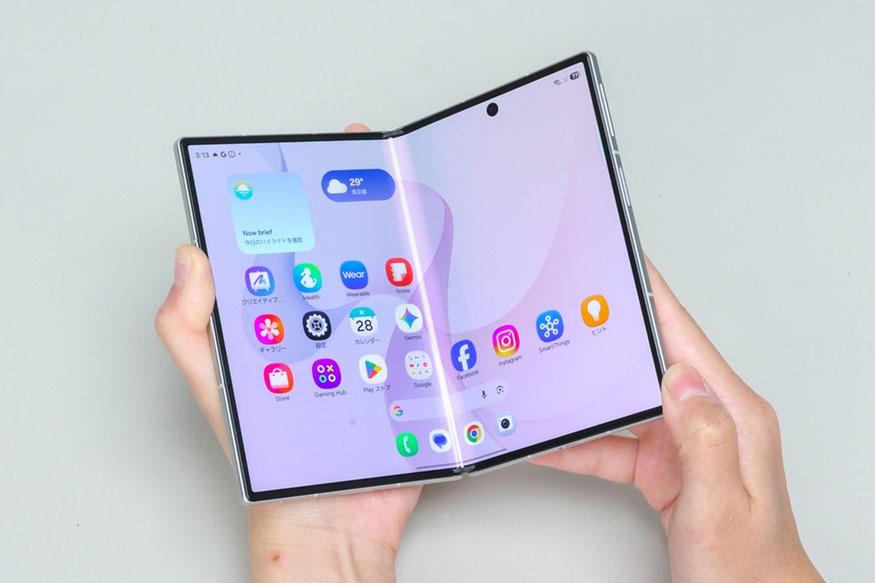
The consensus points toward a horizontal-fold form factor—the kind that opens like a book into a roughly 4:3 screen and folds back into something passport-sized. That is the shape Samsung’s Galaxy Z Fold8 has popularized, and it is the shape that makes the most sense for Apple’s use-case framing. Vertical folders fold inward; horizontal folders create a tablet experience. Apple has been defending the iPad’s relevance for half a decade. A foldable iPhone that closes into a phone but opens into something close to an iPad would let the company make a argument that has historically eluded it: that this single device replaces two.
The weight target is telling. The Z Fold8 comes in at 201 grams—lighter than the iPhone 17 Pro, if the reports are accurate. If Apple can land a foldable in that neighborhood without sacrificing structural rigidity, it solves the single biggest complaint consumers have had about every foldable that preceded it.
The specs: flagship-grade where it matters
CPU: expect the A20 Pro, built on TSMC’s 2nm process. That is non-negotiable. A foldable iPhone that underperforms the iPhone 18 Pro on processing power would be a product that makes no sense at any price. Camera is where the compromise likely lives. The thin chassis required for a foldable form factor means Apple may not be able to fit the same sensor sizes or periscope telephoto lenses found in the Pro Max. Two-camera setups, similar to the standard iPhone line, are the reported possibility. That is a deliberate narrowing of the camera advantage—and a signal that Apple is pricing this device for multitaskers and content consumers, not photographers.
Water and dust resistance will be the real technical flex. IPX8 water resistance is now standard on Android foldables. Dust ingress remains the harder problem, and it is the problem that has killed more foldable longevity claims than anything else. How Apple balances thickness, hinge durability, and ingress protection will determine whether this device is a novelty or a durable upgrade.
The price that changes everything
The most consequential detail in the current rumor cycle is the price. At an estimated $1,799 to $1,999 USD—roughly ¥316,000 to ¥351,800 in Japan—this device would sit comfortably above the iPhone 18 Pro Max. That is not an accident. Apple is not trying to compete with the Galaxy Z Fold at its price. It is trying to create a category above both.
Here is why that matters beyond Apple’s balance sheet: Samsung has spent the last three years convincing enterprise buyers that foldables are durable enough for professional use. Chinese manufacturers like Huawei and Honor have been closing the hardware gap while undercutting on price. Apple’s entry at ¥300,000-plus does not threaten Samsung’s volume segment. It threatens Samsung’s prestige segment. If the iPhone Ultra launches and holds its price, it forces Samsung to either match Apple on features at equal cost or accept that the top tier of the foldable market now belongs to a different brand.
The Face ID question and what it means for enterprises
One detail has not made the mainstream rumor cycle but deserves attention: reports suggest the foldable iPhone may not include Face ID. The Dynamic Island is expected, which means the front camera array will be reconfigured, but removing facial recognition altogether would be a significant departure.
For consumers, the absence of Face ID is inconvenient but manageable—passcode entry has never been a real barrier. For enterprises, it is a different calculation. Face ID has been a quiet enabler of mobile device management in regulated industries. Removing it raises questions about how Apple plans to handle secure authentication on a device that opens into a tablet-sized screen, where biometric options beyond facial recognition become more complicated by design.
If Apple substitutes an under-display fingerprint sensor or relies on a wearable-linked authentication model, that decision will shape whether this device can penetrate the very segments—finance, government, healthcare—that have been slow to adopt any foldable phone, regardless of brand.
What Chinese manufacturers should worry about
Huawei’s foldable lineup has been gaining real traction in China, particularly with the Mate XT series commanding attention for its tri-fold design and domestic supply-chain independence. Honor and Xiaomi are pushing aggressive feature sets at lower prices. None of them face an Apple competitor at their price point, and that asymmetry has allowed them to own the mid-premium foldable space.
An iPhone Ultra at ¥300,000 does not enter that fight directly. But it redraws the map. If Apple successfully positions the foldable iPhone as the definitive premium device—a phone that is also a tablet, built with the same silicon as the iPhone 18 Pro, backed by a brand that carries untapped weight in Asian luxury markets—it creates a ceiling that no Chinese brand can approach without a radical repositioning. The fear for Huawei and Honor is not that Apple will outsell them. It is that Apple will make their best devices look like compromises by comparison.
Who wins, who loses, and what happens next
Apple wins if the device launches at scale in September 2026 with a hinge that does not develop crease anxiety within six months and a price that high-net-worth users accept without blinking. Samsung loses prestige share in the foldable tier it helped create. Chinese manufacturers lose the ability to claim that foldables are primarily a value proposition. Enterprise buyers who wanted stronger biometric security get a device they may still avoid.
The launch date remains uncertain. Production yields on foldable display panels are notoriously difficult, and ASCII.jp’s reporting notes the possibility of delayed availability outside the U.S., or even a launch lag behind the standard iPhone 18 Pro. If Apple struggles to ramp, the device risks arriving as a proof of concept rather than a mainline product—and that would change the entire competitive calculus.
But the rumors are converging. The component orders are being placed. The design direction is clear. Whatever this device is called, the foldable iPhone is no longer a question of whether. It is a question of when, and how much Apple is willing to ask for it.