Octupole Spin-Torque Switching Could Redefine Memory Design
A Nature paper demonstrates current-driven switching of antiferromagnetic tunnel junctions via octupole order — a mechanism that could unlock denser, faster, and more resilient memory. East Asian fabs will be watching closely.
The quiet shift under the spintronics world
A team at Northwestern University and collaborators have demonstrated something that should not work easily: the electrical switching of an antiferromagnetic tunnel junction through an octupole-driven spin-torque mechanism. The results appear in Nature. What makes the work notable is not simply that antiferromagnets were switched — that has been shown before in metallic heterostructures and simple tunnel barriers — but that the switching channel is tied to the octupole moment of a non-collinear antiferromagnetic order parameter.
That distinction matters because octupole degrees of freedom sit above the more familiar ferromagnetic moment and the collinear Néel vector. They are hidden symmetries. Controlling them electrically without invoking a net magnetic moment is one of the harder problems in spintronics, and doing it at room temperature in a tunnel junction architecture is a meaningful advance.
What octupole switching actually does
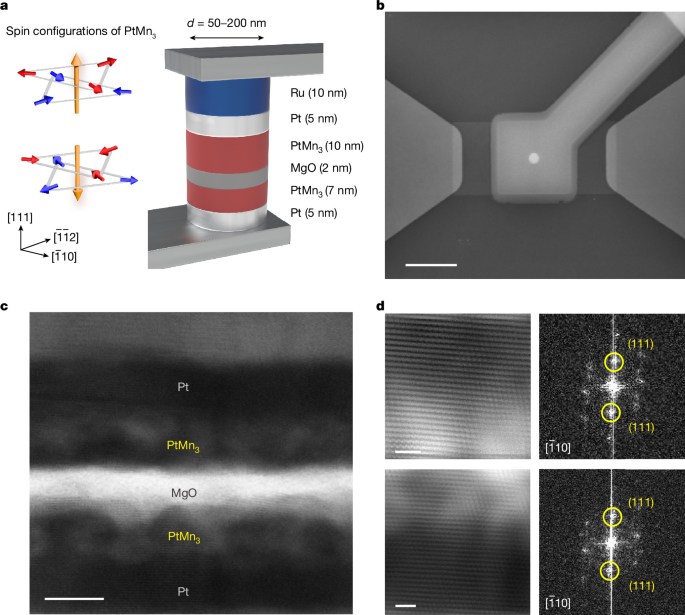
In the device reported, the magnetic order is neither simple ferromagnetic nor a pair of aligned antiparallel sublattices. The structure belongs to the class of chiral or non-collinear antiferromagnets, where the spins form patterns such as triangular or honeycomb arrangements that break time-reversal and certain spatial symmetries in combination. In those systems, the primary order parameter can carry a multipolar character — dipole, quadrupole, octupole — and the octupole term is the one that couples to spin-orbit interactions and to the spin polarization of tunnelling electrons in a way that pure collinear antiferromagnets do not.
Conventional magnetic tunnel junctions rely on a ferromagnetic free layer whose orientation flips under spin-transfer or spin-orbit torque. That mechanism works well but carries familiar baggage: stray fields, cross-talk between adjacent cells, and limits on scaling because the dipole moment does not shrink away as you reduce cell size. Antiferromagnetic memory promised relief from those problems, but previous experimental demonstrations of switching were often slow, required large currents, or depended on material systems that are awkward to integrate with silicon.
The new work appears to sidestep some of that by leveraging the octupole channel. Spin-polarised current flowing through the tunnel barrier transfers angular momentum preferentially to the higher-rank order parameter. The result is a current-driven reorientation that does not depend on generating a macroscopic dipole torque. In practice, that translates into a switching path that is less sensitive to neighbour magnets and less prone to stray-field perturbation — precisely the properties that make antiferromagnetic devices attractive for dense arrays.
Why the fabrication community will care
East Asian fabs are the likely first movers on this. Japan, South Korea, and Taiwan host the semiconductor manufacturing ecosystem that would need to evaluate whether octupole-driven switching can be realised in process-compatible stacks. The relevant questions are not theoretical; they are practical.
First, can the material system grow on silicon with acceptable defect density? The paper includes transmission electron microscopy and X-ray diffraction data, but process engineers at Samsung, SK Hynix, or Kioxia will want to know whether the relevant antiferromagnetic thin films tolerate thermal budgets used in back-end-of-line integration and whether the tunnel barrier can be deposited without degrading the magnetic order underneath.
Second, can switching current densities reach levels compatible with a memory array? Ferromagnetic MTJ commercial products already use current densities in the low 10^6 A/cm^2 range. Antiferromagnetic switching in previous studies has sometimes required higher densities, which limits energy efficiency. The authors report measurements at room temperature, which is the minimum bar for any commercial memory candidate. Whether the switching energy per bit is competitive with existing MRAM or emerging candidates such as SOT-MRAM remains a detail worth waiting for in follow-up work and independent replication.
Third, and perhaps most important, can the octupole state be read reliably through the tunnel junction? Magnetoresistance in antiferromagnetic tunnel junctions has been demonstrated before, but the magnitude and stability of the signal depend on the symmetry of the tunnelling states and on how cleanly the device distinguishes between octupole configurations. The paper cites large tunnel magnetoresistance in related altermagnetic and non-collinear junctions, but this work introduces a distinct reading channel. The read margin will determine whether a fab invests in a new word-line and sense-amplifier design or whether the signal is too marginal for high-density arrays.
Who wins if this scales
If the mechanism proves robust and process-compatible, the winners are clear. Memory designers gain a new degree of freedom that can be used to encode more than one bit per cell by addressing multiple octupole configurations. Device physicists gain a route to switching without stray fields, which relaxes layout constraints and enables tighter packing. The semiconductor equipment sector gains a potential new product line: deposition and annealing tools tuned to the material system, metrology capable of distinguishing octupole textures, and patterning approaches that preserve the delicate symmetry required for the effect.
Losers, or at least laggards, are likely to be incumbents whose product roadmaps assume ferromagnetic MTJ or SOT-MRAM as the final architecture for embedded and standalone non-volatile memory. If octupole switching delivers comparable or better performance at smaller footprint and lower energy, those routes lose relative advantage. The timeline is the variable. Physics papers do not translate directly into tapeouts.
The fab strategy angle
South Korean and Japanese memory manufacturers are likely to prioritise evaluation over adoption. The sequence will probably be: independent verification of switching and readout, integration trials on test wafers, then a decision about whether to commit to a process node. Taiwan’s foundry sector will watch for whether the material system imposes constraints that are incompatible with their standard BEOL flows, because adding a new magnetic material layer is not trivial in a high-volume fab.
China’s memory ambitions add another layer. Both Yangtze Memory and ChangXin follow aggressive capacity expansion strategies, and any new memory paradigm that offers density and speed improvements without demanding exotic lithography is attractive. But the same material-integration hurdles apply, and sanctions-related constraints on advanced semiconductor equipment may slow experimental evaluation.
What to watch next
The most immediate milestone is an independent reproduction that confirms both switching and readout under similar conditions. The second is a demonstration of endurance — how many write cycles the junction sustains before the octupole state degrades. The third is integration: can the device be fabricated in a sub-20 nm pitch array with acceptable yield?
There are also theoretical extensions worth tracking. If octupole states can be addressed selectively, multi-state memory becomes feasible, which changes the economics per bit. If the switching speed reaches the picosecond regime suggested by related work on ultrafast antiferromagnetic dynamics, the device could compete with DRAM latency targets while retaining non-volatility. That combination is what makes the memory landscape interesting right now: the gap between volatile and non-volatile performance is narrowing across multiple material platforms, and octupole-driven switching is one of the newer entries in that race.
The Nature paper does not solve every engineering problem. It does, however, add a mechanism that was previously only a theoretical possibility to the experimental toolkit. For fab planners deciding where to allocate R&D budgets over the next few years, that is enough to shift attention.
The broader implication
Spintronics has spent two decades trying to replace or augment CMOS with magnetic effects. Each generation of the field has promised a breakthrough: GMR heads, TMR sensors, MRAM, spin-orbit torque memory. The cycle repeats because the physics is real but the integration is hard. This work belongs to the same lineage but introduces a symmetry channel that has received far less attention in engineering circles. Octupole order is subtle, which is both its weakness and its strength. It is weak because few teams understand how to measure and manipulate it in a fab environment. It is strong because that same subtlety is what makes the mechanism robust against noise, cross-talk, and stray fields — the very problems that limit conventional magnetic memory scaling.
If the mechanism holds up under integration stress, it will not replace MRAM tomorrow. It will, however, give East Asian fabs a new option to evaluate alongside existing paths, and that option may prove decisive when density and power targets force a choice.
The paper is a signal, not a factory specification. The question now is whether the signal can be turned into a product.