Apple's iPhone Duo Proves Foldables Need a Designer, Not Just a Competitor
Apple's first foldable phone launches at a price premium to Samsung, signaling a deliberate strategy to redefine the category for its existing customer base rather than chase market share. The question isn't whether Apple can compete in foldables — it's whether Samsung's seven-year head start can survive a rival that treats the form factor as its own invention.
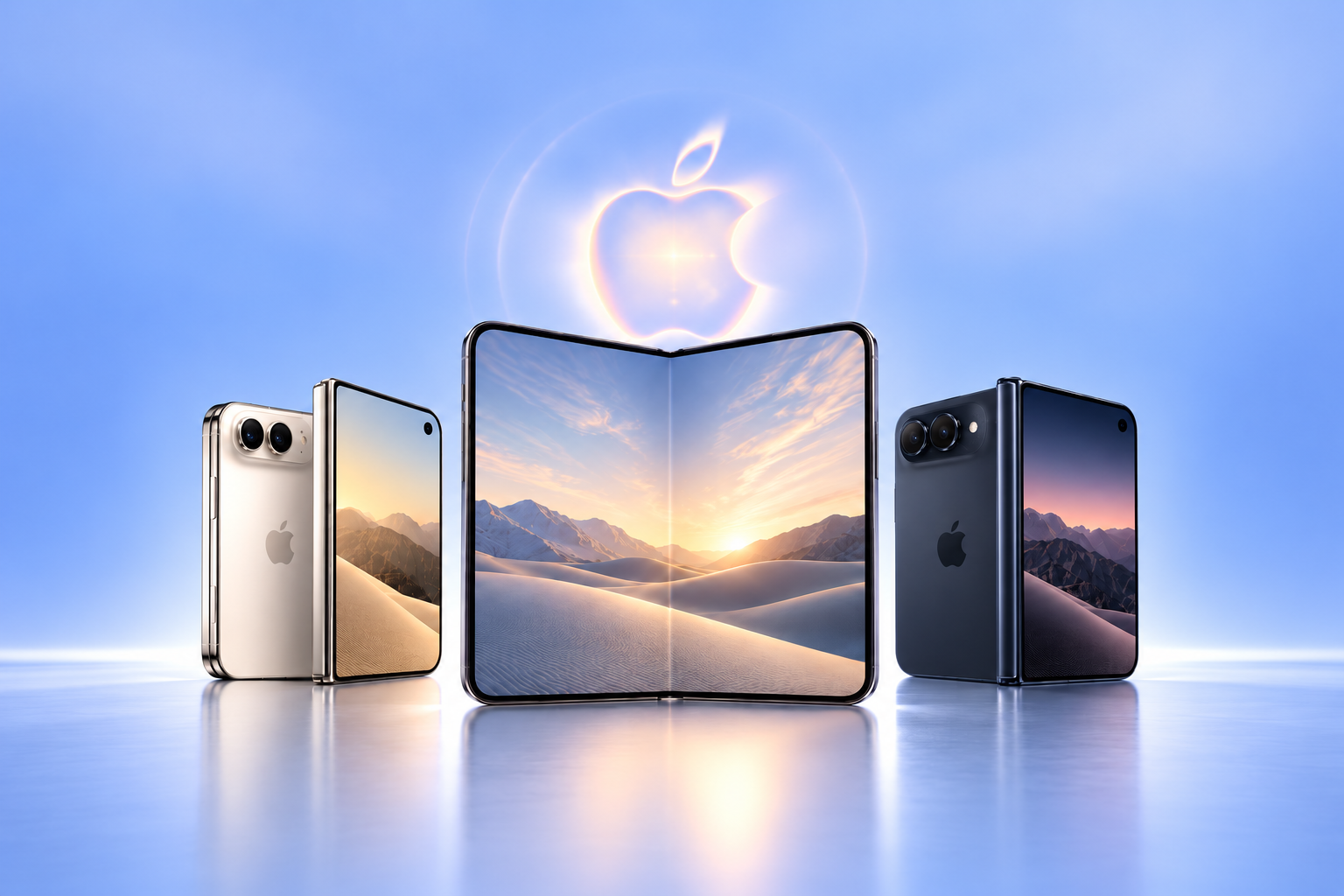
Apple didn’t come to catch up. It came to rewrite the rules.
Seven years after Samsung launched the original Galaxy Fold and spent years debugging its creased screen, Apple’s first foldable phone arrived not as a追赶 product but as a statement. The iPhone Duo starts at 3.29 million won in Korea — roughly $1,999 — about a million won more expensive than Samsung’s own top-tier foldable. That price gap is not a mistake. It is the strategy.
Apple has spent its entire smartphone career treating each new product category as something that should have always existed. The iPhone was the phone that replaced the point-and-shoot. The iPad was the device that made netbooks irrelevant. And now the iPhone Duo is positioned as the foldable that proves all previous attempts were simply prototypes waiting for the real version.
A product that ignores the crowd, courts the core
The folding mechanism itself is conventional — book-style, horizontal open, 5.4 inches when folded, 7.6 when unfolded. But the real innovation Apple is betting on is not hardware. It is audience.
Samsung and its Chinese competitors have been trying to broaden the foldable market by lowering prices and adding features. Apple is doing the opposite. It is targeting iPhone owners who already spend $1,000-plus on phones and convincing them that the extra $1,000 is worth it for a device that functions as both phone and tablet.
The company’s marketing framing is telling. Rather than lead with camera specs or processing power, Apple’s presentation emphasized the user experience of unfolding content — the way apps stretch across the larger canvas, the way media fills the screen without black bars, the way the device feels more like an iPad than a phone that happens to fold.
This is a brand play, not a market share play. And in a segment where Samsung still holds 38% global foldable market share against Apple’s projected 25%, that distinction matters.
The specs behind the premium
Under the titanium body sits Apple’s A20 Pro chip, built on a 2-nanometer process with a 6-core CPU, 7-core GPU, and dual neural engines. The company claims a 40% graphics performance increase over the previous generation and doubles the AI processing capability. A vapor chamber cooling system addresses the thermal throttling that has plagued previous foldable attempts.
The camera system uses the 48-megapixel main sensor and ultra-wide lens in a configuration that lets you compose shots by looking at the front display while the rear camera captures the image. Fold the device halfway and it becomes a stand — no tripod needed. It is a small detail, but one that speaks to Apple’s habit of obsessing over the moments between the headline features.
Durability gets a similar treatment. The hinge uses over 100 components and the device carries IP68 water and dust resistance. The finished product is thicker and heavier than Samsung’s latest Galaxy Z Fold — 5.2 millimeters open, 11.3 millimeters folded, 254 grams total — but Apple’s argument is that those tradeoffs produce a cleaner screen and a more reliable hinge.
iOS 27 changes the software equation
Hardware is only half the foldable story. The software has to justify why you need a device that opens wider than a phone.
Apple’s iOS 27 introduces split-view multitasking for the first time on iPhone, allowing two apps side by side on the unfolded screen. Safari, Zoom, Slack, and Netflix have been optimized for the larger display. Apple Pencil support via USB-C is expected by year’s end, further blurring the line between phone and tablet.
The company is also doubling down on on-device AI processing as a privacy differentiator. Apple Intelligence runs primarily on the device rather than in the cloud, a position that has become increasingly important as regulatory scrutiny of data collection intensifies. Siri, enhanced by the A20 Pro’s neural engines, can now understand context from what’s displayed on screen and your personal usage patterns.
What the numbers say — and don’t say
Global foldable market projections for this year place Samsung at 38%, Apple at 25%, and Huawei at 22%. Apple entering at second place with a single product launch is remarkable. Counterpoint Research projects Apple could reach 40% market share within a year if it maintains its current trajectory.
Samsung, meanwhile, has seen its Galaxy Z8 series gain momentum. The Z Fold 8 accounts for roughly 57% of Z8 series sales in its first two weeks, up 8% from the previous generation. Counterpoint notes that Samsung’s overall smartphone sales had been below year-ago levels through much of the year due to rising memory component costs, but the Z8 series helped reverse that trend starting in week 32.
The data reveals a market that is still small relative to the total smartphone industry. Foldables remain a premium segment, and both companies are competing for the same narrow slice of high-spending consumers. The question is not who will win the foldable war — it is whether the category will grow large enough to support both players comfortably, or whether one will eventually consolidate the segment.
The real test is not hardware
Samsung’s advantage is tenure. It has seven years of hinge engineering, software optimization, and consumer feedback baked into its product line. Apple’s advantage is trust. Its customers already believe the company makes the best phones in the world; the Duo simply extends that belief to a new form factor.
The challenge for Apple is whether the Duo feels like an evolution of the iPhone or a departure from it. Early reviews suggest the 5.4-inch closed form factor is comfortable for one-handed use, and the unfolded experience is closer to what people actually want from a tablet than any previous foldable has managed. But Apple also needs to prove that the premium price is justified by experience, not just by logo.
Samsung’s counter-argument is simpler: it has been selling foldables for years, and people keep buying them. The brand loyalty Apple is banking on may already be distributed across both ecosystems in ways that favor the incumbent.
Where this goes next
Apple’s entry into foldables is significant because it validates the category at the highest level of consumer electronics. When the company that defined the modern smartphone takes a form factor seriously, the market pays attention. Other players — Google, Microsoft, even Huawei — will face a new benchmark for design quality and user experience.
The pricing strategy suggests Apple does not expect to capture the mass market in this segment. It is aiming for the top tier, where margins are healthier and customer retention is stronger. Whether that approach can sustain long-term growth depends on whether foldables become a permanent part of the smartphone lineup or remain a niche experiment.
Seven years ago, Samsung bet that consumers would accept a device that looked and felt different. Apple is now betting that those consumers have been waiting for someone to make it feel normal. The iPhone Duo is that bet. The next three years will tell whether it pays off.