Apple's Vision Pro Isnt Dead — Its Strategy Just Changed
Code leaked from macOS reveals Apple may still be working on a second-generation Vision Pro, even as it cuts staff and pivots toward smart glasses. The real story is pricing — and whether spatial computing can survive past its early adopters.
A Line of Code That Won’t Die
Apple fired 200 people working on Vision Pro and Siri this spring. In Silicon Valley parlance, that reads as closure — a company closing its tent. But dig into the latest macOS Tahoe release candidate and you find something that refuses to let go: a single unexplained reference to a LiDAR sensor file labeled “Peridot” inside a product codenamed N109.
N109 is the codename Bloomberg’s Mark Gurman has long associated with a second-generation Vision Pro. Peridot is the same generation of LiDAR Apple introduced with the iPhone 15 Pro. The old Vision Pro used an earlier, slower sensor. A newer one inside a new headset would be a meaningful upgrade — unless, of course, this code is just digital debris left behind when a project was quietly shelved.
That ambiguity is exactly where things stand today.
The Two Bets Apple Is Making
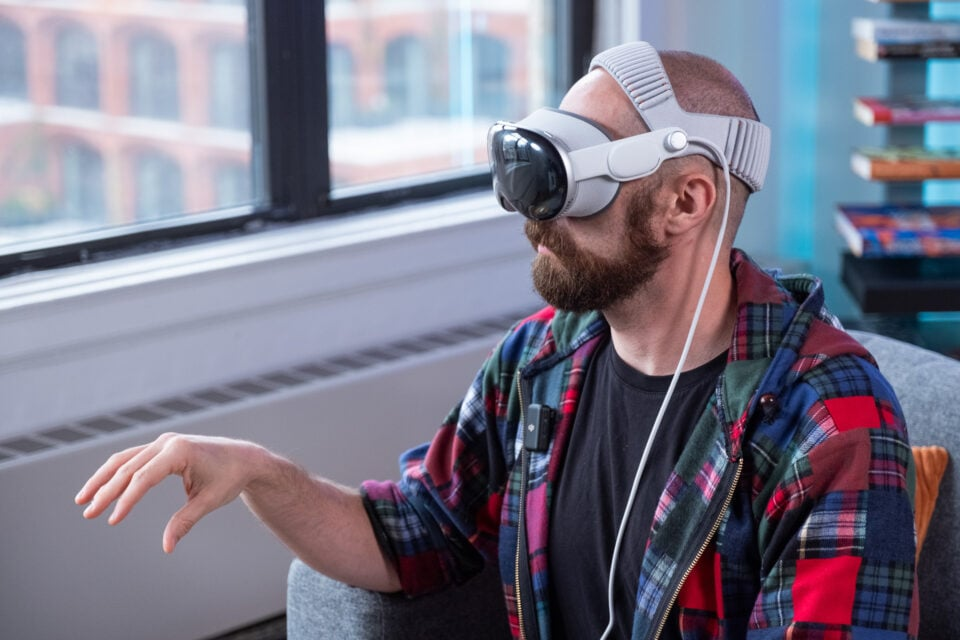
Apple is running a dual experiment right now. On one track: the Vision Pro, a standalone mixed-reality headset priced at $3,699 in the United States and roughly ¥650,000 in Japan. On the other: slim smart glasses that would resemble something closer to Ray-Ban Meta’s offering, but ideally with Apple’s ecosystem locked in.
In October 2025, Gurman reported that Apple told employees it was halting development of a lower-cost headset and redirecting resources toward smart glasses. That sounded like a verdict on the Vision Pro form factor entirely. But the N109 code suggests the room the headset occupies hasn’t been vacated — just rearranged.
The staff cuts, then, are not necessarily a retreat. They look more like pruning. Apple is trimming redundancy between teams that were built for two different futures and betting that one of them will win by default.
Why the Headset Still Matters
The Vision Pro launched in February 2024 to tepid sales. Its price tag has only climbed since — Apple raised it by $200 during a June 2026 refresh, pushing it past ¥600,000 in Japan. By every conventional metric, it is a commercial disappointment.
But the people who bought one have not stopped using it.
MacRumors and Gizmodo both note a persistent cohort of users who find the device indispensable for one specific thing: an enormous virtual display that ignores the physical limits of a desk. The Vision Pro can project a screen wider than any monitor you can buy, anchored to a wall across the room. For a narrow slice of buyers — developers, creatives, people who work across multiple monitors daily — that capability justifies the cost in a way no other product on the market does.
Apple is feeding that niche deliberately. NBA games stream into the headset now. Apple TV+ added live “Friday Night Baseball” coverage starting August 28, with the Red Sox taking on the Yankees across four games. The content playbook mirrors what Apple has done with the Apple Watch — ship experiences that make the hardware feel necessary rather than decorative.
The problem is scale. Those who find the device useful keep using it. Those who don’t, don’t. And at ¥650,000, the barrier to finding out which group you belong to is steep enough that most people never cross it.
The LiDAR Clue
Brad Lynch, a developer known for parsing Apple’s internal build files, flagged the Peridot LiDAR reference as significant. Not because it proves anything on its own — a lone string in a compiler can be leftover noise — but because LiDAR sensors are largely unnecessary on a pair of smart glasses. Glasses sit centimeters from your eyes. They do not need depth-sensing the way a headset does to anchor virtual objects in a room.
If Apple were building only glasses, there would be little reason to carry forward a Peridot-generation LiDAR driver into a macOS build. The fact that it is there at all argues, weakly, that a headset-shaped device is still on the table. Whether that device is cheaper, lighter, or simply a refresh remains unknown.
What the Staff Cuts Actually Signal
Cutting 200 roles across Vision Pro and Siri is not trivial. Both divisions were viewed as central to Apple’s AI and spatial-computing ambitions under Tim Cook. The timing is telling: Apple has been tightening its AI narrative for months, shifting emphasis away from on-device spatial experiences toward cloud-connected features like Apple Intelligence. The cuts suggest a recalibration, not a surrender.
What Apple appears to be doing is narrowing its Hardware bets. The Vision Pro stays alive just enough — a second generation is not ruled out — while the cheaper headset project dies. Smart glasses move to the front. Siri gets leaner but sharper. Everything else gets trimmed until it either proves itself or disappears.
Who Wins, Who Loses
Developers who built for Vision Pro are in the awkward middle. Their platform is not dead, but it is no longer the centerpiece of Apple’s future. The smart-glasses track may not support the same immersive experiences their code was written for. Expect a phase of uncertainty as Apple clarifies whether the next glass product will run a different software stack entirely.
Early Vision Pro owners should not worry — their devices will continue to receive software support, and the library of spatial experiences is not being abandoned. Apple’s sports streaming investments suggest the company still sees value in the installed base, even if it is small.
Consumers priced out at ¥650,000 are the ones who could change the equation — but only if a second-generation model arrives at half that price. History suggests Apple knows how to do that. The original iPhone launched at $499; the third generation under $400 within two years. The question is timing, not capability.
The Real Test Ahead
A second-generation Vision Pro at a lower price would not just move units — it would answer whether spatial computing is a permanent category for Apple or a high-end experiment. The code in macOS Tahoe does not confirm either outcome. It simply refuses to close the door.
For now, the story is not whether the Vision Pro is dead. It is whether Apple can make spatial computing affordable without making it boring. The Peridot LiDAR line in a compiler is a whisper, not a declaration. But whispers from Cupertino tend to become products eventually.
The next move will come in how Apple prices the next generation — and whether it decides the room a headset commands is worth the cost of building it.