At the White House, AI Is the Real Stage for US-China Rivalry
Trump and Xi's White House meeting produced diplomatic warmth and new trade language, but the deeper contest is over who sets global AI governance rules. The absence of a joint statement and the Korean Peninsula talk being left deliberately vague signal where the friction really is.
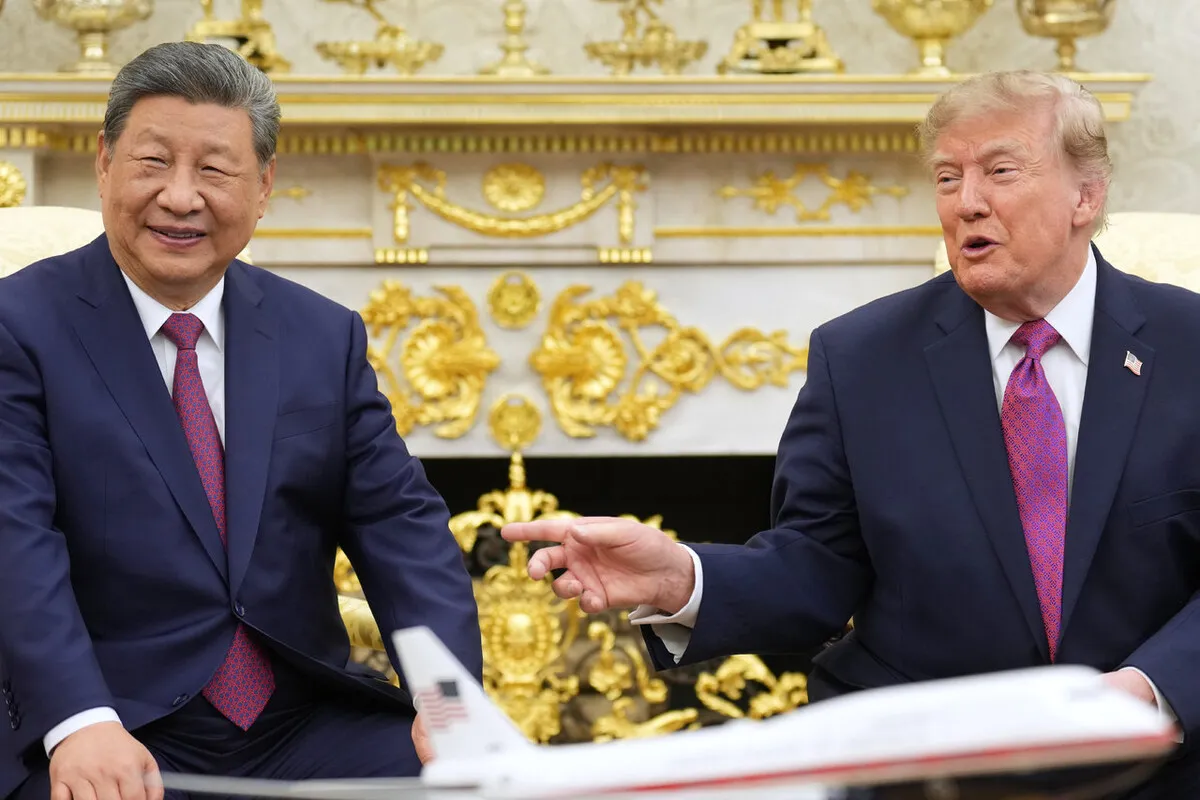
The handshake hides the fault line
Donald Trump and Xi Jinping spent three hours and twenty-two minutes in the Oval Office on October 24 and left with nothing to show except a shared photo and a press conference where neither disclosed a word of substance. The White House issued no joint statement. That silence is the story.
Xi arrived in Washington for a state visit that was supposed to lock in the so-called constructive strategic stability framework the two leaders sketched out at their May summit. He got a warm welcome, a reference to the Flying Tigers, a mention of gung-ho, and an offer to bring two giant pandas to Atlanta. He also got something more useful: confirmation that the United States still officially opposes Taiwanese independence and will handle the island carefully. On paper, that is the status quo Beijing has demanded for decades. In practice, the words matter less than what happens next.
AI is where the real disagreement lives
The most consequential exchange at this summit was not about Taiwan or the Korean Peninsula but about artificial intelligence. And here the two leaders revealed a gap that no amount of diplomatic phrasing can bridge.
Xi framed China and the United States as both AI powers that must cooperate rather than build walls. He explicitly argued for human control over AI systems and a human-centered principle that would steer the technology toward progress rather than risk. The language sounds responsible. But it carries a specific policy implication: China is positioning itself as the champion of governance frameworks that prioritize state oversight and collective safety over unrestricted development. That is a direct challenge to the American model, which has increasingly embraced a faster, less regulated approach to frontier AI.
Trump, meanwhile, told Truth Social before the meeting that he wanted to leave AI as it is. He then suggested at the welcoming ceremony that the decisions made that day could promote peace and prosperity for decades. The contradiction is telling. Wanting to preserve the status quo is itself a position — and it is the position of the side that currently leads in generative AI, foundation models, and the chip ecosystem that underpins them. China’s call for “human control” is, in effect, a bid to reshape the rules before the technology locks in.
This is not abstract. The countries that define AI safety standards, evaluation benchmarks, and deployment protocols now are the countries that will export those standards to the rest of the world. Southeast Asian governments, Middle Eastern sovereign wealth funds, and African tech hubs are all watching to see which framework wins credibility. The US-China AI dialogue announced at this summit will determine which model gains traction in those markets.
The Taiwan question is quieter than usual, and that is notable
Xi repeated Beijing’s standard line: the United States should maintain its correct position opposing Taiwanese independence and handle the Taiwan issue carefully. China’s Xinhua News Agency reported the remarks but did not frame them as a breakthrough or a shift. They were a reminder, not a negotiation.
What is worth noting is what was absent. There was no mention of the recent tensions around Chinese military activity near Taiwan, no reference to US arms sales, no language about the red lines either side has drawn. That omission suggests both capitals chose to keep the topic contained rather than escalate it during a visit that was already calibrated for visibility. Xi also invoked the Thucydides Trap in his state banquet speech, insisting that the US and China must hold the line against conflict and that the trap can be overcome. The phrase is now part of China’s diplomatic vocabulary, used to signal awareness of the danger without making any concession.
The Korean Peninsula was discussed, deliberately unreported
The sources confirm that Trump and Xi exchanged views on the Korean Peninsula but refused to specify what was said. This is unusual for a summit of this profile and deliberate in a way that speaks volumes.
South Korea’s relationship with both the United States and China is one of the most fragile balancing acts in international politics. Seoul depends on Washington for security guarantees and on Beijing for trade. Any public signal that the two superpowers are coordinating policy toward Pyongyang could spook allies in Tokyo and Seoul. Any signal that they disagree could invite pressure from both capitals on Seoul to pick a side.
The silence protects everyone and commits no one. But it also means that whatever was discussed remains available for either side to frame later. If Washington later claims Xi offered tacit support on North Korea sanctions, there is no record to contradict it. If Beijing later claims Trump acknowledged Chinese interests in the region, the same applies. The ambiguity is a feature, not a oversight.
Trade language is positive; details are invisible
Both leaders praised new economic and trade agreements reached by their negotiating teams. Xi called the results good news for industry and citizens on both sides and for the global economy. Trump echoed the sentiment. The absence of any specific figures, sectors, or timelines is consistent with a pattern that has defined much of the Trump-Xi economic diplomacy: announcements of progress precede the actual deal by months, sometimes years, and the language is always generous.
What is real is that both sides want de-escalation in the trade domain. The United States wants China to buy more American energy and agricultural products. China wants certainty for its exporters and access to American technology that has been restricted. Neither side can fully deliver what the other wants. That is why the announcements are carefully vague.
The numbers that matter
Xi proposed inviting 100,000 American youths to China over the next five years. That is 20,000 per year. It is a soft-power ambition that signals China’s desire to rebuild people-to-people ties that have eroded since the pandemic. Whether the number translates into actual visits is another question. Visa policies, political climates, and public sentiment in both countries will determine the real flow.
The two giant pandas headed for the Atlanta Zoo are charming but symbolic. Pandas are China’s oldest diplomatic currency. They cost hundreds of millions over their lending periods and buy goodwill, not policy concessions.
What happens next
The immediate test is whether the AI dialogue produces a working group with a mandate, a timeline, and a public report. Without those, the conversation remains a courtesy. The next test is whether the trade language matures into published agreements with tariffs adjusted and export controls revised. The third test is whether the Korean Peninsula silence becomes useful ambiguity or merely an excuse for inaction.
For South Korea, the takeaway is sobering. The US and China are managing their competition, not resolving it. On Taiwan, AI, and potentially the Korean Peninsula, the two powers are establishing a framework of managed rivalry. Seoul’s interests will be considered, but not decided. The question for Yoon’s successors, whoever they are, is whether they accept that reality or try to force a choice that neither Washington nor Beijing will allow them to make.
The summit produced warmth. It did not produce clarity. In US-China relations, that is the normal condition. The AI governance contest is where the real architecture of the next decade will be drawn.