An Atmosphere That Should Not Exist — and Why It Might Rewrite Outer Solar System Geology
A 500km icy world beyond Neptune appears to hold gas that should have escaped long ago. Whether it's a fresh impact wound or a hidden engine within, the finding is upending assumptions about how small frozen bodies behave.
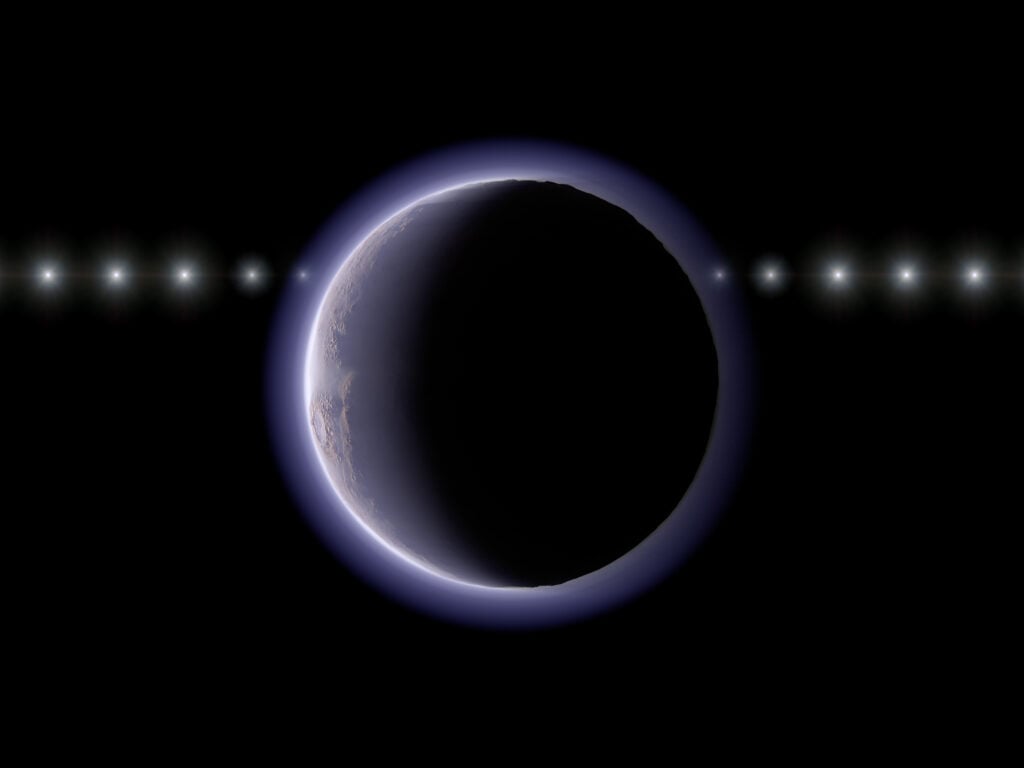
A thin ghost in the dark
The object is small enough that you could drive across its surface in a day. Its radius is roughly 250 kilometres. At 5.5 billion kilometres from the Sun, sunlight is a pale memory and temperatures sit well below minus 200 degrees Celsius. By every conventional rule, it should be a silent, frozen stone with nothing but vacuum around it.
Instead, astronomers have strong evidence it is wrapped in a global atmosphere.
That is the problem with 2002 XV93, a trans-Neptunian object reported in a May 2026 study in Nature Astronomy. Its atmosphere, if confirmed, should not be there. Not now. Not after 4.6 billion years. It should have leaked away in less than a thousand years — a blink in cosmic terms — unless something is actively replacing it or it was created very recently.
The discovery does not just add another object to the growing list of distant worlds with atmospheres. It challenges a foundational assumption: that small icy bodies beyond Neptune are geologically dead. Size matters there. Pluto and Eris are big enough to retain gas. Triton, captured by Neptune, is large enough to show activity. Below a certain threshold, gravity loses the tug-of-war against thermal escape, and any atmosphere drifts into space until nothing remains.
2002 XV93 sits well below that threshold. And yet the evidence suggests it has gas overhead right now.
How a shadow revealed what no telescope could image
No instrument has photographed an atmospheric rim around the object. It is far too small and far too faint. The detection came from a different technique — stellar occultation, one of astronomy’s most elegant geometries.
On January 10, 2024, 2002 XV93 passed in front of a distant background star as seen from Earth. The alignment was observed by a campaign centred at Kyoto, Kiso Observatory and a site in Fukushima. When a solid, airless body crosses a star, the star’s light drops off sharply. An atmosphere changes that signature. Its density gradient refracts starlight before the solid surface blocks it, producing a more gradual dimming.
That gradual transition is exactly what the Fukushima data showed. The other sites recorded clean occultations behind the main body, consistent with the object’s solid silhouette. Together, the profiles pointed to a refracting layer — gas surrounding the world, not a transient exosphere of a few escaping molecules.
The National Astronomical Observatory of Japan described the data as consistent with atmospheric attenuation. That careful language is important. This is an inference from a fleeting event, not a direct measurement of pressure or composition. But the inference is physically sound, and it is hard to replicate with an airless body.
The number that makes the puzzle sharp
The researchers estimate a surface pressure between 100 and 200 nanobars. A nanobar is one-billionth of a bar. Earth’s sea-level pressure is about one bar. So this atmosphere is roughly five to ten million times thinner than our own.
Pluto, often held up as the template for cold-world atmospheres, is denser by a factor of 50 to 100. Pluto’s pressure is near 10 microbars. 2002 XV93 is nowhere near a miniature Pluto. But the distinction that matters here is not scale — it is existence. Even that thin a layer of gas, held globally around a 500-kilometre object, is extraordinary.
The study also found that models dominated by methane, nitrogen or carbon monoxide could each reproduce the refraction signal. Those are the right kinds of molecules for this region. But the occultation cannot tell which one is present. Composition will require spectra — perhaps from JWST or a future infrared observatory — to resolve.
Why survival time is the real story
Atmospheric escape is not mysterious. Molecules move at speeds set by temperature and mass. On a small body, escape velocity is low. Even at the frigid temperatures beyond Neptune, a fraction of the gas population sits in the high-energy tail and leaves permanently. Over time, the atmosphere thins.
For 2002 XV93, the calculated survival time is under 1,000 years. The exact number depends on model assumptions — composition, temperature structure, solar wind conditions — but changing those assumptions by reasonable factors does not remove the central result. The atmosphere is ephemeral.
The Solar System is 4.6 billion years old. A primordial atmosphere left exposed at the surface would be gone long before now. So either the gas was produced recently, or it is being replenished continuously. Either case forces a revision of how we think about this object’s recent history or its interior state.
The missing surface reservoir
Pluto’s atmosphere has a straightforward source. Solar heating sublimates nitrogen ice on the surface. Gas fills the sky, then condenses back as seasons shift and illumination changes. The surface and atmosphere exchange volatiles in a coupled cycle.
That cycle does not work here. James Webb Space Telescope observations found no sign of frozen methane, nitrogen or carbon monoxide on 2002 XV93’s surface. A non-detection is not definitive — a deposit could be buried, tiny, or masked in an averaged spectrum — but there is no observed reservoir that naturally feeds the inferred atmosphere.
The gas and its source are separated. That separation is what makes the object interesting.
Two explanations, neither proven
The leading hypotheses place the missing reservoir either in the recent past or beneath the crust.
An impact is the simpler option. A collision with another icy body could vaporise material from the projectile, excavate volatile-rich ice from below the surface, or both. The released molecules would form a temporary atmosphere that escapes over centuries. In the crowded belt of small bodies beyond Neptune, impacts are inevitable. Catching the aftermath during its short lifetime requires timing, but it does not require ongoing geological activity.
This hypothesis makes a clear prediction. If the collision supplied a finite pulse, later occultations should show the atmosphere weakening. Measuring that fade would be difficult but not impossible with repeated observations. The obstacle is that no impact was observed, and the occultation alone cannot date one. An impact is plausible, not reconstructed from direct evidence.
Cryovolcanism is the alternative. Volatile liquids, vapours or slurries could rise through fractures and replace escaping molecules. This would keep the atmosphere alive without relying on a recent collision. It would also make 2002 XV93 one of the smallest known active worlds in the Solar System.
The problem here is energy. A body this small, this far from the Sun, should have lost most of its internal heat long ago. Radioactive decay, freezing of a buried volatile mixture or tidal flexing can sometimes sustain activity on other worlds, but no specific engine has been demonstrated for 2002 XV93. The researchers offer cryovolcanism as a possibility, not a detected process. There are no resolved plumes, vents or fresh flows in the data. The atmosphere is the only sign that something may have moved material upward.
Why this matters beyond one object
The outer Solar System is full of selection effects. Distant worlds spend most of their orbits beyond survey reach. Atmospheres hide in an even harder way: the right body, background star, observing sites and fast cameras must line up during a shadow that lasts only seconds. Finding one case cannot tell us whether atmospheres on small trans-Neptunian objects are rare or common. But it does show that the assumption that all small distant bodies are inert and airless now has a counterexample.
More importantly, the finding reframes how we think about size as a predictor of activity. The conventional picture is simple: big worlds retain atmospheres and show geological activity; small worlds do neither. 2002 XV93 breaks that binary. It suggests that impacts and interior processes can create temporary atmospheres on bodies where none was expected. If that mechanism operates broadly, the population of small icy worlds may host transient atmospheres far more often than current models predict.
That has implications for icy worlds beyond our Solar System as well. Exoplanet surveys increasingly detect small, cold bodies around other stars. If collisions and sporadic outgassing can produce detectable gas signatures on distant Kuiper-belt objects, similar processes could leave traces around exoplanetary bodies that we currently interpret as airless.
The clock is ticking
Alan Stern, who led the New Horizons science team and was not involved in this study, told the Associated Press that the result needs independent verification. That is a proportionate response. One occultation is a beginning, not a verdict. Another well-observed event could confirm the refractive edge, test whether the inferred pressure is changing, and perhaps constrain composition.
Time itself may settle the question. If later occultations find a fading atmosphere, the impact hypothesis gains ground. If the gas persists or shows repeatable variation, continuing internal activity becomes more credible. The atmosphere is functioning as a clock, counting down from an event we have not yet identified or being rewound by a process we have not yet seen.
2002 XV93 remains a dim point whose surface has never been mapped. Its atmosphere has not been sampled. Its composition is unknown. Neither proposed source has been observed directly. The honest conclusion is narrower than the most dramatic version of the story, but no less consequential. A tiny world appears to carry gas that should soon be gone. If later observations confirm it, that improbable veil will force a reckoning with how much life small, cold worlds can still sustain — and how often we may have missed it.