August’s Heat and Humidity Record Signals a New Survivability Threshold
August 2026 shattered global records for both heat and moisture, with temperatures 2.97°F above pre-industrial levels and atmospheric water vapor reaching an all-time high. The collision of record warming and an intensifying El Niño is rewriting the limits of human habitability.
A Month That Rewrites the Rules
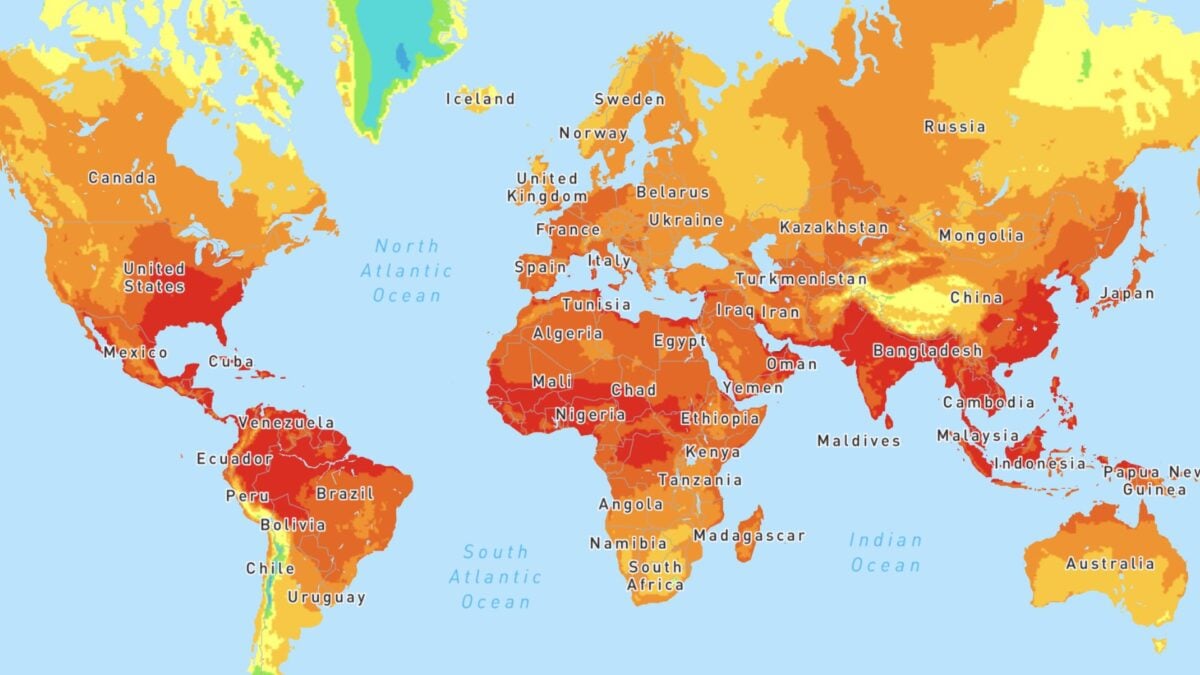
August 2026 did not edge past previous records. It obliterated them. Global average temperatures sat 2.97 degrees Fahrenheit above pre-industrial levels — a full quarter-degree hotter than August 2024, which had itself been a milestone month. At the same time, the atmosphere held more water vapor than at any point since satellite-era records began. Two separate analyses, one by climatologist Zeke Hausfather and another by meteorologist Ben Noll, both using the ERA5 reanalysis dataset stretching back to 1940, arrived at the same unsettling conclusion: last month was simultaneously the hottest and most humid August ever recorded.
The numbers are stark. Global precipitable water — the depth of liquid water that would result if every molecule of water vapor in a vertical column of air were condensed — reached 1.08 inches (2.74 centimeters). That is not a marginal increase. It is a new baseline.
What makes this moment distinct from previous heat records is the humidity component. Warm air is one thing. Warm, saturated air is another. It is the difference between a discomfort you can sweat through and a condition where sweat ceases to function as a cooling mechanism at all.
The Expanding Sponge
The physics behind August’s double record are well understood and deeply interconnected. Greenhouse gas emissions warm the planet. A warmer planet evaporates more water from oceans, lakes, and soil. The atmosphere — often described as an expanding sponge — absorbs roughly 7 percent more moisture for every degree Celsius of warming. That moisture then falls back down as precipitation, but not evenly. It falls harder in some places, less in others, and with increasing violence.
Water vapor itself is a greenhouse gas. More moisture in the air means more heat trapped. The feedback loop is self-reinforcing: warming drives humidity, and humidity drives further warming. August 2026 was not an anomaly in the sense of a random spike. It was the logical expression of a system already deep into that cycle.
Then El Niño arrived.
The El Niño Multiplier
This year’s El Niño event is projecting to peak in December with tropical Pacific sea surface temperatures running approximately 7.2 degrees Fahrenheit (4 degrees Celsius) above average. By most metrics, that would make it the strongest El Niño on record by a wide margin. The central and eastern tropical Pacific is effectively acting as a massive heat and moisture engine, pumping both into the atmosphere at rates that amplify global averages well beyond what greenhouse gases alone would produce.
Hausfather estimates a 75 percent chance that 2026 will stand as the warmest year on record. Noll expects moisture levels to continue climbing well into 2027, noting that atmospheric water vapor and rainfall do not scale one-to-one — but higher moisture absolutely increases the probability of precipitation extremes. During August, 17 percent of the planet experienced monthly rainfall in the top 10 percent of historical August totals. That is the largest geographic footprint recorded in the ERA5 dataset.
The weather impacts were immediate and geographic. A persistent heat dome continued to press down on south-central United States states throughout the month. In the Grand Canyon, a deluge triggered flash flooding on August 29 that killed at least two people — a stark illustration of how drought-stricken and burn-scarred landscapes respond to intense rainfall with dangerous rapidity rather than absorption.
Who Bears the Cost
The implications of sustained high heat combined with high humidity extend far beyond uncomfortable summers. Human thermoregulation has a hard limit: when the wet-bulb temperature — a measure combining heat and humidity — approaches 35 degrees Celsius (95 degrees Fahrenheit), the human body can no longer cool itself through sweating, even for healthy individuals resting in the shade. Exceeding that threshold for extended periods is physiologically unsurvivable without artificial cooling.
August 2026 did not globally breach that limit, but it closed the distance. Regions spanning South Asia, the Persian Gulf, parts of sub-Saharan Africa, and the American Southwest now experience frequent episodes where wet-bulb temperatures approach dangerous levels during peak summer months. Each year, the window of exposure lengthens. Each El Niño event pushes the envelope further.
The economic and agricultural costs are equally concrete. Crop yields in heat-stressed regions face compounding pressure from both elevated temperatures and erratic precipitation. Floods destroy harvests; droughts do the same from the other direction. Infrastructure designed for 20th-century climate norms — drainage systems, power grids, building codes — is increasingly mismatched to the conditions it must now withstand.
Noll’s projections point to an unusually stormy and wet winter across large portions of the United States, Europe, eastern Asia, and South America. That means more flooding, more displacement, more strain on emergency response systems already operating near capacity from the previous seasons’ heat damage.
The Threshold Moment
What distinguishes August 2026 from previous record-setting months is not just the magnitude of the numbers but what they signify. Climate records used to be milestones that arrived with warning — gradual trends that occasionally broke through. This time, heat and humidity accelerated together, each reinforcing the other, driven by a feedback loop that greenhouse gas emissions have been tightening for decades and that El Niño has now supercharged.
The data from Hausfather and Noll, anchored in the ERA5 dataset, leaves little room for ambiguity. The atmosphere is holding more energy and more moisture than it has at any point in the observational record. The question no longer centers on whether global conditions are shifting. It centers on how quickly societies can adapt to a baseline that continues to move.
August was not a preview of a distant future. It was a measurement of the present, and the reading was higher than anything measured before.