A Battery That Eats Itself Could Solve Implantable Device Waste
MIT researchers built a swallowable paper battery that powers medical devices inside the body before dissolving away. Pig trials confirm three days of reliable operation — a meaningful step toward eliminating permanent implant hardware.
A battery that disappears
MIT’s Giovanni Traverso and colleagues have built a battery that swallows easily, powers devices for a few days, and then dissolves into the body’s natural waste streams. The research, published in Nature Chemical Engineering, represents a genuine step away from one of implantable electronics’ oldest headaches: how to power a device that should not live forever inside a patient.
The battery itself is unglamorous by design. Magnesium alloy serves as the anode. Molybdenum trioxide paper composite forms the cathode. The electrolyte is a salt of choline chloride and lactic acid — both materials the body already knows how to process. Beeswax wraps the cell for short-term protection in the stomach, and candelilla wax slows degradation just enough to keep the battery alive for the duration of the intended treatment window. Maximum voltage reached 1.84 volts. Not extraordinary, but sufficient for low-power ingestible sensors and stimulators.
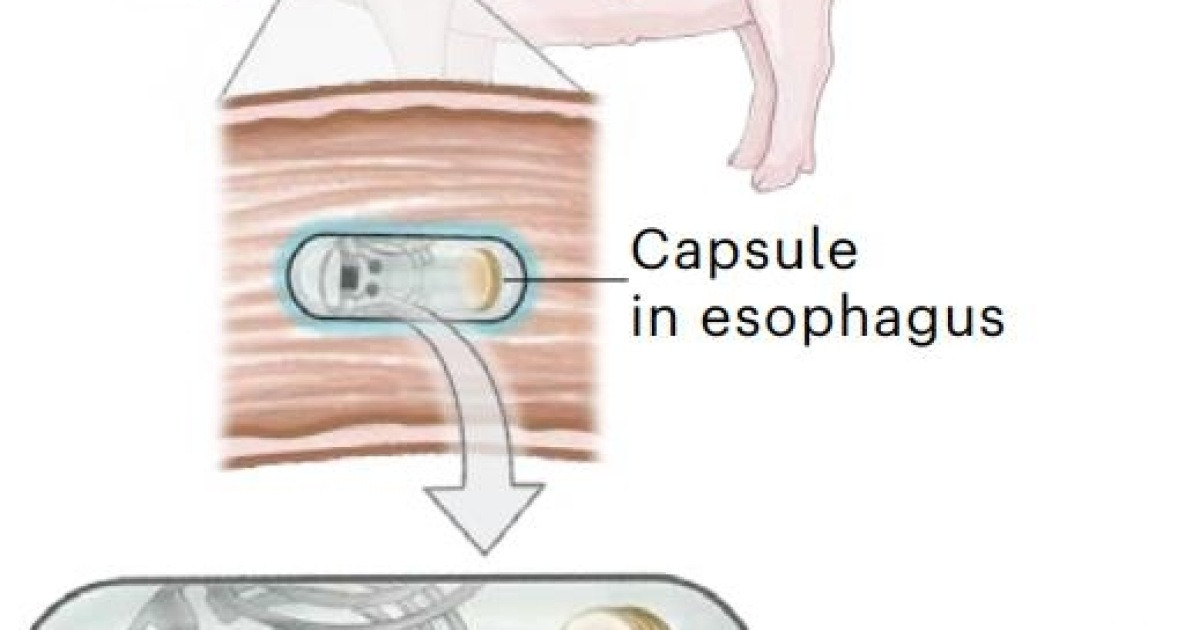
The pig trials confirm the concept works under real physiological conditions. A miniature battery sealed in a standard gelatin capsule was placed in the stomach. Over three days it continued supplying power, with voltage and energy density declining gradually rather than dropping off abruptly. That gradual decay matters. Sudden failure in an implanted device can leave a patient unprotected; slow depletion gives clinicians time to respond.
Two functional demonstrations accompanied the battery work. First, researchers paired the cell with an RFID tag and swallowed the capsule. An external reader detected the tag reliably from 1.5 meters away while it traveled through the esophagus and stomach. The signal strength shifted depending on whether the capsule sat in air or inside tissue, which means the same system could, in principle, verify that a patient actually ingested a dose — a simple but persistent problem in medication adherence tracking.
Second, they attached bioresorbable electrodes to the stomach wall and ran electrical stimulation for twenty minutes. Gastric stimulation modulated ghrelin, the hunger hormone, by an average of 36.3 percent, with peak increases reaching roughly 50 percent. No tissue damage appeared at the stimulation site. The result is modest, but it proves the battery can drive therapeutic stimulation, not just sensor readouts.
The chemistry of vanishing
What makes this battery different from previous attempts at bioresorbable power sources is how deliberately the team engineered the degradation timeline. Earlier transient electronics often relied on pure magnesium or other single-material systems that corroded too quickly or too slowly to be clinically useful. Traverso’s group tuned the wax coatings — beeswax for initial barrier protection, candelilla wax for extended structural integrity — to create a battery whose lifespan could be predicted within a day or two across variable gastric environments.
The electrolyte choice is equally deliberate. Choline chloride is already used in animal feed supplements and is generally recognized as safe by the FDA. Lactic acid is a natural metabolite. Together they form an ionic conductor that the body can neutralize and excrete without triggering inflammation or immune response. The magnesium anode oxidizes into magnesium ions, which are readily absorbed through the intestinal wall or excreted in urine. The molybdenum trioxide cathode breaks down into compounds that the kidneys filter out. None of the byproducts accumulate in tissues at levels that raised concerns during the pig trials.
This careful material selection is what separates a laboratory curiosity from something that might one day reach regulatory approval. The FDA has been notably cautious about bioresorbable devices, partly because the breakdown products must be shown to clear cleanly from the body — not just in animals but across diverse human populations with varying kidney function and gastrointestinal pH levels.
Who wins, who loses
The immediate winner is the concept of transient electronics — devices designed to perform a task and then disappear. Permanent implants carry risks that compound over years: lead corrosion, insulation failure, the need for revision surgery. Each revision introduces infection risk and scar tissue. A battery that vanishes removes half that problem by design.
Patients stand to benefit most. Ingestible sensors and stimulators could monitor the gastrointestinal tract, deliver targeted electrical therapy for conditions like obesity or gastroparesis, or track drug absorption in real time — all without leaving hardware behind. The three-day operational window covers a clinically useful range of acute monitoring and short-course therapy.
The biomedical device industry faces a reckoning it has avoided so far. Current ingestible products rely on conventional chemistries sealed in biocompatible housings. Those housings eventually need removal or remain as foreign bodies indefinitely. A company building the next generation of smart pills will need to redesign its power architecture from scratch, which means new supply chains, new regulatory pathways, and new safety data.
What does not win yet is completeness. The RFID chip and the circuit board in the trial were not bioresorbable. They passed through the digestive tract naturally, but their long-term fate in humans was not demonstrated. The researchers acknowledge that full bioresorbability still needs validation. Until every component — not just the battery and electrodes — dissolves safely, the device is only partially transient.
There are also questions about scale. The paper battery produced 1.84 volts and a handful of milliamp-hours of capacity — enough for sensors and brief stimulation pulses but not for anything resembling continuous therapeutic power delivery. A full gastric pacing system for gastroparesis, for example, would likely need to operate for weeks or months, not three days. Extending the lifespan while maintaining clean dissolution remains an open engineering challenge.
Why this matters beyond the lab
The broader implication reaches past medicine. Temporary electronic implants are the missing piece in a category of devices that has existed in theory for years but never scaled: ingestible and implantable monitors that track health metrics without requiring surgical retrieval. Cardiovascular stents with embedded sensors, gastric bands that report pressure and pH, neuromodulation patches that dissolve after a course of treatment — all of these converge on the same power problem.
E-waste from implantable devices is a smaller-volume problem than consumer electronics, but the toxicity profile is worse. Lithium and cobalt leaching from degraded implants inside human tissue is not a scenario clinicians want to model. Magnesium and molybdenum compounds are far less dangerous if they escape containment. The choice of materials is itself a safety intervention.
Three days of power in a pig stomach is early preclinical data. Human trials will need to answer questions the animal work cannot: Does the dissolution rate match the intended treatment duration across different gastrointestinal environments? Do the breakdown products accumulate or clear cleanly? How does repeated dosing behave if multiple capsules are swallowed over time? Pigs are useful models for human gastrointestinal anatomy, but their gastric emptying times and acid secretion rates differ from humans in ways that could affect battery longevity.
The MIT team’s claim is measured and defensible. They have shown that a bioresorbable paper battery can function reliably inside a living animal and drive both sensing and stimulation. The technology is real. The path from pig stomach to approved medical device is longer.
But the direction is clear. The era of permanent implanted power sources may not arrive as a revolution. It will arrive in millimeter-scale sheets of paper that dissolve after doing their job — leaving behind nothing but the memory of what they helped monitor and treat.