Dinosaur Fossil Suggests Bird Flight Evolved Multiple Times
A remarkably preserved feathered raptor from China is reshaping one of evolutionary biology's oldest debates. The fossil suggests bird flight may have emerged independently at least twice, forcing scientists to rethink how wings first took to the air.
The Fossil That Broke a Comfortable Story
For decades, the evolutionary path from ground-dwelling theropod dinosaurs to soaring birds was supposed to be a straight line. Find a feathery, partially winged dinosaur, slot it onto the family tree, and the story of flight emerged as one origin — a singular breakthrough inherited by every bird alive today.
A new fossil from northeastern China is not letting that narrative stand.
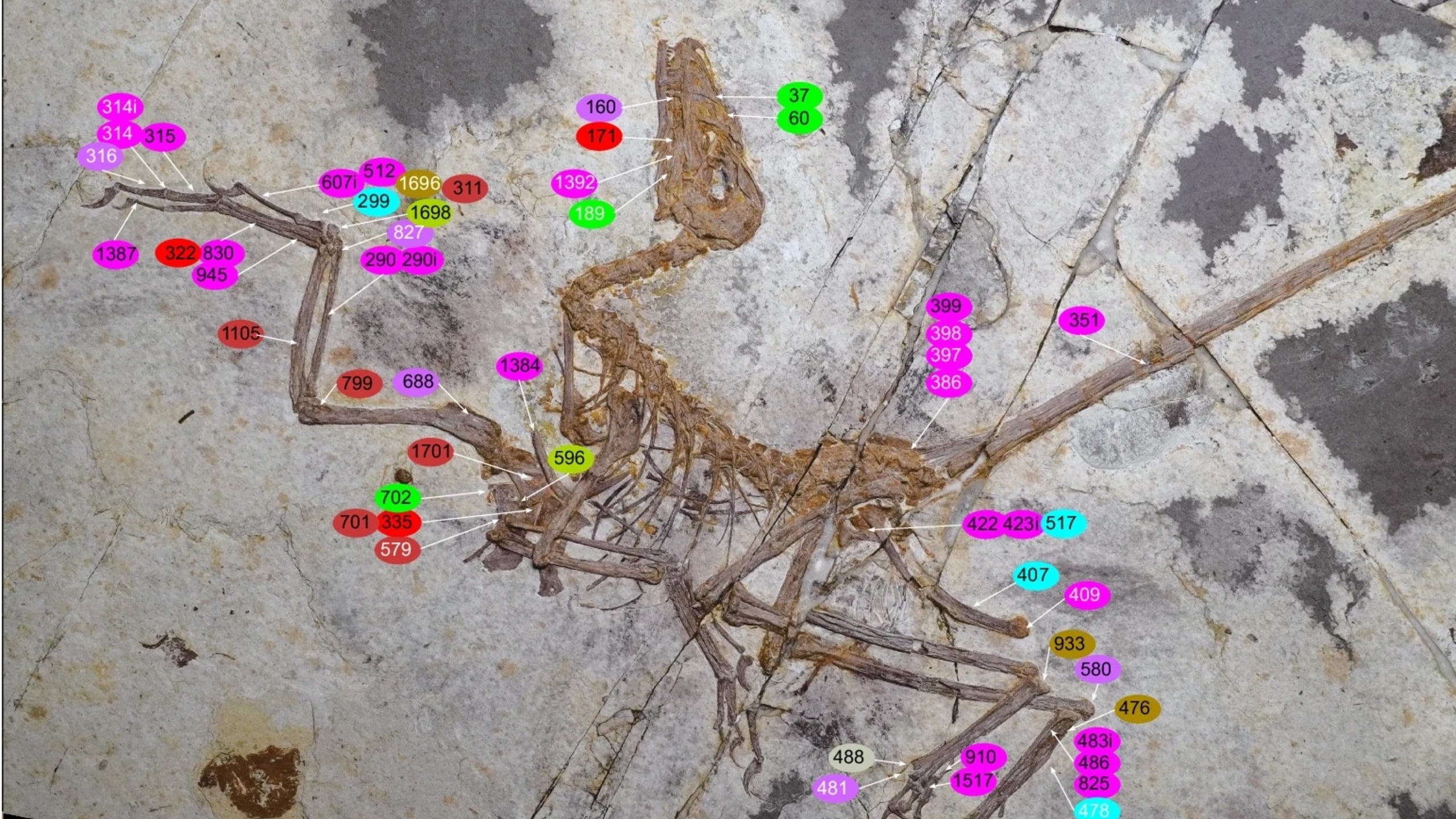
Norellraptor barsboldi, described in a paper published in Nature Communications by Xuri Wang of the Chinese Academy of Geological Sciences and colleagues, is an exquisitely preserved microraptor — a small, feathered dinosaur roughly the size of a large pigeon. At 57 centimeters long, it was likely still growing when it died. Its skeleton is detailed enough that researchers can see where flight feathers clustered along the forelimbs and tail, and where simpler, straight feathers covered the rest of the body. It could probably fly. It also looks nothing like the flying dinosaurs that sit directly beside birds on the family tree.
That difference, subtle on the surface, is what makes this find disruptive.
Who Norellraptor Is and Why It Matters
The name is a deliberate nod. Robert Norell, the famous paleontologist at the American Museum of Natural History who has spent decades championing the link between dinosaurs and birds, lends his name to a creature that may complicate the very story he helped write. Barsboldi references Rinchen Barsbold, the Mongolian paleontologist whose work on Asian theropods laid groundwork for understanding paravian evolution.
Both dedications point to the same truth: this discovery lives squarely inside the conversation about how birds became birds. It also sits at the edge of it.
Microraptorines — the group to which Norellraptor belongs — have long been treated as early relatives of birds, the kind of transitional form that makes the dinosaur-to-bird story feel almost inevitable. They had feathers. They had wings. They glided or flapped through Cretaceous forests. The comfortable assumption was that their flight apparatus descended from a common ancestor shared with birds, a single evolutionary experiment in aerial locomotion that succeeded and diversified.
Wang and the team are now arguing that assumption was too tidy.
What the Bones Are Saying
The critical evidence comes from two places: phylogenetic position and bone development.
When the researchers mapped Norellraptor onto the Paraves family tree — the clade that includes birds and their closest dinosaur cousins — it landed outside the bird lineage, yet firmly within the group of flying or gliding dinosaurs. That positioning alone doesn’t prove independent evolution. Fossils rarely do on their own. But combined with the developmental data, it becomes harder to maintain the single-origin view.
The microraptor’s forearm — the key structural element of the wing — appears to have stopped developing early in its life. Modern flying birds, by contrast, show sustained wing growth throughout development, a pattern that builds the asymmetrical flight feathers and reinforced skeletal elements needed for powered flight. Norellraptor followed a different developmental track. Its flight-related features reached an early plateau; birds kept building.
“The sequences of flight-related novelties reconstructed along the two lineages differ consistently,” the authors write. They add that histological evidence from the bones suggests a “peculiar limb growth model” in microraptorines, distinct from the pattern seen in early birds. Together, the data point to independent selective regimes — separate evolutionary paths toward similar aerial abilities.
Convergent evolution. Whales and fish swim using fins and tails, but no one claims they inherited that body plan from a common swimming ancestor. The same logic now applies to flight in Paraves.
Who Wins and Who Loses From This Shift
The winners here are the fossil record itself and the researchers willing to let it contradict established narratives. China has produced some of the most complete feathered dinosaur specimens ever found — particularly from the Jehol Biota deposits of northeastern China, which preserve soft tissue alongside bone with unusual fidelity. Those deposits have fueled the dinosaur-bird connection for years. This find asks scholars to extend that same richness of detail into more uncomfortable conclusions.
The losers, if there are any, are oversimplified textbooks. Evolutionary biology textbooks have leaned hard on the single-origin model for flight because it tells a clean story: feathers first for insulation, then display, then gliding, then powered flight — a gradual escalation inside one lineage. Independent evolution of flight in Paraves complicates that gradient. It means nature found the sky more than once, using different blueprints.
For the paleontology community, the immediate impact is methodological. One fossil — however exquisite — cannot overturn a paradigm. The authors acknowledge this explicitly, noting that the relationships between microraptorine aerial adaptations and the avian flight apparatus remain “controversial from both functional and phyogenetic perspectives.” The burden of proof is now on additional specimens, additional lineages, and additional developmental data.
What Comes Next
The question is no longer whether flight evolved once or multiple times. The question is how many times, and under what conditions.
If Norellraptor is confirmed as an independent flyer, other microraptorines may need similar re-examination. Several well-known genera — Microraptor, Anchiornis, Xiaotingia — already sit near the base of the paravian tree. Some of them show flight feather distributions and skeletal features that, under the new framework, look less like ancestral precursors to birds and more like parallel experiments in aviation.
Chinese institutions are well positioned to pursue this. The field sites producing specimens like Norellraptor are heavily worked, and new excavations continue annually. What distinguishes this work is not just volume but preservation quality — the kind of detail that makes histological analysis of limb bone development possible. Wang’s team used that level of resolution; others will need to replicate it across multiple taxa.
The broader implication reaches beyond China. Paraves are global in their evolutionary significance because they contain birds — every species of avian alive today. If the origin of flight inside that group was multiply sourced rather than singular, then the entire narrative of avian evolution requires recalibration. Not destruction. Calibration.
Norellraptor does not disprove that birds and microraptors share a distant common ancestor. It does not even definitively prove that flight arose independently. What it does is replace certainty with a more honest uncertainty — the kind that drives real science forward. The skies may have been won more than once, and the fossil record, patient and meticulous, is finally asking the right questions.
Why This Story Travels Beyond the Lab
This discovery matters outside paleontology because it reframes a fundamental biological intuition: that complex traits arise once and spread. Convergent evolution is not new — cameras and eyes have both evolved independently dozens of times across the tree of life. But flight, the most dramatic transition in vertebrate history, has enjoyed a special status. We have wanted it to happen once because a single origin makes the story of birds feel like destiny.
Multiple origins make it something else: repetition. A pattern. Evidence that given the right conditions — feathers, light bodies, selective pressure — evolution does not hesitate to try again.
The specimen sits in a Chinese research institution, studied by a team led by a Chinese paleontologist, emerging from one of the world’s most productive fossil beds. That geographic reality is often invisible in English-language coverage of the subject. The science transcends borders, but the infrastructure that produces it does not. China’s role in dinosaur paleontology has grown steadily over the past two decades, and finds like Norellraptor make that trajectory impossible to ignore.
Whether this paper triggers a full revision of paravian flight evolution or simply adds a footnote to an ongoing debate remains unclear. What is clear is that the comfort of a single origin is ending. The sky, it turns out, was always more crowded than we thought.