Bulgaria Summons Russia After Drone Attack Sinks Ship Near NATO Coast
A Russian drone attack sinks a cargo ship off Bulgaria's coast, leaving 11 sailors missing. The strike blurs the line between the Ukraine war and direct confrontations with NATO members.
The Black Sea Is No Longer Just About Ukraine
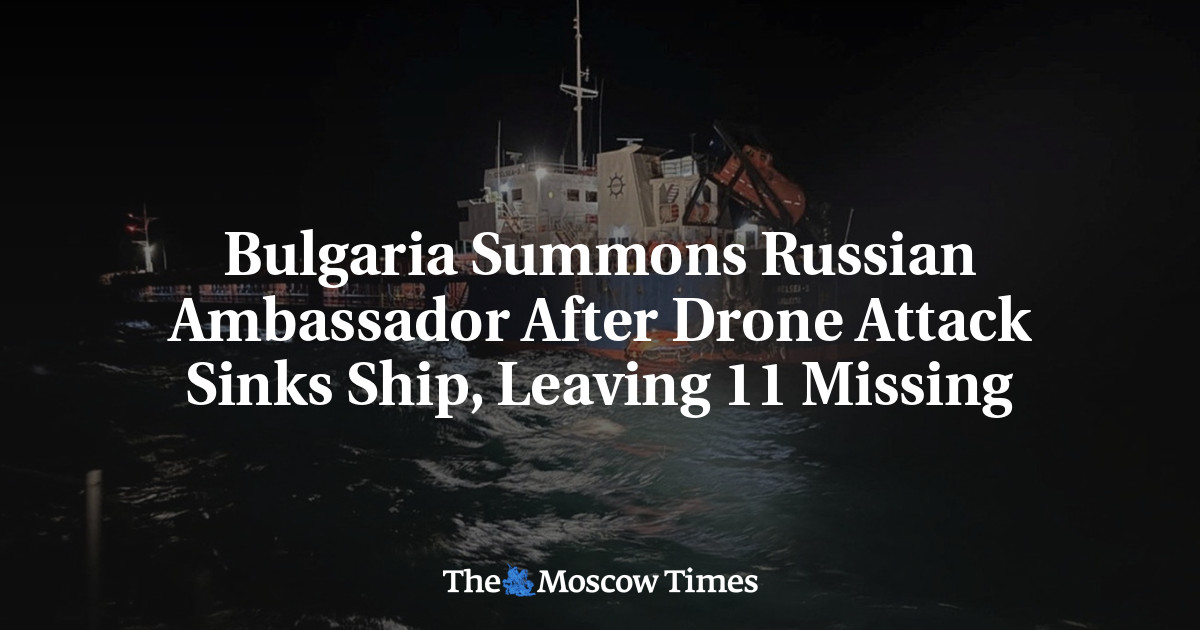
The attack came overnight on Tuesday, but its implications stretch far beyond a single night’s violence in international waters. A Russian drone sank the Guinea-Bissau-flagged cargo ship HS Dignity off Bulgaria’s Black Sea coast. Eleven sailors are still missing, their families left in agonizing limbo as rescue operations yield nothing more than cold water and debris. Five were rescued from the water, pulled from the sea by nearby vessels in a dramatic nighttime operation that underscored both the vulnerability of commercial crews and the thin margin between survival and death in these increasingly contested waters.
A second vessel, the Maltese-flagged Chelsea 3, was struck by three drones but its fifteen crew — seven Ukrainians and eight Azerbaijanis — survived. Reports suggest the attack on the Chelsea 3 involved coordinated strikes, with drones approaching from multiple bearing angles, a pattern consistent with Russian electronic warfare tactics designed to overwhelm defensive systems and create confusion during engagement.
What makes this incident sharper and more dangerous than the one that hit just a week earlier is the location. Both attacks occurred inside Bulgaria’s exclusive economic zone, not in contested waters or far from any NATO member’s shore. This is not a proxy strike against Ukrainian logistics anymore. This is a strike on a member state’s maritime territory — waters that fall under Bulgarian jurisdiction and, by extension, NATO’s southern flank.
The geographic precision of these attacks cannot be overstated. The EEZ extends 200 nautical miles from the baseline, placing the HS Dignity well within Bulgaria’s sovereign maritime domain. International law grants coastal states exclusive rights to resource exploration and economic activity within this zone, but it does not guarantee security from aerial attack. That gap in legal coverage is precisely what Moscow is exploiting.
Who Won and Who Lost
Moscow gains something it has wanted for months: the ability to punish any vessel sailing near its flank without declaring open war. By keeping attacks ambiguous — targeting flag states that lack the political weight to demand a formal response, using drones that leave no identifiable launcher, and avoiding direct attribution — Russia enforces a shadow blockade of NATO’s southeastern approach to the Black Sea.
The strategy operates on multiple levels simultaneously. Economically, it raises insurance premiums for any shipping company willing to transit these waters, effectively taxing freedom of navigation without firing a single conventional weapon. Militarily, it tests NATO’s response thresholds, probing for the precise point where ambiguity becomes unacceptable. Diplomatically, it forces alliance members into reactive postures, spending political capital on crisis management rather than strategic initiative.
Bulgaria loses the illusion that the war next door stays on the other side of the border. Prime Minister Rumen Radev put it plainly: the outcome benefits the Russian Federation. He summoned Ambassador Eleonora Mitrofanova and told her it was unacceptable. She offered no explanation from Moscow, only a noncommittal suggestion that a third party might be responsible. That phrasing — which Moscow has used before to cast doubt — is itself a strategy. It keeps NATO guessing and therefore slow to act.
The Bulgarian government faces an impossible calculation. Escalate too quickly and risk becoming the flashpoint that drags the alliance into a conflict it has deliberately avoided. Stay measured and risk appearing indifferent to attacks on Bulgarian waters that have already cost eleven lives. Every response option carries political cost, and Moscow knows it.
Ukraine loses what little diplomatic cover it had built around the safe navigation of commercial ships. Foreign Minister Andrii Sybiha condemned the attack as deliberate disregard for civilian lives. But Ukraine’s own campaign against Russian grain exports has long relied on the same tactics. The distinction between a Russian drone sinking a Maltese-registered ship carrying grain and a Ukrainian drone hitting a Russian tanker is now harder for Brussels to justify to its own publics. The moral equivalence argument, once a fringe talking point, is becoming mainstream across European capitals.
The Article 5 Question Nobody Wants to Answer
This is the part that matters most. NATO’s founding treaty commits members to treat an armed attack against one as an attack against all. But Article 5 has never been tested by a drone strike on a commercial vessel in a member state’s own economic zone. It was designed for Soviet tanks rolling across borders, not for unmanned craft dropping munitions on cargo ships near resort villages.
Radev pressed NATO Secretary General Mark Rutte and European Commission President Ursula von der Leyen by telephone for help bolstering Bulgaria’s maritime and airspace surveillance. Both agreed the Black Sea had become another front of Russian escalation. Rutte said NATO would adjust its presence on the eastern flank as needed. Neither spoke about Article 5.
That silence is telling. Brussels and Washington are likely to keep the response calibrated — more patrol aircraft, more radar coverage, perhaps a quick-reaction naval group. Full Article 5 invocation would require a consensus among twenty-five members, including countries with their own economic ties to Russia. A cargo ship is not a warship. Eleven missing sailors, however grave, may not meet the threshold NATO has implicitly set for collective defense triggers.
Yet the precedent being established is no less significant for being unacknowledged. If NATO accepts that drone attacks on commercial vessels in member states’ EEZs will be met with enhanced surveillance and patrol adjustments rather than collective defense commitments, it is effectively creating a new category of sub-threshold aggression that falls outside the alliance’s core security guarantee. That creates a dangerous gray zone where Moscow can apply pressure continuously without triggering the very response it seeks to avoid.
The Gray-Zone Doctrine
What Russia is building here is not merely a tactical tactic but a new doctrine of gray-zone warfare in European waters. The playbook is recognizable: use deniable assets, target commercial rather than military shipping, operate within a member state’s economic zone without crossing into territorial waters, maintain plausible ambiguity about who fired. Each attack tests how far NATO will go before it treats a hit on a Bulgarian EEZ as an attack on Bulgarian territory.
The pattern is already visible. A week before Tuesday’s strike, nine Syrian and one Egyptian sailor died when a different vessel sank in the same waters after a drone hit. Bulgaria has been clear about the pattern. Moscow has been equally clear about its refusal to acknowledge it.
This doctrinal evolution represents a fundamental shift in how great powers can project force against smaller neighbors without triggering traditional responses. The Russian approach mirrors techniques refined in Crimea and Donbas: controlled aggression, information warfare, legal ambiguity, and patience. Each incident is designed to be just below the threshold that would compel decisive action, just large enough to impose costs without inviting retaliation.
The economic dimension deserves particular attention. Commercial shipping through the Black Sea carries an estimated $40 billion in annual trade volume. Insurance companies operating in the region have already begun adjusting premiums, and some larger carriers are rerouting through the Mediterranean and Suez Canal rather than risk the Bulgarian corridor. This is economic coercion without a single Russian warship leaving port.
What Happens Next
Bulgaria will ask for more surveillance equipment. NATO will likely deliver some combination of maritime patrol aircraft, coastal radar, and possibly a rotating frigate detachment. None of this changes the fundamental calculation that any ship in the Black Sea near Bulgarian waters now carries a non-zero risk of drone attack.
The real question is whether the alliance draws a line in the water — formally or informally — declaring that attacks on commercial shipping in a member state’s economic zone will be treated as attacks on the alliance itself. If it does, Russia will have to adjust. If it doesn’t, the Black Sea approach to NATO’s eastern flank becomes a lawless corridor where Moscow can impose economic costs without triggering a wider war.
European defense manufacturers are already reporting increased interest from Balkan nations seeking maritime surveillance capabilities. The demand extends beyond Bulgaria to Romania, Turkey, and Georgia — all states sharing Black Sea coastlines that have come under indirect Russian pressure. This is a regional security crisis in slow motion, with each incident adding incremental pressure rather than dramatic confrontation.
The humanitarian dimension remains unresolved. Eleven sailors are missing, presumed dead, with bodies likely scattered across the seafloor in waters too deep for recovery operations. Their families await news that may never come. The political calculations unfolding in Brussels and Washington do not ease that grief, nor should they. But in the architecture of gray-zone warfare, human costs are the very currency being spent — and Moscow is counting on the alliance to hesitate before responding with force.