How a BOJ Hike and Trump Tariff Shock Could Rewrite Global Finance
The Bank of Japan's likely rate hike collides with surging US yields driven by Trump's tariff and spending plans. The result: a macro moment that could reshape household budgets in Tokyo and market volatility worldwide.
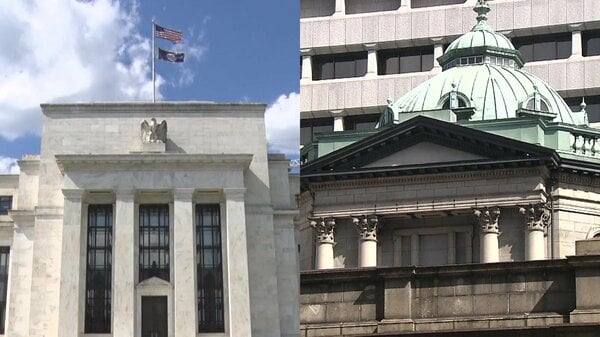
The collision course
This week is what the markets call “central bank week.” The Federal Reserve meets September 15–16. The Bank of Japan follows on September 17–18. Two decisions, one volatile backdrop, and a convergence of forces that few investors outside Japan are fully pricing in.
The Fed is expected to raise rates with roughly 90% probability. The BOJ is even more certain — overnight index swap markets are pricing in a 98% chance of a 25-basis-point hike to 1.25%. That would be the highest policy rate in 31 years.
But the real story isn’t either decision in isolation. It’s what happens when a tightening BOJ meets a Fed that’s being dragged higher by forces entirely unrelated to monetary policy fundamentals.
America’s twin inflation shocks
The first shock arrived in the form of a campaign promise. At the Republican National Convention on September 6, Donald Trump declared that if Republicans maintain their congressional majorities, every adult American would receive $5,000. Roughly $1 trillion in direct transfers, funded through deficit spending at a time when US federal debt already exceeded $40 trillion for the first time in history and the fiscal deficit sits near 6% of GDP.
Markets interpreted this as inflationary fuel. The 10-year Treasury yield surged to 4.99% on September 11, nearly touching the psychologically significant 5% level for the first time in three years. The 2-year note hit 4.65%, its highest since July 2024.
The second shock is geopolitical, and it is already moving through the energy markets.
Trump indicated on September 9 that a ceasefire with Iran would not come until after the midterm elections. The following day, Houthi forces seized the port city of Mocha in Yemen, near the Bab-el-Mandeb strait. On September 11, Saudi Arabia announced that a pipeline carrying oil from the Persian Gulf to the Red Sea had been attacked and taken offline.
That pipeline was increasingly important as an alternative to the Strait of Hormuz. April through June data from the US Energy Information Administration showed 8.1 million barrels per day flowing through Bab-el-Mandeb — up 80% from the previous year — while Hormuz traffic dropped nearly 80% to 4.9 million barrels per day. With WTI crude exceeding $104 a barrel and US gasoline already above $4.31 a gallon nationally, the inflation feed-through is real and accelerating.
Both shocks point in the same direction: higher for longer in America, regardless of what the Fed intends.
The yen squeeze
Japan is caught between these forces. The yen weakened sharply earlier this year, partly because the BOJ moved slower than markets expected after its December 2024 rate hike. US Treasury Secretary Scott Bessent pressed Bank of Japan Governor Kazuo Ueda directly during their August 30 meeting, publicly noting they discussed “the normalization of Japan’s monetary policy” — a clear signal Washington wants a stronger yen to import disinflation.
The yen has since recovered about 8 yen against the dollar over the past week, but the pressure remains directional.
A BOJ hike to 1.25% should, in theory, support the currency. But history complicates that expectation. After the March 2024 negative-rate removal, the yen weakened. After the December 2025 hike to 0.75%, it also weakened — Ueda’s dovish framing overwhelmed the rate move. The yen strengthened only when the BOJ signaled aggressive future hikes, as in December 2023, and even then the response was short-lived once US conditions shifted.
The market now watches Ueda’s September 18 press conference as the pivotal moment. A hawkish tone could push the yen higher and ease import-cost pressures at home. A cautious one risks reigniting yen depreciation just as the BOJ is trying to normalize — a dynamic that forces the central bank into an impossible position: raise rates to fight imported inflation, but risk worsening the very currency weakness that drives it.
Who pays the bill in Japan
n
The BOJ’s hike is not abstract for Japanese households. A rate to 1.25% means the era of sub-1% variable mortgage rates is ending, according to the mortgage comparison service Mogecheck. For borrowers already in loans, the base rate would likely rise in April 2027, with repayment adjustments kicking in by July 2027.
The Mizuhо Research Institute’s estimate is blunt: two-person households as a whole gain roughly ¥6,000 annually from higher deposit interest, offsetting most of their loan costs. But mortgage holders lose about ¥19,000 on average. Under-30s with loans face a ¥50,000 hit. Those in their 30s lose ¥41,000.
The generational split is stark. Older homeowners who paid off mortgages years ago see modest gains from rising deposit rates. Younger borrowers — many already strained by the cost of living — absorb the full weight of higher debt service. This is a distributional shift that monetary policy rarely announces explicitly but always delivers.
What comes next
The Fed’s trajectory is now tied to fiscal politics andMiddle Eastern instability rather than purely domestic labor and inflation data. Markets are pricing 2–3 more hikes by year-end with over 70% probability. Each one reinforces the dollar, complicates the BOJ’s path, and raises the cost of everything Japan imports — including energy.
The BOJ’s own language suggests acceleration. Governor Ueda said he wants to “discuss carefully at every meeting.” Deputy Governor Takahiro Takada stressed the need for “flexible” action not bound by fixed intervals or magnitudes. Both remarks signal a central bank moving faster than markets previously assumed — or at least wanting the market to believe it is.
But speed has consequences. A rapid tightening cycle in Japan, against a backdrop of US fiscal expansion and supply-chain disruption, creates a volatile environment where currency movements become unpredictable and policy errors costly.
The September 18 Ueda press conference will be the first real test. What he says about the pace ahead will determine whether the yen’s recent recovery holds, whether Japanese borrowers brace for more pain, and whether global markets discount the possibility that Asia’s largest economy is finally exiting its decades-long monetary experiment — on terms that may surprise everyone.