Brussels Draws a Red Line Around North Korean Troops in Ukraine
The EU has formally designated North Korea's arms transfers and troop deployment to Russia as violations of international law and UN Security Council resolutions — a shift from diplomatic grumbling to legal accusation that hands Seoul leverage and forces Beijing into a tighter corner.
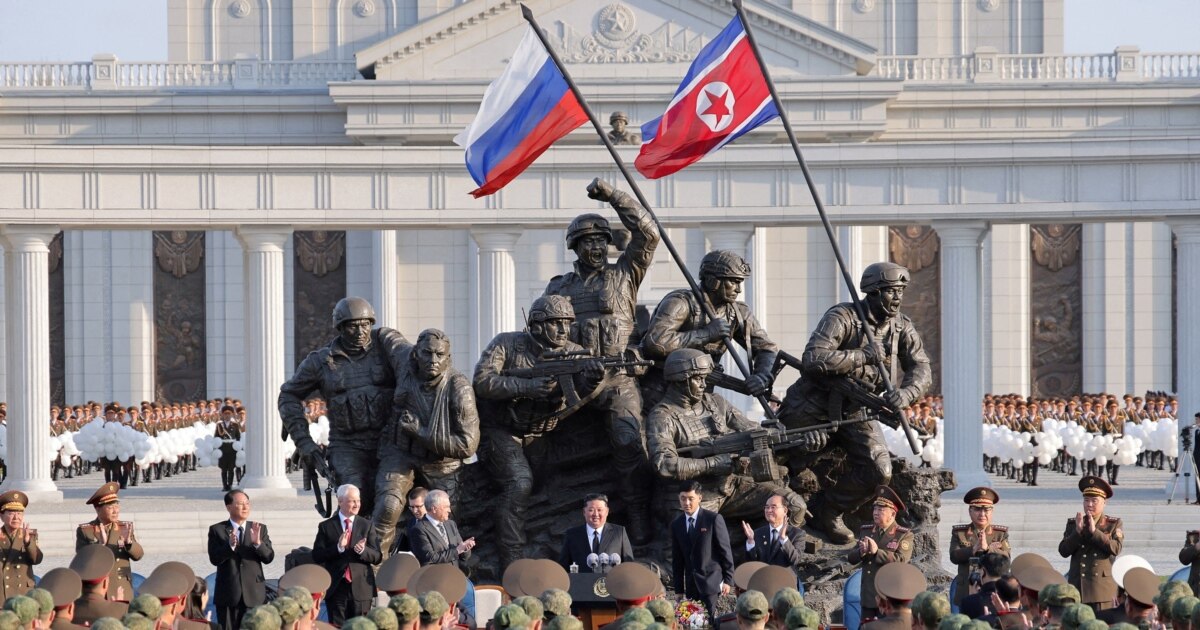
When Brussels Turns Legal
The European Union has stopped treating North Korea’s military support to Russia as background noise and started calling it what it legally is: a violation of international law and explicit UN Security Council resolutions. On 24 March, EU acting representative Hedda Samuelsson told the UNSC that North Korean weapons transfers and troop deployments are a “serious violation” of international law and a “clear violation” of the very resolutions Russia itself voted to adopt as a permanent member.
The same day, the EU made an identical statement at the OSCE’s Standing Council in Vienna. Two forums. One message. This is not a coordinated photo opportunity — it is the beginning of a sustained legal and diplomatic campaign to isolate North Korea as a belligerent actor in a war it officially does not recognize.
The distinction matters because legal condemnation is harder for Moscow and Pyongyang to shrug off than political rhetoric. It creates a paper trail. It opens the door to future enforcement mechanisms. And it hands Seoul exactly what it has been seeking: a multilateral framework to demand that other countries, especially China, stop facilitating the North Korea-Russia supply chain.
What the EU Declaration Actually Says
The text of the EU’s position is narrower and more precise than the headline framing suggests. The core claims are threefold:
First, the EU asserts that North Korean troops are deployed in Russia’s war against Ukraine. It did not publish evidence in the UNSC — that was expected, given the classification environment — but the declaration treats the deployment as an established fact, not an allegation.
Second, it identifies the transfer of arms and dual-use goods (items with both military and civilian applications) as the operational mechanism, and calls on every state to halt direct and indirect support immediately.
Third, it links these actions explicitly to UN Security Council resolutions 1718, 1874, 2087, 2094, 2270, 2321, 2371, 2375, 2397 and 2461 — the full cascade of resolutions that prohibit North Korea from engaging in weapons trade and transferring military-related technology. Russia’s own vote in favor of those same resolutions is the quiet dagger in the statement: Moscow cannot credibly deny the legal framework without contradicting its own recorded position.
Why This Is Different
The EU raised the same issue at the UNSC on 10 March — barely two weeks earlier. The return visit is the signal. An ad hoc complaint stays ad hoc. A repeated complaint becomes a position. By standing before the Security Council twice in a single month, the EU is building the diplomatic foundation for something larger: potentially a formal resolution, expanded sanctions targeting the third-country intermediaries, or at minimum a coordinated export-control regime for dual-use goods flowing to Russia through North Korean networks.
EU officials have stated that 21 rounds of Russia sanctions are already in effect, covering approximately 3,000 individuals and entities across the military-industrial complex, energy sector, financial system and the network of transit countries. The North Korea angle adds a fourth vector — the Central Asian and Caucasus routes that Washington and Brussels have long suspected of carrying North Korean munitions into Russia.
Seoul’s Calculus
For South Korea, the EU’s move is a gift wrapped in complication. The Yoon administration has been pursuing a so-called “K-NATO” architecture — a mini-alliance web linking Seoul with Washington, Tokyo, Canberra and European capitals. Pyongyang’s presence on Russian battlefields, however quietly, gave that architecture an urgency it had previously struggled to communicate to European partners who viewed the Korean Peninsula through a Cold War lens.
Brussels is now speaking that language. The EU’s declaration validates Seoul’s central claim: that North Korea’s military integration with Russia is not a regional concern but a global security threat. That validation translates into diplomatic cover for South Korea to deepen defense coordination with NATO, increase arms exports to Eastern Europe, and push for tighter sanctions enforcement at the UN — moves that Japan and Australia are already making but that require European buy-in to succeed.
The complication is equally real. If the EU treats North Korean troop deployment as an established fact, it raises the question of what happens when that fact is disputed or when evidence emerges that complicates the picture. Moscow has not confirmed the presence of North Korean personnel, and Pyongyang has denied it. A legal finding built on unverified claims could eventually require recalibration — and Seoul does not want to see its key diplomatic victory overinterpreted or reversed.
China’s Tightening Noose
Beijing faces the sharpest strategic pressure. China has long maintained a policy of strategic ambiguity toward North Korea’s relationship with Russia, avoiding public criticism while privately expressing discomfort. The logic was straightforward: keep Pyongyang dependent on Beijing, avoid provoking North Korean defection toward Washington, and prevent a united front that could destabilize the regime.
The EU’s declaration closes part of that space. By anchoring its condemnation in UNSC resolutions that China voted for and continues to support, Brussels is forcing Beijing into a contradiction it has managed to avoid so far. China cannot simultaneously champion North Korea’s sovereignty and dismiss the legal findings without undermining its own voted positions at the UN — positions that Beijing has consistently defended in other contexts.
The practical consequence is likely to be increased Chinese pressure on North Korea to limit visible aspects of the military cooperation, particularly any dual-use goods transiting Chinese territory. Beijing will not publicly admit this pressure exists, but the signal from Seoul and Washington is that they will treat any North Korean weapons or materials found on Russian battlefields as traceable back through the Chinese logistics chain — a claim China has repeatedly denied.
The Broader Triangle
This development sits inside a much larger triangle: NATO, South Korea and Russia. The EU’s condemnation is the diplomatic arm of a strategy that also includes military dimension. NATO has been quietly increasing defense exercises in Eastern Europe and enhancing forward presence. South Korea has been accelerating arms deliveries to Ukraine and deepening intelligence sharing with Japan and the United States. The North Korea-Russia military cooperation, real or alleged, gives both sides a reason to accelerate.
The most consequential unanswered question is whether the EU’s legal framework will translate into actionable enforcement. Condemnation without consequences is diplomacy. Condemnation with consequences is statecraft. The next six months will determine which this was — and whether Pyongyang learns that deploying troops in a European war carries costs beyond the battlefield.
What is clear is that the conversation has changed. North Korea is no longer a side note in the Ukraine war. It is a named party, cited by name in UNSC resolutions, held to the same legal standards as the belligerents. That framing will not disappear easily.